 HistoPol (#HP) 🏴 🇺🇸 🏴
 earthling

 (Roughly) Daily
“Do not fold, spindle, or mutilate”*…
Punched cards have a long history in machine control (dating back to Jacquard) and computing (starting with Babbage‘s Difference Engine), but it was Herman Hollerith who brought them into modern computation in the late 1880s… where punch cards remained for about 100 years. From the Smithsonian’s American History Museum…
In the late 1880s, American engineer Herman Hollerith saw a railroad punch card when he was trying to figure out new ways of compiling statistical information for the U.S. Census. His first punch card, like those used on railways, only had holes along the edges. The meaning of each hole was indicated on the card. By the time Hollerith tabulating equipment was used in the 1890 U.S. Census, holes were scattered across the cards, although their meaning was not indicated on it.
Hollerith and his employees at the Tabulating Machine Company in Washington, D.C. soon developed punched cards for use in compiling information for commercial enterprises such as railroads. They and staff of the U.S. Census Bureau prepared improved machines—these devices are shown in the object group on tabulating equipment. By the 1920s, the United States had two major manufacturers of punch card equipment, International Business Machines (the descendent of the Tabulating Machine Company) and Remington Rand (the descendent of Powers Accounting Machine Company established by Russian emigré and former Census Bureau employee James Powers). Each manufacturer developed a distinctive standard punch card. IBM cards had eighty columns of rectangular holes while those of Remington Rand had ninety columns of circular holes. Tabulating machines were widely used in both government and commerce, with cards designed to meet the needs of customers. For example, checks issued by the U.S. government often came on punch cards.
When IBM and Remington Rand began selling electronic computers in the years following World War II, punch cards became the preferred method of entering data and programs onto them. They also were used in later minicomputers and some early desktop calculators. Punch cards surviving in the Smithsonian collections reflect the widespread use of computers – they announced scores on standardized tests, served as a library cards, were part of the proof of mathematical theorems, and kept medical records. Some are printed with the names of users, from university computer centers and computer clubs to the Library of Congress to Bell Laboratories…
Browse the collection: “Punch Cards for Data Processing“
See also: here, here, and here.
* Ubiquitous warning on punch cards:
… in the 1950s, after the invention of the computer and its widespread business use, that everyone began to see punch cards. Companies sent punch cards out with bills: the telephone company, utility companies, and even department stores realized that they could save a step in their billing process, as well as making it easier for them to process the returned check, by using the cards themselves as the bills. By the 1960s, punch cards were familiar, everyday objects.
While company employees could be trusted to take care of the cards, the person in the street could not. Warnings were necessary. In the 1930s the University of Iowa used cards for student registration; on each card was printed “Do not fold or bend this card.” Cards reproduced in an IBM sales brochure of the 1930s read “Do not fold, tear, or mutilate this card” and “Do not fold tear or destroy.” I’m not sure when the canonical “Do not fold, spindle, or mutilate” first appeared; it’s one of those traditions whose author and origin is lost in the mists of time. Let’s consider the words one at a time, stop and take them seriously…
– “A Cultural History of the Punch Card” (from 1991; eminently worth reading in full)
###
As we contemplate chads (of which, punch cards produced a gracious plenty), we might spare a thought for Gerald Hawkins; he died on this date in 2003. An astronomer and author, he was best known for his work in archaeoastronomy— most of all, for his 1965 book, Stonehenge Decoded. In the early 1960s, Hawkins had used punch cards to load data modeling sun and moon movements onto magnetic tapes, then into an IBM 7090. The results led him to conclude, as the book argues, that the features at the monument were arranged in such a way as to predict a variety of astronomical events– that Stonehenge was a giant prehistoric observatory and computer. While some archaeologists are hesitant to accept Hawkins’ theories, many archaeoastronomers have built upon his work. More widely, scholars accept that the importance of astronomical alignment and large complexes being planned and constructed to fulfill cosmology has been demonstrated at other prehistoric sites, such as the Snake Mound and Cahokia in the U.S.
#archaeoastronomy #astronomy #Babbage #Census #CharlesBabbage #computing #culture #data #GeraldHawkins #HermanHollerith #history #historyOfComputing #Hollerith #input #Jacquard #punchCard #punchCards #Stonehenge #storage #Technology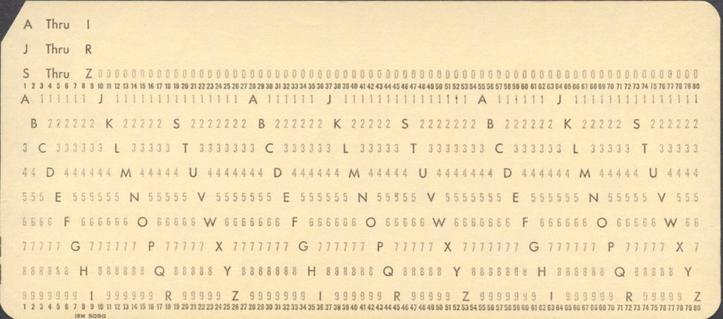

 tomsharp
 Rod2ik 🇪🇺 🇨🇵 🇪🇸 🇨🇱 🇺🇦 🇨🇦 🇬🇱☮🕊️
 Christian Schröter, geb. Vater
 framboise314