Running Pokémon with a Compass and Straightedge
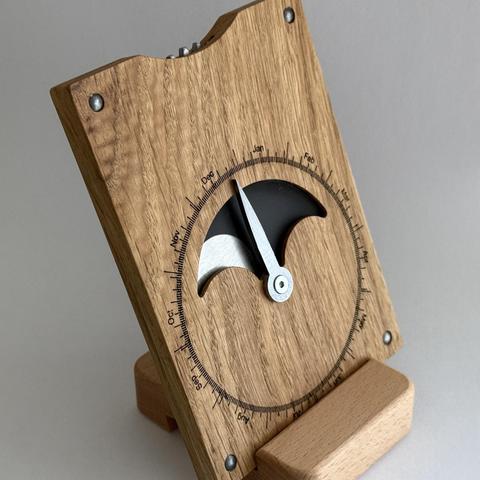
A year ago I started building first prototypes of a device that would be capable of calculating #moon phases based on the historical Metonic cycle. The result was „Meton“, a 3D-printed lunar phase calculator. So if you need an #opendata moon machine, go ahead.
https://www.thomasweibel.ch/?post=rechner-aus-dem-drucker
Or build it yourself, from oak and steel.
#astronomy #astrophysics #mathematics #antiquity #history #3dprint #mechanics #moonphase #openglam #digitalhumanities #diy #analogcomputing
"Phương pháp máy tính tương tự mới giảm mạnh năng lượng đào tạo AI. Công nghệ mới giúp tiết kiệm hàng chục lần năng lượng cho AI. #AI #AnalogComputing #EnergyEfficiency #TríTuệNhânTạo #CôngNghệ"
@thomasweibel @johncarlosbaez I guess anyone interested in analog mechanical computers knows Titiana Van Vark... If not, see: https://www.tatjavanvark.nl/
I don't know the validity of her works on the Antikythera Mechanism, though. I'm most subjugated by her Fourier series machines.
@giacomoi @albertcardona @RuthMalan
I am hoping to see lots more practical developments along the lines of: This physical phenomenon does something (by virtue of being itself) that is isomorphic to some computation. How do we couple it to the environment so that the naturally occurring computation corresponds to something we care about?
To be honest, I am a little surprised that there haven't been more attempts at modern analog computers. This paper by Jaeger et al gives some clue as to the potential for extracting computational services from physic: http://arxiv.org/abs/2307.15408
I suspect that one contributor to the lack of progress on modern analog computing is the difficulty of mapping from the user's problem of interest to the computation offered by the physical substrate. In the AOC case you need to map the user's problem to a fix-point problem (because that's all the hardware can solve). This paper by Kleyko et al deals with that issue by proposing that Vector Symbolic Architectures could be used as an intermediate abstraction between the user's problem and a wide range of nonstandard computational hardware: http://arxiv.org/abs/2106.05268
#neuromorphic #AnalogComputing #VectorSymbolicArchitectures #VSA #HyperdimensionalComputing #HDC
Approaching limitations of digital computing technologies have spurred research in neuromorphic and other unconventional approaches to computing. Here we argue that if we want to systematically engineer computing systems that are based on unconventional physical effects, we need guidance from a formal theory that is different from the symbolic-algorithmic theory of today's computer science textbooks. We propose a general strategy for developing such a theory, and within that general view, a specific approach that we call "fluent computing". In contrast to Turing, who modeled computing processes from a top-down perspective as symbolic reasoning, we adopt the scientific paradigm of physics and model physical computing systems bottom-up by formalizing what can ultimately be measured in any physical substrate. This leads to an understanding of computing as the structuring of processes, while classical models of computing systems describe the processing of structures.
I'm not really looking for analogue computers anymore but I could not resist this small one: a gorgeous Philbrick Researches RP-F manifold from around 1966. I have not yet checked if it is still operational...
Microsoft’s analog optical computer
Still wonder if analog computing has a part to play in AI