 ICalzada
RE: https://mastodon.social/@ICalzada/115626182691892169
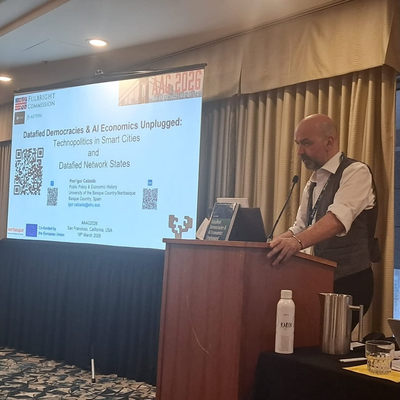
Agindu moduan, hemen gaur @ehu.eus Bizkaia Aretoan #EmergentSovereignties Kongresuan Bilbon #AI & #AlgorithmicNations egin dudan hitzartzearen gardenkiak
#OpenAccess #OpenScience
RE: https://mastodon.social/@ICalzada/115626182691892169
Agindu moduan, hemen gaur @ehu.eus Bizkaia Aretoan #EmergentSovereignties Kongresuan Bilbon #AI & #AlgorithmicNations egin dudan hitzartzearen gardenkiak
#OpenAccess #OpenScience
After intense #USA discussions on
🔖#Decentralization
https://mdpi.com/2504-2289/8/3/26
🔖#GenAI #Web3
https://mdpi.com/2504-2289/9/3/62
🔖#DataCooperatives
https://mdpi.com/2624-6511/4/3/62
🔖#AlgorithmicNations
https://mdpi.com/1999-5903/16/10/361
...worth watching #Cyberlibertarianism
https://youtube.com/watch?v=f4pmXl4RCcE&t=13s https://pic.x.com/lH8XDCjCXm #OpenAccess


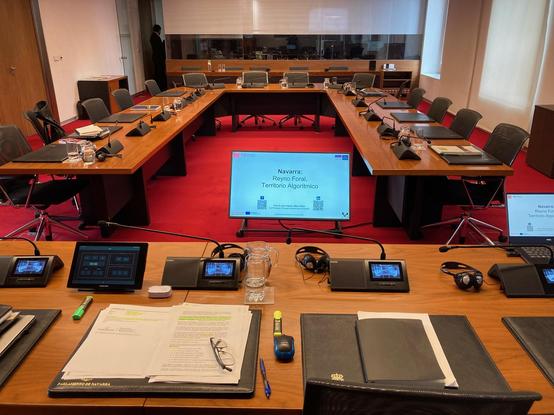
🎙️Today, I delivered an institutional #keynote at
@parlamentoNA
, addressing the role of #AI & digital transformations in foral governance & #LORAFNA
✅ Data sovereignty & #AI in #policymaking
✅ Algorithmic governance
✅ Regional digitalization
#Video https://grabaciones.parlamentodenavarra.es/watch?id=Yjg2ZWE1YjgtNjA3Ny00ODRjLThhZWYtNDZiZWJhYWQ2NzYw&start=0
#LORAFNA #AI #DigitalSovereignty #AlgorithmicGovernance #PublicPolicy #Science4Policy #AI4SI #AIAct #AlgorithmicNations
🚨 New #Publication AOUT 🚨
Pleased to share my latest article in @FutureInternet! 🌐 It explores the intersection of decentralized #Web3 techs shaping #InternetGovernance #DigitalCitizenship
🛡️ #DigitalSovereignty: Empowering individuals through decentralized ecosystems
🌐 Geopolitics of #Decentralization: Challenging legacy governance structures
👥 Citizen-State Relations: Adapting to #Web3's stakeholder dynamics
Beyond tech, it's about reshaping global power
📢 #Journal #Article #OpenAccess
OUT!
Decentralized #Web3 Reshaping
#Internet #Governance:
Towards Emergence of New Forms of
#Nation #Statehood ?
https://www.mdpi.com/1999-5903/16/10/361
Stemming from #California @usukfulbright.bsky.social fieldwork #AcademicSky
#Sovereignties #AlgorithmicNations #NetworkStates
@politicalscience @politicaltheory @international-TheEconomist @geography @digitalhumanities @economics @sociology @web3job
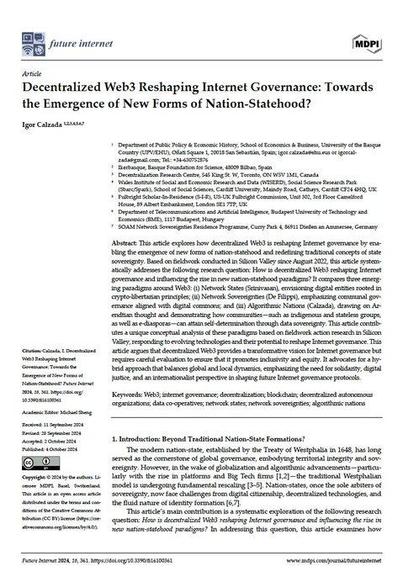

This article explores how decentralized Web3 is reshaping Internet governance by enabling the emergence of new forms of nation-statehood and redefining traditional concepts of state sovereignty. Based on fieldwork conducted in Silicon Valley since August 2022, this article systematically addresses the following research question: How is decentralized Web3 reshaping Internet governance and influencing the rise in new nation-statehood paradigms? It compares three emerging paradigms around Web3: (i) Network States (Srinivasan), envisioning digital entities rooted in crypto-libertarian principles; (ii) Network Sovereignties (De Filippi), emphasizing communal governance aligned with digital commons; and (iii) Algorithmic Nations (Calzada), drawing on Arendtian thought and demonstrating how communities—such as indigenous and stateless groups, as well as e-diasporas—can attain self-determination through data sovereignty. This article contributes a unique conceptual analysis of these paradigms based on fieldwork action research in Silicon Valley, responding to evolving technologies and their potential to reshape Internet governance. This article argues that decentralized Web3 provides a transformative vision for Internet governance but requires careful evaluation to ensure that it promotes inclusivity and equity. It advocates for a hybrid approach that balances global and local dynamics, emphasizing the need for solidarity, digital justice, and an internationalist perspective in shaping future Internet governance protocols.
📢New #Publication OUT!
Decentralized #Web3 Reshaping #Internet #Governance
Towards Emergence of New Forms of #Nation-Statehood?
https://doi.org/10.3390/fi16100361
Stemming from my #SiliconValley
@USUKFulbright
fieldwork
#Web3 #Sovereignties #AlgorithmicNations #NetworkStates
@balajis
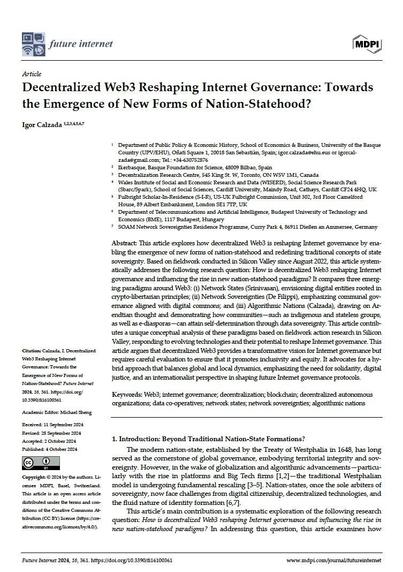
This article explores how decentralized Web3 is reshaping Internet governance by enabling the emergence of new forms of nation-statehood and redefining traditional concepts of state sovereignty. Based on fieldwork conducted in Silicon Valley since August 2022, this article systematically addresses the following research question: How is decentralized Web3 reshaping Internet governance and influencing the rise in new nation-statehood paradigms? It compares three emerging paradigms around Web3: (i) Network States (Srinivasan), envisioning digital entities rooted in crypto-libertarian principles; (ii) Network Sovereignties (De Filippi), emphasizing communal governance aligned with digital commons; and (iii) Algorithmic Nations (Calzada), drawing on Arendtian thought and demonstrating how communities—such as indigenous and stateless groups, as well as e-diasporas—can attain self-determination through data sovereignty. This article contributes a unique conceptual analysis of these paradigms based on fieldwork action research in Silicon Valley, responding to evolving technologies and their potential to reshape Internet governance. This article argues that decentralized Web3 provides a transformative vision for Internet governance but requires careful evaluation to ensure that it promotes inclusivity and equity. It advocates for a hybrid approach that balances global and local dynamics, emphasizing the need for solidarity, digital justice, and an internationalist perspective in shaping future Internet governance protocols.
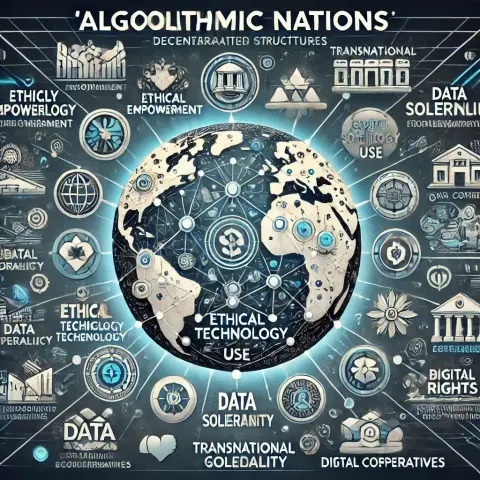
This article explores how decentralized Web3 is reshaping Internet governance by enabling the emergence of new forms of nation-statehood and redefining traditional concepts of state sovereignty. Based on fieldwork conducted in Silicon Valley since August 2022, this article systematically addresses the following research question: How is decentralized Web3 reshaping Internet governance and influencing the rise in new nation-statehood paradigms? It compares three emerging paradigms around Web3: (i) Network States (Srinivasan), envisioning digital entities rooted in crypto-libertarian principles; (ii) Network Sovereignties (De Filippi), emphasizing communal governance aligned with digital commons; and (iii) Algorithmic Nations (Calzada), drawing on Arendtian thought and demonstrating how communities—such as indigenous and stateless groups, as well as e-diasporas—can attain self-determination through data sovereignty. This article contributes a unique conceptual analysis of these paradigms based on fieldwork action research in Silicon Valley, responding to evolving technologies and their potential to reshape Internet governance. This article argues that decentralized Web3 provides a transformative vision for Internet governance but requires careful evaluation to ensure that it promotes inclusivity and equity. It advocates for a hybrid approach that balances global and local dynamics, emphasizing the need for solidarity, digital justice, and an internationalist perspective in shaping future Internet governance protocols.
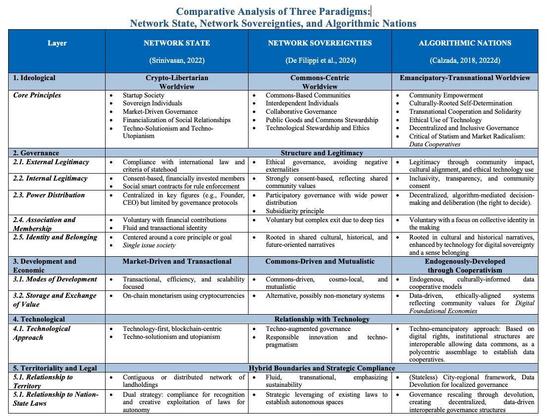
🗺️How is #Web3 shaping the future of #nation-statehood? It compares 3 paradigms across 5 stacks:
1️⃣ #NetworkStates
2️⃣ #NetworkSovereignties
3️⃣ #AlgorithmicNations
1. Ideological
2. Governance
3. Development/Economic
4. Technological
5. Territorial/Legal
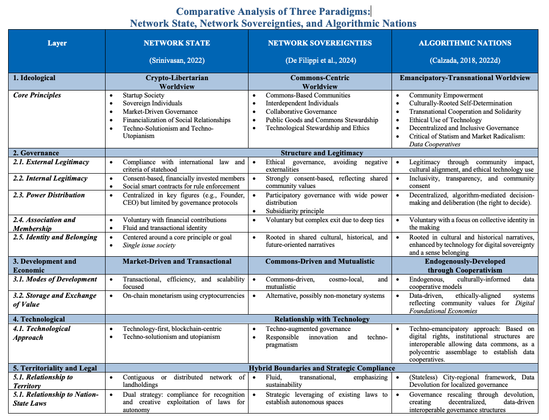
This article explores how decentralized Web3 is reshaping Internet governance by enabling the emergence of new forms of nation-statehood and redefining traditional concepts of state sovereignty. Based on fieldwork conducted in Silicon Valley since August 2022, this article systematically addresses the following research question: How is decentralized Web3 reshaping Internet governance and influencing the rise in new nation-statehood paradigms? It compares three emerging paradigms around Web3: (i) Network States (Srinivasan), envisioning digital entities rooted in crypto-libertarian principles; (ii) Network Sovereignties (De Filippi), emphasizing communal governance aligned with digital commons; and (iii) Algorithmic Nations (Calzada), drawing on Arendtian thought and demonstrating how communities—such as indigenous and stateless groups, as well as e-diasporas—can attain self-determination through data sovereignty. This article contributes a unique conceptual analysis of these paradigms based on fieldwork action research in Silicon Valley, responding to evolving technologies and their potential to reshape Internet governance. This article argues that decentralized Web3 provides a transformative vision for Internet governance but requires careful evaluation to ensure that it promotes inclusivity and equity. It advocates for a hybrid approach that balances global and local dynamics, emphasizing the need for solidarity, digital justice, and an internationalist perspective in shaping future Internet governance protocols.
3 key paradigms are analyzed:
1️⃣ #NetworkStates - rooted in crypto-libertarian digital entities
2️⃣ #NetworkSovereignties - focusing on decentralized communal governance
3️⃣ #AlgorithmicNations - emphasizing self-determination through data sovereignty

This article explores how decentralized Web3 is reshaping Internet governance by enabling the emergence of new forms of nation-statehood and redefining traditional concepts of state sovereignty. Based on fieldwork conducted in Silicon Valley since August 2022, this article systematically addresses the following research question: How is decentralized Web3 reshaping Internet governance and influencing the rise in new nation-statehood paradigms? It compares three emerging paradigms around Web3: (i) Network States (Srinivasan), envisioning digital entities rooted in crypto-libertarian principles; (ii) Network Sovereignties (De Filippi), emphasizing communal governance aligned with digital commons; and (iii) Algorithmic Nations (Calzada), drawing on Arendtian thought and demonstrating how communities—such as indigenous and stateless groups, as well as e-diasporas—can attain self-determination through data sovereignty. This article contributes a unique conceptual analysis of these paradigms based on fieldwork action research in Silicon Valley, responding to evolving technologies and their potential to reshape Internet governance. This article argues that decentralized Web3 provides a transformative vision for Internet governance but requires careful evaluation to ensure that it promotes inclusivity and equity. It advocates for a hybrid approach that balances global and local dynamics, emphasizing the need for solidarity, digital justice, and an internationalist perspective in shaping future Internet governance protocols.
(Libertarian) Decentralized #Web3 Map:
In Search of a #PostWestphalian Territory
via @SSRN
#GlobalGovernance #NetworkStates #AlgorithmicNations #NetworkSovereignties #PolicentricGovernance #Blockchain #AI #P2P #Commons #Crypto #Token