✨ What secret molecular partnership helps mycobacteria stay alive when conditions turn deadly?

🔗 Structural modeling and biochemical characterization of MSMEG_0748, a MoxR ATPase from Mycobacterium smegmatis. Computational and Structural Biotechnology Journal, DOI: https://doi.org/10.1016/j.csbj.2025.11.010

📚 CSBJ: https://www.csbj.org/

#Mycobacterium #MoxR #ATPase #AlphaFold #StructuralBiology #Biophysics #Microbiology #MolecularModeling


Black Tailed Prairie Dog Laying on Back 🇺🇸

#10cmpetridish #2d #A #AIDS #ATPase #Acinus(Pancreas) #Bafilomycin #Blood;red;icon;droplet

⏩ 109 new pictures from NIH BioArt https://commons.wikimedia.org/wiki/Special:ListFiles?limit=378&user=OptimusPrimeBot&ilshowall=1&offset=20251127003524

Discovery of amino acid unveils how light makes stomata open in plants

Scientists from Nagoya University have discovered a novel regulatory mechanism that controls the opening of stomata in plants, which is crucial for harnessing solar energy through photosynthesis. The team uncovered the role of phosphorylation at the 881st threonine residue (Thr881) of the plasma membrane proton pump in response to red and blue light in this process.

Phys.org

Combining unique methods, researchers discover new #protein functions, explore physical space of proteins.

#DNA #replication #clamp_loaders #ATPase

https://phys.org/news/2024-02-combining-unique-methods-protein-functions.html

Combining unique methods, researchers discover new protein functions, explore physical space of proteins

Researchers in the lab of John Kuriyan, professor of biochemistry and dean of the School of Medicine Basic Sciences, have revealed a key element of how a molecular machine responsible for high-speed DNA replication works. The results of their study build on growing theories of molecular evolution.

Phys.org
A close-up of biological nanomachines: Researchers take a deep look at peroxisomal processes

Every system has its waste disposal system. The cell organelles known as "peroxisomes" dispose of toxic substances and fats in the human body, among other things, and, in doing so, they prevent serious illnesses. The "Pex" group of proteins (peroxisomes biogenesis factors) keep these "detox units" functioning properly.

How does p97/VCP #ATPase achieve selective disassembly of regulatory protein complexes? #CryoEM showing #p97 holding on to one #PP1 partner, while threading another, suggest a hold-and-extract mechanism
Hemmo Meier, Helen Saibil and coworkers
https://www.embopress.org/doi/10.15252/embj.2022113110
Phenomenal phytoplankton: Scientists uncover cellular process behind oxygen production

Take a deep breath. Now take nine more. According to new research, the amount of oxygen in one of those 10 breaths was made possible thanks to a newly identified cellular mechanism that promotes photosynthesis in marine phytoplankton.

Phys.org
Ancestral protein reconstruction has revealed the evolutionary events that govern variation in an enzyme called Dicer. #Evolution #ATPase https://elifesciences.org/articles/85120?utm_source=mastodon&utm_medium=social&utm_campaign=organic
Ancestral protein reconstruction reveals evolutionary events governing variation in Dicer helicase function

Ancient animal Dicer used its helicase domain to couple the detection of foreign double-stranded RNA to efficient ATP hydrolysis and antiviral defense, but this function declined before the advent of deuterostomes and vertebrates.

eLife
Unwinding the world's smallest biological rotary motor by degrees

Adenosine triphosphate (ATP) is the energy currency of cells. It powers various cellular processes that require energy, including enzymatic reactions. ATP is synthesized with the help of an enzyme complex called F-type ATP synthase. This enzyme complex has a bidirectional functionality, working to synthesize ATP as well as hydrolyzing it, depending on environmental and cellular cues.

Phys.org
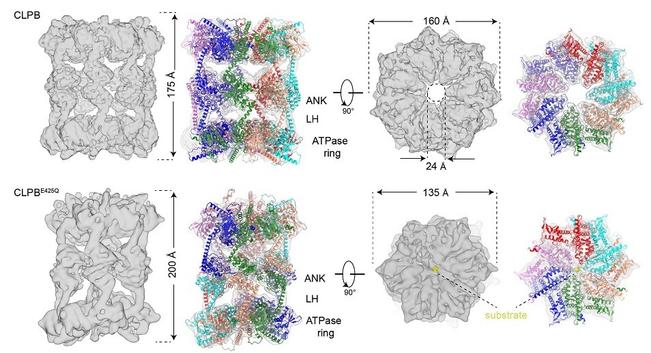
The human AAA+ #ATPase CLPB (SKD3) is a disaggregase in the #mitochondrial intermembrane space. This structural & functional study of CLPB provides insights into its assembly and how it helps to solubilize mitochondrial proteins #PLOSBiology https://plos.io/3HGpoFY
Comprehensive structural characterization of the human AAA+ disaggregase CLPB in the apo- and substrate-bound states reveals a unique mode of action driven by oligomerization

The human AAA+ ATPase CLPB (SKD3) is a protein disaggregase in the mitochondrial intermembrane space that promotes the solubilization of various mitochondrial proteins. This structural and functional study of CLPB provides insights into its assembly and mechanism of action.