Michael Gerth

163 Followers
250 Following
14 Posts
Insects, microbes, symbiosis, bioinformatics, molecular approaches in ecology & phylogeny. Emmy Noether Research Group Leader iDiv & MLU Halle. he/him
Personal websitehttps://www.michaelgerth.net
Lab websitehttps://www.idiv.de/en/symbiont-evolution.html

Hear ye hear ye 🔔 Come see the cool things Wolbachia does. New work from my lab (known at lab meetings as Amelia’s weird side project) with contributions from my grad student Megan Jones and our friends from @chicaScientifica and Tennessen labs at IU.

TLDR; having Wolbachia helps you grow big and strong

https://www.biorxiv.org/content/10.1101/2023.01.20.524972v1

Wolbachia is a nutritional symbiont

https://doi.org/10.1101/2023.01.20.524972

Can obligate endosymbionts evolve larger genomes?

Check out our paper in Nature Microbiology!

https://www.nature.com/articles/s41564-022-01284-9

Co-first authored with Jennah Dharamshi

Matthias Horn @ettemalab Astrid Collingro @mschoen Uppsala universitet @MIB_WUR DOME #OpenAccess

1/7

Gene gain facilitated endosymbiotic evolution of Chlamydiae - Nature Microbiology

Extensive gene gain via horizontal gene transfer facilitated the evolution of obligate intracellular Chlamydiae.

Nature

The community ecology perspective of omics data

Commentary published @ Microbiome on how sample prep/collection/processing impacts diversity estimates.

#microbiome #microbiota #science #ecology #research #metagenomics

https://microbiomejournal.biomedcentral.com/articles/10.1186/s40168-022-01423-8

The community ecology perspective of omics data - Microbiome

The measurement of uncharacterized pools of biological molecules through techniques such as metabarcoding, metagenomics, metatranscriptomics, metabolomics, and metaproteomics produces large, multivariate datasets. Analyses of these datasets have successfully been borrowed from community ecology to characterize the molecular diversity of samples (ɑ-diversity) and to assess how these profiles change in response to experimental treatments or across gradients (β-diversity). However, sample preparation and data collection methods generate biases and noise which confound molecular diversity estimates and require special attention. Here, we examine how technical biases and noise that are introduced into multivariate molecular data affect the estimation of the components of diversity (i.e., total number of different molecular species, or entities; total number of molecules; and the abundance distribution of molecular entities). We then explore under which conditions these biases affect the measurement of ɑ- and β-diversity and highlight how novel methods commonly used in community ecology can be adopted to improve the interpretation and integration of multivariate molecular data. Video Abstract

BioMed Central
Yuval Gottlieb on Twitter

“https://t.co/vvA3x2OT82 Abstract submission deadline: February 28, 2023 Registration deadline: March 31, 2023 🐞🪱🦟🕷️see you there🦋🪳🐜🪲”

Twitter

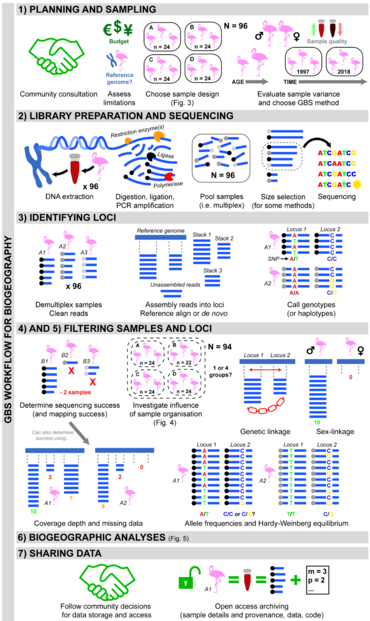
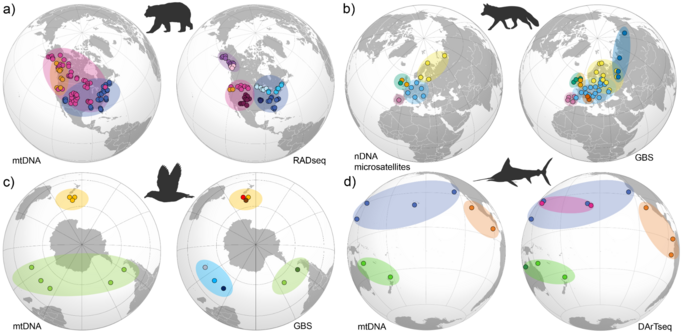
To get the ball rolling, I'd like to share a recent paper! Genotyping-by-sequencing for biogeography: https://doi.org/10.1111/jbi.14516

We provide a practical guide for #biogeography using #GBS or #RADseq, which should particularly assist new users or students. There's a wealth of research exploring differences in reduced-representation sequencing (RRS) methods, sources of genotyping error, and much more. Our aim was to guide new users through this exciting literature. #genomics #ecology #evolution #DNA

I am recruiting a postdoc and a postdoc/lab manager for my 5-year ERC StG grant, so if anyone knows anyone... please, spread the news!

https://academic.oup.com/pnasnexus/advance-article/doi/10.1093/pnasnexus/pgac293/6895556

Our paper on Wolbachia has been published! Effects of male-killing Wolbachia on cellular sex determination.

Cell-based analysis reveals that sex-determining gene signals in Ostrinia are pivotally changed by male-killing Wolbachia

Abstract. Wolbachia, a maternally transmitted bacterium, shows male-killing, an adaptive phenotype for cytoplasmic elements, in various arthropod species during

OUP Academic
Doctoral Researcher (m/f/d) “Multidiversity-Multifunctionality” in the Experimental Interaction Ecology Group

🦀Big #CRUSTMAS news!🦀
New preprint on a molecular #phylogeny of true #crabs. We find crabs moved to non-marine environments 5-15x over 100+ myr!
This culminates 20 years(!) of effort from an international team! 1/5
https://www.biorxiv.org/content/10.1101/2022.12.09.519815