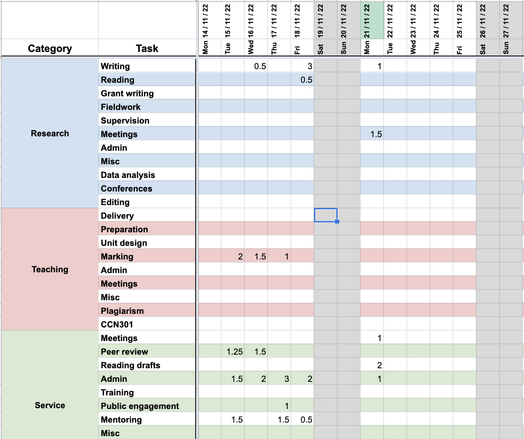
For a few years I've been maintaining and slowly improving a Google Sheet template to help #academics (particularly salaried academics) track how much they are working, and how this work is distributed. I've just updated the template for 2023.
The reason for this is academic #workloads are often left very abstract and vague, usually measured in 'percentages' with only the loosest connection to time and the actual number of hours you are paid to work. I find that tracking my hours helps to reassure me I am doing enough work in some aspects of my job (in #research, for instance), and also help prevent me from overworking.
For example, this year, I know I have worked 61 hours more than I have been paid for thus far. This means in December, once marking and everything is wrapped up, I'm just going to tap out and do pretty much no work for a couple of weeks (just keep an eye out for urgent emails), but also not take leave. Because those are hours I'm owed. So by the end of the year, I should be back close to zero hours overworked.
Some academics hate counting hours as bean counting or volunteering into surveillance. I get that. But considering how the ever-intensifying exploitation of academic staff relies on #university management obscuring and intensifying our work, I find tracking how much I've actually worked incredibly empowering.
With the new year, maybe consider tracking your own #academic work!
The template: https://docs.google.com/spreadsheets/d/1W-w_pbJgsemr5vznErqqNG5UJsfxeiPUNgG8f6pXyfg/edit#gid=1226213337 #commodon

 Auschwitz Memorial


 Fritters


 Brendan Keogh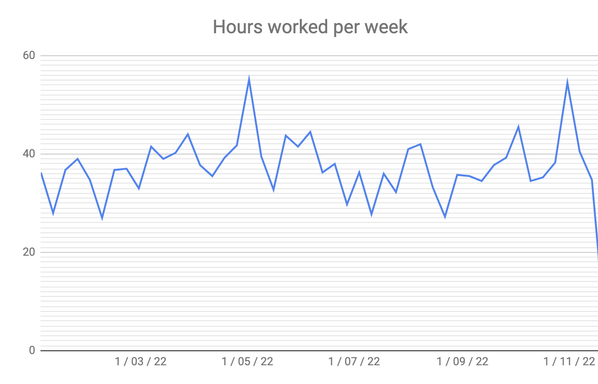

 Fondazione BEIC
 Karl Heinz Häsliprinz
 Gary Love