188 Followers
397 Following
161 Posts

Author of While the Gods Were Sleeping: A Journey Through Love and Rebellion in Nepal.

Once an academic anthropologist, I now live among yaks, chickens, & lots of wildlife in eastern Oregon.

She/Her

#Neurodivergent #ActuallyAutistic #SustainableAgriculture #SmallFarms #Biodiversity

Header photo is a view up through the tops of tamarack trees that have turned gold for fall. Blue sky is above.

Pronounsshe/her
Websitehttps://WWW.elizabethenslin.com
One of the most crucial articles you could read about #autism research: How ridding research of ableist framings of what autism is leads to greater scientific accuracy, not less. Please spread this link. https://www.frontiersin.org/articles/10.3389/fpsyt.2023.1244451/full?utm_source=S-TWT&utm_medium=SNET&utm_campaign=ECO_FPSYT_XXXXXXXX_auto-dlvrit
Anti-ableism and scientific accuracy in autism research: a false dichotomy

It was recently argued that autism researchers committed to rejecting ableist frameworks in their research may sacrifice “scientifically accurate” conceptualizations of autism. In this perspective piece, we argue that: (a) anti-ableism vs. scientific accuracy is a false dichotomy, (b) there is no ideology-free science that has claim to scientific accuracy, and (c) autism science has a history of false leads in part because of unexamined ableist ideologies that undergird researcher framings and interpretations of evidence. To illustrate our claims, we discuss several avenues of autism research that were promoted as scientific advances, but were eventually debunked or shown to have much less explanatory value than initially proposed. These research programs have involved claims about autism etiology, the nature of autism and autistic characteristics, and autism intervention. Common to these false leads have been ableist assumptions about autism that inform researcher perspectives. Negative impacts of this work have been mitigated in some areas of autism research, but these perspectives continue to exert influence on the lives of autistic people, including the availability of services, discourses about autism, and sociocultural conceptualizations of autistic people. Examining these false leads may help current researchers better understand how ableism may negatively influence their areas of inquiry. We close with a positive argument that promoting anti-ableism can be done in ...
Frontiers
From Timothy Snyder, Yale History professor:

I just watched Neuroscientifically Challenged’s YouTube video on autism – https://www.youtube.com/watch?v=tEBsTX2OVgI – part of a playlist on ‘Pathology & Disorders’

By watching the 2-minute video, I hoped to gain some insight into my neurology, or at least enjoy learning some new brain facts. I was disappointed, and left this comment:

—✁—

I have been binge-watching your 2-minute and 10-minute neuroscience videos for the last couple of days, and have found them very educational and enjoyable. I’ve only just dipped into the ’Pathology & Disorders’ playlist, and thought it would be interesting to know more about what neuroscience currently says about Autistic brains and how they are different from allistic (non-Autistic) brains (or at least what can be said in 2 minutes).

So I was dismayed to see my neurology so lazily characterised.

• Autistic brains are neurodivergent (differing from the neurotypical ‘average’ brain), not ‘disordered’. This is a biased value judgement.

• Having an Autistic brain is not a disease, so there are no ‘symptoms’. Traits perhaps.

• I don’t have ‘impairments’ in social communication and interaction. I simply communicate differently from neurotypical people. See for instance research by Catherine Compton at the University of Edinburgh: https://journals.sagepub.com/doi/10.1177/1362361320919286 and https://doi.org/10.3389/fpsyg.2020.586171

• So-called ‘restrictive and repetitive behaviours’ are actually either things that we’re passionately interested in, and things that give us pleasure, or coping mechanisms we resort to when we’re under extreme stress, which may go unnoticed by neurotypical people because of our very different sensory profiles.

• We are not ‘individuals with autism’. We are Autistic people. There are many reasons the vast majority of Autistic people prefer this way to describe ourselves, the main one being that most of us couldn’t imagine being, and wouldn’t wish to be, anything other than Autistic: there is no ‘autism’ we ‘have’ that we could do without.

• Talk of the ‘risk of autism’ plays to this idea that being Autistic is undesirable. (Oh, and the risk of being neurotypical is also strongly influenced by genetics!)

• My brain probably looks a lot like yours: it certainly isn’t made out of brightly coloured jigsaw pieces. The so-called charity that this imagery is linked to is reviled by the Autistic community. We prefer to use our own symbols, notably the gold infinity sign.

I hope you can take these comments on board in the spirit of constructive criticism. I really appreciate the rest of your videos that I’ve watched thus far.

#ActuallyAutistic #NothingAboutUsWithoutUs #neuroscience #pathology #AutismSpeaks

@actuallyautistic

2-Minute Neuroscience: Autism

YouTube

**CALLING ALL FRIENDS, ADVOCATES, AND ACTIVISTS** A leaked e-mail from a Texas Department of Protective Safety trooper documents the remarkably cruel measures Governor Greg Abbott has instituted at the border to deter crossings. These include hidden razor wire traps, the withholding of water even in extreme heat, and orders to push migrants—including children and infants—back into the Rio Grande where they might drown. The sight of razor wire to corral innocent human beings has echoes for me personally, when similar wire surrounded the Japanese American internment camps of my youth. We cannot let Governor Greg Abbott get away with this. I'm calling on you, my friends, advocates and activists, to help put a stop to this by signing the petition demanding the Biden Administration puts an end to these inhumane practices against migrants in Texas.

https://www.thepetitionsite.com/takeaction/806/513/820/?TAP=2430&source_id=TexasMigrants

Sign Petition: Demand The Biden Administration End Inhumane Practices Against Migrants In Texas

Dear Friends, Advocates and Activists, A leaked e-mail from a Texas Department of Public Safety trooper documents the remarkably (22736 signatures on petition)

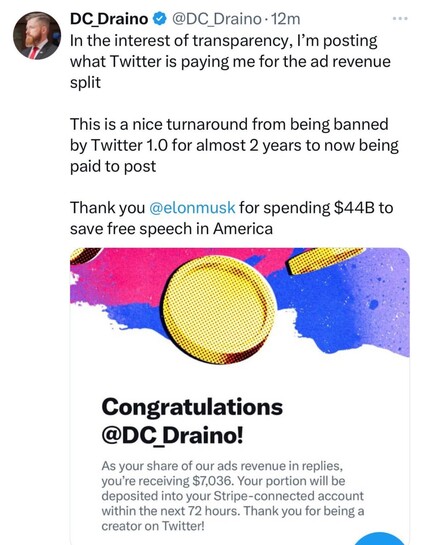
Twitter is now paying people to spread hate

Reminder: if you’re still on Twitter—your presence and your interactions generate revenue. You’re literally funding the alt right.

#DeleteTwitter

🏳️‍⚧️🏳️‍🌈🇺🇸

"We never saw any of this ADHD or autism stuff when I was young!"

You never saw any photos of the surface of Mars back then either, but I'm pretty sure it was still there the whole time

Why RFK Jr.'s lies about #autism are so damaging to the vulnerable people and families that he claims to be defending. Important piece by #autistic reporter Matthew Rozsa at Salon, with quotes from me and others. Please spread this link! https://www.salon.com/2023/06/30/rfk-jr-spreads-bigotry-against-autistic-people--and-autistic-people-arent-taking-it-anymore/
RFK Jr.'s anti-vaxx views also reinforce damaging autism stereotypes, advocates say

RFK Jr. says he advocates for the marginalized, but built his career spreading harmful lies about autism

Salon.com
If you are going to read the #SCOTUS affirmative action case opinions today - PLEASE start with KBJ's dissent. #LawFedi

SCOTUS struck down AA b/c it’s allegedly discriminatory. Here’s the Facts:
•AA benefitted white women more than all other groups COMBINED—plaintiffs never complained about that
•43% of white Harvard students are legacy or athlete students, of which 75% would not be admitted otherwise—plaintiffs never complained about that
•Asians are 6% of the population & 26% of Harvard admissions—plaintiffs never complained about that

This SCOTUS ruling is 100% anti-fact & 100% anti-Black racism.

Tim Snyder is incredible, and this postmortem of the #Prigozhin escapade (a.k.a. #Coup) is dead on, up and down. If you want to understand the #Russia - #Ukraine nexus, Tim Snyder’s work is a very good place to start.

https://snyder.substack.com/p/prigozhins-march-on-moscow

Prigozhin's March on Moscow (corrected)

Ten lessons from a mutiny

Thinking about...