Lace Padilla

711 Followers
281 Following
50 Posts

I am an Assistant Professor of Computer Science and Psychology at Northeastern University and a member of the Data Visualization Lab @Khoury.

#infovis #DataVis #Psychology #HCI

Homepagehttp://lacepadilla.com
Labhttps://vis.khoury.northeastern.edu/people/
Twitterhttps://twitter.com/LacePadilla
Google Scholarhttps://scholar.google.com/citations?hl=en&user=WqJQayQAAAAJ

Recording this video was tough, but the conversation is so important. I share my candid experiences and insights on thriving as a woman in academia.

Hoping it fosters more discussion and community. https://youtu.be/jzgJrXsL4SU
#WomenInSTEM #Academia

Thriving as a Woman in Academia: Real Talk and Strategies

YouTube

I just posted what I thought was the final video in my series on thriving in academia, but the response has been incredible! 🎓 Your feedback has inspired me, and I decided to keep going🙏!

Check out my latest 🎥 on handling rejection in academia https://youtu.be/6S1G1oMMPyA #phdlife

How to Handle Rejection in Academia: Tips for Staying Resilient

YouTube

Do you use Probability Density Function (PDF) plots to show your results?
Discover how compressing PDFs impacts data interpretation in research!

Racquel Fygenson reveals surprising insights from our study on plot scaling. 📈
Video: https://www.youtube.com/watch?v=BEsD1RIIjCo&ab_channel=Dr.LacePadilla
Paper: https://vis.khoury.northeastern.edu/pubs/Fygenson2024ImpactVerticalScaling/

#Datavisualization #Bayesian

Visualizing Probability: How Compression Changes Perception of Data

YouTube

If you squish another PDF, we will know that you missed @racquel and @lace 's Impact of Vertical Scaling on Normal Probability Density Functions 👀 In the Perception & Cognition track at 1:30pm EST

https://ieeevis.org/year/2024/program/session_full26.html
https://pubmed.ncbi.nlm.nih.gov/39255124/ #ieeevis

Virtual IEEE VIS 2024 - Session: VIS Full Papers: Perception and Cognition

See the session and its presentations inside.

Virtual IEEE VIS 2024 - Session: VIS Full Papers: Perception and Cognition

See the session and its presentations inside.

Just released a new video on my YouTube channel about impostor syndrome—something I've struggled with throughout my career. Hope this perspective can be helpful to others in academia! ❤️‍🩹🎓#Academia #ImpostorSyndrome #PhDLife https://youtu.be/7Fb76s8kaxA?si=YDmQkHsRYyo9oElU
Overcoming Imposter Syndrome in Academia: Strategies for Success

YouTube
The National Parks and Social Media

Studying Engagement with Digital Ecotourists

We're bummed #ieeevis isn't in person, but that doesn't mean you can't reach out! Ask @racquel about her Doctoral Colloquium topic, "Non-interactive Visualization Affordances" -- she has some great ideas 👀 #affordances #hci #datavisualization

Join us for the #IEEEVIS Conference Futures panel: Community Opinions on Recent Experiences, Challenges, and Opportunities for Hybrid Event Formats

IEEE VIS 2024 Oct 16, 2024 – 3:30pm Eastern following the VIS Town Hall

Moderated by Matt Brehmer & Narges Mahyar of the VIS Executive Committee (VEC)

featuring panelists Tim Dwyer, @jguerra, Petra Isenberg @dr_pi , Takayuki Itoh, Elsie Lee-Robbins @elsieleerobbins, Andrew McNutt @mcnutt

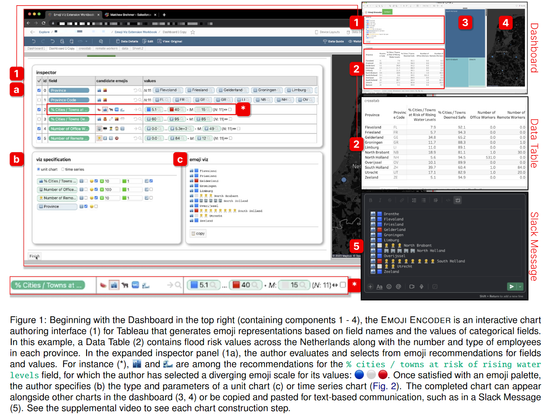
This paper definitely wins the superlative for "VIS paper with the most emojis" this year 😉 Check out @Birdbassador & co-authors' "Data-Wink" ratio paper from today's workshop on Data Storytelling in an Era of Generative AI (Gen4DS) https://www.arxiv.org/abs/2408.13418 #IEEEVIS #VIS2024 #GenAI #Emojis

https://ieeevis.org/year/2024/program/paper_w-storygenai-5237.html

The Data-Wink Ratio: Emoji Encoder for Generating Semantically-Resonant Unit Charts

Communicating data insights in an accessible and engaging manner to a broader audience remains a significant challenge. To address this problem, we introduce the Emoji Encoder, a tool that generates a set of emoji recommendations for the field and category names appearing in a tabular dataset. The selected set of emoji encodings can be used to generate configurable unit charts that combine plain text and emojis as word-scale graphics. These charts can serve to contrast values across multiple quantitative fields for each row in the data or to communicate trends over time. Any resulting chart is simply a block of text characters, meaning that it can be directly copied into a text message or posted on a communication platform such as Slack or Teams. This work represents a step toward our larger goal of developing novel, fun, and succinct data storytelling experiences that engage those who do not identify as data analysts. Emoji-based unit charts can offer contextual cues related to the data at the center of a conversation on platforms where emoji-rich communication is typical.

arXiv.org