 Colin Purrington
Finally found a male basilica orbweaver (Mecynogea lemniscata). It was cruising around on a tree but males make domed webs just like females. Pic of female is from Florida several years ago. Such a beautiful spider. #spider #spiders #orbweaver #nature #web #araneidae

fercfossati
- 100 Followers
- 52 Following
- 48 Posts
Ecólogo de #Artrópodos 🕷️🦂🪲 y #Veneno de #Arañas. Además de estudiar #bichos, soy Oceanógrafo, divulgador, escritor, ilustrador...y #metalhead 🎸 Hago #ciencia en el Área de Biodiversidad y Conservación, #ESCET - #URJC, Madrid (Spain)
 Bill Kimler
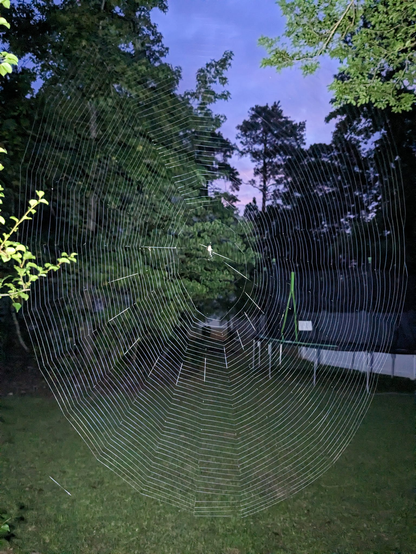
What would YOU do if you walked unexpectedly face-first into this beauty on a dark summer morning while letting your dog out to do his business?
 Conchi Lillo 🧠🔬👀
🕷️ En nuestros estudios tratamos con muchas arañas viuda negra mediterránea de España, Latrodectus tredecimguttatus. Aquí una puesta recién eclosionada. Nacen ya con su patrón de 13 manchas en el abdomen sobre fondo negro. De adultas suelen presentar estos colores ⬛🟥🟨.
Cuando la multitud de crías nace, entre todas realizan una tela comunal donde la defensa se basa en la protección de grupo. Una monada, tantos bebés recién nacidos juntitos, mientras dura. Una vez maduran, comenzarán a irse.
 Carl T. Bergstrom


 Alex Wild
An eastern yellowjacket, Vespula maculifrons, drinks nectar from a milkweed. Texas.
More ant-mimics here:
#entomology #insects #spiders https://www.alexanderwild.com/Ants/Natural-History/Ant-Mimics/

Ant Mimics - Alex Wild
A great many animals mimic the form, color, and movements of ants. Some gain protection from general predators that don't eat ants, some are specialized ant predators who trick prey ants into coming closer, and others copy ants for reasons that aren't well understood. This gallery showcases the diversity of mimics.
 Michael Brewer
The latest paper from my lab was published!
My former PhD student Jeff Cole did an amazing job combining field work, transcriptomics, proteomics, and analyses of molecular evolution to explore the origins of inhibitory cysteine knot (ICK) toxins in wandering spiders (Ctenidae), the family that includes the infamous Brazilian Wandering Spider _Phoneutria nigriventer_.
https://www.mdpi.com/2072-6651/15/2/112
#spiders #spider #venom #venomics #evolution #EvolutionaryBiology #genomics #OpenAccess #OpenScience

Killer Knots: Molecular Evolution of Inhibitor Cystine Knot Toxins in Wandering Spiders (Araneae: Ctenidae)
Venom expressed by the nearly 50,000 species of spiders on Earth largely remains an untapped reservoir of a diverse array of biomolecules with potential for pharmacological and agricultural applications. A large fraction of the noxious components of spider venoms are a functionally diverse family of structurally related polypeptides with an inhibitor cystine knot (ICK) motif. The cysteine-rich nature of these toxins makes structural elucidation difficult, and most studies have focused on venom components from the small handful of medically relevant spider species such as the highly aggressive Brazilian wandering spider Phoneutria nigriventer. To alleviate difficulties associated with the study of ICK toxins in spiders, we devised a comprehensive approach to explore the evolutionary patterns that have shaped ICK functional diversification using venom gland transcriptomes and proteomes from phylogenetically distinct lineages of wandering spiders and their close relatives. We identified 626 unique ICK toxins belonging to seven topological elaborations. Phylogenetic tests of episodic diversification revealed distinct regions between cysteine residues that demonstrated differential evidence of positive or negative selection, which may have structural implications towards the specificity and efficacy of these toxins. Increased taxon sampling and whole genome sequencing will provide invaluable insights to further understand the evolutionary processes that have given rise to this diverse class of toxins.
EXTRAÑA ARAÑA ERESUS (hembra)
Este #animal pertenece a un género muy curioso de #arañas. Su morfología es cuanto menos peculiar. Además, los machos, mas pequeños y estilizados poseen en el dorso de su abdomen bellos patrones anaranjados rojizos, con puntos que varían dependiendo de la especie.
Algunas Eresus están listadas como impactadas por causas antrópicas en los catálogos de varios países europeos.
Este #animal pertenece a un género muy curioso de #arañas. Su morfología es cuanto menos peculiar. Además, los machos, mas pequeños y estilizados poseen en el dorso de su abdomen bellos patrones anaranjados rojizos, con puntos que varían dependiendo de la especie.
Algunas Eresus están listadas como impactadas por causas antrópicas en los catálogos de varios países europeos.
Retrato de #mantis para empezar la semana. Esta adulta estaba a punto de poner su puesta. Nacen a principios de #primavera, y se dedican a #comer sin parar, mudar y crecer. Por eso son tan importantes controlando #insectos. En #otoño ya adultas, se reproducen y mueren. NO SON #VENENOSAS a pesar de que muchas historias folclóricas lo digan.
Por cierto, en la península tenemos varias especies de mantis de diversos géneros, no solo Mantis religiosa. Otro día, fotos de esas más desconocidas
