David Schnettler

60 Followers
53 Following
15 Posts
Postdoctoral researcher at ETH Zurich. Previously PhD student in the Hollfelder Lab at University of Cambridge. Interested in all aspects of #proteinengineering and #proteinevolution.
Webhttps://usys.ethz.ch/en/people/profile.MjkzNzI2.TGlzdC82MzcsMzIwMTk3MjIy.html
ORCIDhttps://orcid.org/0000-0002-9909-6190
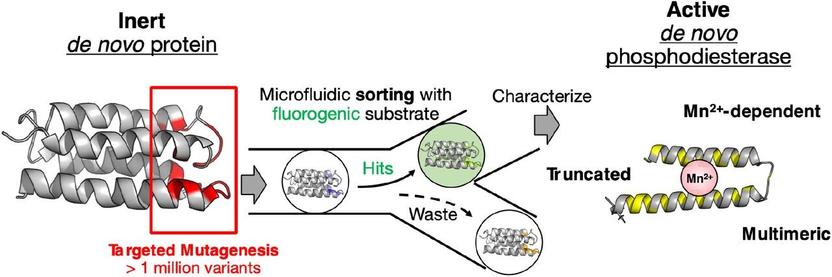
In this project, we screened de novo designed protein libraries without natural ancestry for function, using #microfluidic droplets - and massively enriched short, truncated protein fragments. Turns out that these ≈ 40- to 60-residue fragments oligomerize to form a dynamic, catalytically proficient assembly, just as primordial peptides might have formed early enzymes during the prebiotic events that led to the #OriginOfLife! #ProteinEvolution
This project was a wonderful collaboration between the Hollfelder Lab at @cambridge_uni and the Hecht Lab at Princeton, with brilliant contributions from Adrian Bunzel from ETH Zurich. Huge thanks to all co-authors, with a special shoutout to my co-first authors Max Gantz and Mike Wang for this great piece of teamwork!

If you've ever done a bit of #ProteinEngineering or #DirectedEvolution you know that funny things can happen 🤯 – and sometimes it's worth following up!

I'm excited to share that our paper is finally out in Nature Chemistry! 🎉

Read it here:
https://www.nature.com/articles/s41557-024-01490-4

Selection of a promiscuous minimalist cAMP phosphodiesterase from a library of de novo designed proteins - Nature Chemistry

Evolution separates complex modern enzymes from their hypothetical simpler early ancestors, which raises the question of how unevolved sequences can develop new functions. Here a library of non-natural protein sequences was subjected to ultrahigh-throughput screens in microfluidic droplets, leading to the isolation of a phosphodiesterase enzyme capable of hydrolysing the biological second messenger, cyclic AMP.

Nature

🎉 Excited to share that I've been awarded the NOMIS-ETH Postdoctoral Fellowship to do research on the origin of life! Starting this September, I'll join the Panke group at the Department of Biosystems Science and Engineering (D-BSSE) in Basel and the Centre for Origin and Prevalence of Life (COPL) of ETH Zürich. I'm very grateful to the NOMIS Foundation for this incredible opportunity! 🌱🔬 #OriginOfLife #ProteinEvolution

https://copl.ethz.ch/news/COPL-news-channel/2024/03/2024-cohort-of-the-nomis-eth-fellows.html

2024 Cohort of the NOMIS-ETH Fellows

#DirectedEvolution is a powerful method but has not been easy to do with gigantic #nonribosomal biocatalysts that make important #antibiotics. We have developed a #microfluidics screen that uses liposomes as sensors for membrane active peptides. Bacteria are grown in tiny droplets. If they make gramicidin S, the sensor liposomes burst, liberate calcein, and generate fluorescence. This was tested for screening mutants and may become a useful tool for directed evolution. https://www.biorxiv.org/content/10.1101/2023.01.13.523969v1

Happy to see our preprint out on #bioRxiv! We screened #denovodesigned proteins for #phosphoesterase activity in #microfluidic droplets – and found truncated peptides that dynamically oligomerise to proficiently break down cAMP! This project from my time at the Hollfelder lab at the University of #Cambridge was a collaboration with the Hecht lab at #Princeton University. Special thanks to Michael Wang (co-first!) and Max Gantz for the wonderful teamwork!

https://biorxiv.org/content/10.1101/2023.02.13.528392v2

We need more #CRISPR Cas systems isolated from bacteria unknown to our immune system. You can look around on this planet, in every single corner. Or you can travel back in time. We chose the second path, and reported the outcome today in #NatureMicrobiology
https://www.nature.com/articles/s41564-022-01265-y
Evolution of CRISPR-associated endonucleases as inferred from resurrected proteins | Nature Microbiology

Clustered regularly interspaced short palindromic repeats (CRISPR)-associated Cas9 is an effector protein that targets invading DNA and plays a major role in the prokaryotic adaptive immune system. Although Streptococcus pyogenes CRISPR–Cas9 has been widely studied and repurposed for applications including genome editing, its origin and evolution are poorly understood. Here, we investigate the evolution of Cas9 from resurrected ancient nucleases (anCas) in extinct firmicutes species that last lived 2.6 billion years before the present. We demonstrate that these ancient forms were much more flexible in their guide RNA and protospacer-adjacent motif requirements compared with modern-day Cas9 enzymes. Furthermore, anCas portrays a gradual palaeoenzymatic adaptation from nickase to double-strand break activity, exhibits high levels of activity with both single-stranded DNA and single-stranded RNA targets and is capable of editing activity in human cells. Prediction and characterization of anCas with a resurrected protein approach uncovers an evolutionary trajectory leading to functionally flexible ancient enzymes. The CRISPR–Cas9 system is widely studied for its role as a phage defence system and for gene editing applications, but its evolutionary origins are poorly understood. Here the authors use ancestral sequence reconstruction to determine the evolutionary history and ancient protein sequences of Streptococcus pyogenes Cas9 ancestors.

Conclusions:

- Microfluidic droplet sorting is an extremely powerful tool for #proteinengineering
- Cys-triad enzymes might be predisposed and well suited for evolution towards pesticide decontamination or catalytic bioscavengers (6/6)

By using steady and transient state #kinetics as well as linear free-energy relationships (#LFER) we show that the breakup of the covalent phosphoryl intermediate – which is the 'lethal' step for acetylcholinesterase – is surprisingly fast in this enzyme.

Instead, the rate-limiting step is the initial formation of the covalent intermediate. This step subsequently gets vastly accelerated through our directed evolution campaign (by increased leaving group stabilisation). (5/6)

By combining smart libraries with the ultrahigh throughput of droplet #microfluidics, we increased its catalytic efficiency by 360-fold in only two rounds of evolution, matching the activity of most metal-dependent phosphotriesterases.

But how does this new triad-based phosphotriesterase escape the fate of acetylcholinesterase, irreversible covalent entrapment? (4/6)