
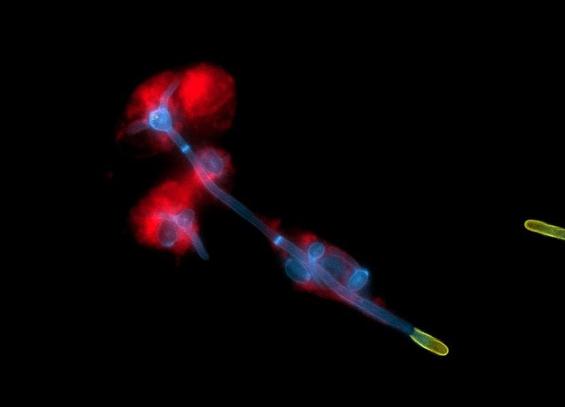
Dose makes the difference! #Candidaalbicans uses the toxin #candidalysin not only to cause infections but also to quietly colonize the mouth – too little fails, too much triggers immune defense.
#NatureMicrobiology
@LeibnizHKI

🗞️ Press release: https://shorturl.at/AzMAg
🧪Original paper: https://doi.org/10.1038/s41564-025-02122-4

picture credits: Erik Böhm, Leibniz-HKI
We need more #CRISPR Cas systems isolated from bacteria unknown to our immune system. You can look around on this planet, in every single corner. Or you can travel back in time. We chose the second path, and reported the outcome today in #NatureMicrobiology
https://www.nature.com/articles/s41564-022-01265-y
Evolution of CRISPR-associated endonucleases as inferred from resurrected proteins | Nature Microbiology

Clustered regularly interspaced short palindromic repeats (CRISPR)-associated Cas9 is an effector protein that targets invading DNA and plays a major role in the prokaryotic adaptive immune system. Although Streptococcus pyogenes CRISPR–Cas9 has been widely studied and repurposed for applications including genome editing, its origin and evolution are poorly understood. Here, we investigate the evolution of Cas9 from resurrected ancient nucleases (anCas) in extinct firmicutes species that last lived 2.6 billion years before the present. We demonstrate that these ancient forms were much more flexible in their guide RNA and protospacer-adjacent motif requirements compared with modern-day Cas9 enzymes. Furthermore, anCas portrays a gradual palaeoenzymatic adaptation from nickase to double-strand break activity, exhibits high levels of activity with both single-stranded DNA and single-stranded RNA targets and is capable of editing activity in human cells. Prediction and characterization of anCas with a resurrected protein approach uncovers an evolutionary trajectory leading to functionally flexible ancient enzymes. The CRISPR–Cas9 system is widely studied for its role as a phage defence system and for gene editing applications, but its evolutionary origins are poorly understood. Here the authors use ancestral sequence reconstruction to determine the evolutionary history and ancient protein sequences of Streptococcus pyogenes Cas9 ancestors.

Today we report five ancestral #CRISPR #Cas nucleases generated by maximum likelihood molecular philogeny from bacteria that could have lived 37, 137, 200, 1000 and 2600 Millions years ago and we found that are capable of acting as gene editing tools in human cells. The oldest ancestral Cas are less specific (PAMless) and prefer to cut single strand DNA and RNA. We publish this collaborative study today in #NatureMicrobiology
https://www.nature.com/articles/s41564-022-01265-y
Evolution of CRISPR-associated endonucleases as inferred from resurrected proteins | Nature Microbiology

Clustered regularly interspaced short palindromic repeats (CRISPR)-associated Cas9 is an effector protein that targets invading DNA and plays a major role in the prokaryotic adaptive immune system. Although Streptococcus pyogenes CRISPR–Cas9 has been widely studied and repurposed for applications including genome editing, its origin and evolution are poorly understood. Here, we investigate the evolution of Cas9 from resurrected ancient nucleases (anCas) in extinct firmicutes species that last lived 2.6 billion years before the present. We demonstrate that these ancient forms were much more flexible in their guide RNA and protospacer-adjacent motif requirements compared with modern-day Cas9 enzymes. Furthermore, anCas portrays a gradual palaeoenzymatic adaptation from nickase to double-strand break activity, exhibits high levels of activity with both single-stranded DNA and single-stranded RNA targets and is capable of editing activity in human cells. Prediction and characterization of anCas with a resurrected protein approach uncovers an evolutionary trajectory leading to functionally flexible ancient enzymes. The CRISPR–Cas9 system is widely studied for its role as a phage defence system and for gene editing applications, but its evolutionary origins are poorly understood. Here the authors use ancestral sequence reconstruction to determine the evolutionary history and ancient protein sequences of Streptococcus pyogenes Cas9 ancestors.