 Peter Jelinek
Gute Nachrichten, die wir teilen sollten :)
RE: https://mastodon.social/@benhermann/116312519903300425
REMINDER: Our call for a professorship in the programming language field ends this Sunday! Make sure your application is in the system on time.
📢 Call for Artifact Evaluation Reviewers! Join the ASE 2026 & ISSTA 2026 AE committees. Support open science while gaining an inside look at top-tier research artifacts.
📝 Apply now: https://docs.google.com/forms/d/e/1FAIpQLSf9niVU6wiLToSjzsHXANpkH0QY_RXPIzvhPxDkbFZUDn7atA/viewform
🔁 Please boost! #ASE2026 #ISSTA2026
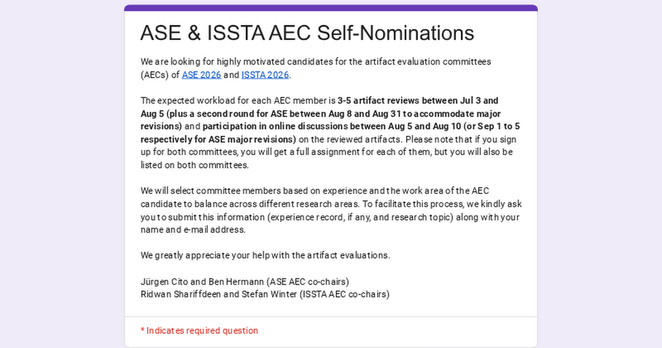
We are looking for highly motivated candidates for the artifact evaluation committees (AECs) of ASE 2026 and ISSTA 2026. The expected workload for each AEC member is 3-5 artifact reviews between Jul 3 and Aug 5 (plus a second round for ASE between Aug 8 and Aug 31 to accommodate major revisions) and participation in online discussions between Aug 5 and Aug 10 (or Sep 1 to 5 respectively for ASE major revisions) on the reviewed artifacts. Please note that if you sign up for both committees, you will get a full assignment for each of them, but you will also be listed on both committees. We will select committee members based on experience and the work area of the AEC candidate to balance across different research areas. To facilitate this process, we kindly ask you to submit this information (experience record, if any, and research topic) along with your name and e-mail address. We greatly appreciate your help with the artifact evaluations. Jürgen Cito and Ben Hermann (ASE AEC co-chairs) Ridwan Shariffdeen and Stefan Winter (ISSTA AEC co-chairs)
Do you want to be my new colleague in Stuttgart?
We just opened a tenured professor position for researchers in Programming Languages. So, if you are working in this field, including but not limited to Program Analysis, Compilers, Runtime Environments, Constructive PL, Empirical PL, Quantum PL, ... please consider applying.
If you are not in this field, please repost and boost. 📣
https://www.f05.uni-stuttgart.de/en/faculty/news/news/Professorship-W3-in-Programming-Languages/
Für alle, die ungeduldig darauf gewartet haben:
Die Zahlen 1-100 in alphabetischer Reihenfolge:
8, 88, 38, 58, 98, 68, 78, 48, 28, 18, 80, 3, 30, 83, 33, 53, 93, 63, 73, 43, 23, 13, 1, 81, 31, 51, 91, 61, 71, 41, 21, 11, 5, 85, 35, 55, 95, 65, 75, 45, 25, 15, 50, 100, 9, 89, 39, 59, 99, 69, 79, 49, 29, 19, 90, 6, 86, 36, 56, 96, 66, 76, 46, 26, 16, 60, 7, 87, 37, 57, 97, 67, 77, 47, 27, 17, 70, 4, 84, 34, 54, 94, 64, 74, 44, 24, 14, 40, 10, 20, 2, 82, 32, 52, 92, 62, 72, 42, 22, 12
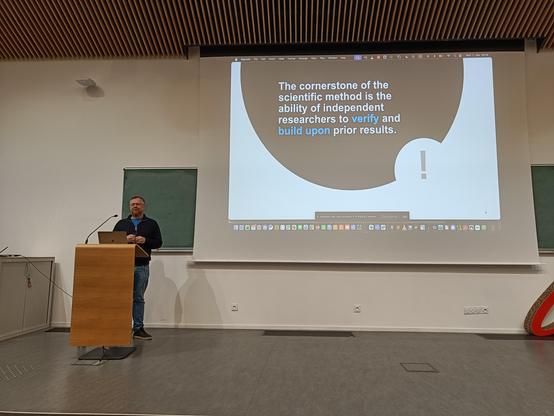
In empirical software engineering research, we use "replication package" as term of art for artifacts shared to enable others to rerun a scientific experiment.
Sadly, it is a semantically wrong expression. It should be called "reproducibility package" instead.
The former (replication) is for a "Different team, [with a] different experimental setup" to rerun experiment, which is not the goal.
The latter (reproducibility) is for a "Different team, [with the] same experimental setup", which is.
Shortly before the holidays the OPAL team prepared a little gift themselves. OPAL 7 has just been released. And it finally provides support for Scala 3 (3.7.3 to be exact). We have been working on that for some time now. Functionality-wise it is the same as OPAL 6. You can perform bytecode parsing, abstract interpretation, call-graph construction, ... for JVM (Java, Scala, ...) bytecode from version 1.0 to 25.
Check it out on GitHub (https://github.com/opalj/opal/releases/tag/7.0.0) or Maven (https://central.sonatype.com/search?q=opal-project)

 Vinzenz
 Stefano Zacchiroli