Ben Hermann

@benhermann
286 Followers
208 Following
147 Posts
Professor for secure software engineering at @Uni_Stuttgart@bawü.social, human being 🏳️‍🌈💻🎓
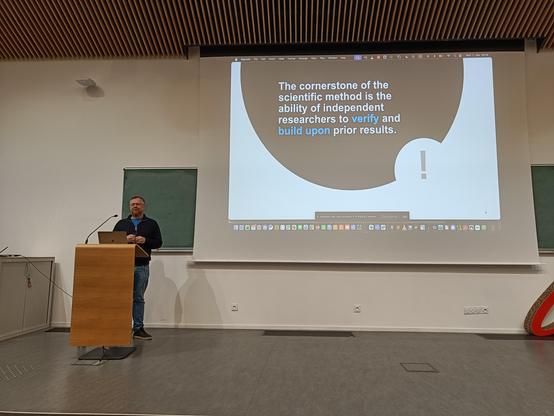
Welcoming @benhermann at #SoftwareHeritage headquarters today, to talk about « What We Learned in 15 Years of #ArtifactEvaluation » #research #digitalpreservation #softwareEngineering
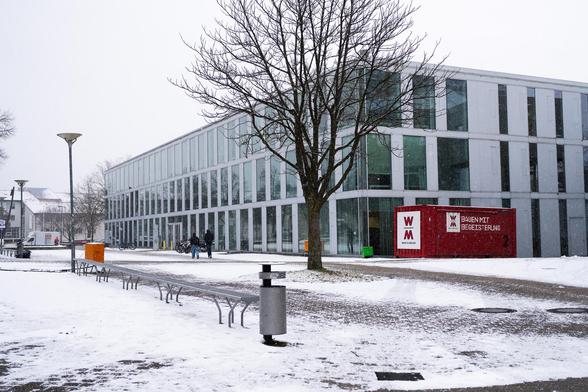
New office as of today. @Uni_Stuttgart

Shortly before the holidays the OPAL team prepared a little gift themselves. OPAL 7 has just been released. And it finally provides support for Scala 3 (3.7.3 to be exact). We have been working on that for some time now. Functionality-wise it is the same as OPAL 6. You can perform bytecode parsing, abstract interpretation, call-graph construction, ... for JVM (Java, Scala, ...) bytecode from version 1.0 to 25.

Check it out on GitHub (https://github.com/opalj/opal/releases/tag/7.0.0) or Maven (https://central.sonatype.com/search?q=opal-project)

General Chair Shin Yoo opening ASE'25 in Seoul #ase25 #ase2025
true

Quantum computing is slowly becoming available for everyone, but we’re still far from everyday use. What’s missing is scalable program analysis. Falk Howar, Benedikt Fauseweh, and I want to change that. We’ll work on scaling verification for digital quantum simulations—an exciting field modelling complex quantum processes as quantum programs. It’s also my first interdisciplinary project with a physicist! Exciting times ahead as we see what the next three years bring.

https://cs.tu-dortmund.de/en/details/dfg-foerdert-dortmunder-projekt-zur-verifikation-digitaler-quantensimulationen-57937/

DFG Funds Dortmund Project on Verification of Digital Quantum Simulations

Interdisciplinary Team from Physics and Computer Science Lays Foundations for Reliable Quantum Simulations

TU Dortmund

In my seminar last week, the students discussed "Understanding and improving artifact sharing in software engineering research" by Timperley, Herckis, @clegoues, and @michaelhilton
For their presentation they chose the overhead projector and made slides that line up. They filled them out with the other students in three separate discussions. Sometimes old tech beats a collaboration platform when you're in the same room. 😄

https://doi.org/10.1007/s10664-021-09973-5

A good first-year module is a dangerous first-year module. If it stretches the students beyond their elastic limit but not beyond their breaking point, that's a fantastic payoff. University is plasticity. We do not stay who we were. And if colleagues think "Goodness me! I couldn't teach that stuff! In fact, I'd fail that module!", that's a reason for them , as lifelong learners, to act to become less stupid, rather than to act to make the teaching offer more stupid. We need to design our courses to grow how people see. And we should, as a college, grow with each other's insights.
A summery cartoon for @newscientist.com

Meet the AITO Dahl-Nygaard Prize Winners at ECOOP'25:

Mira Mezini, TU Darmstadt (Senior Prize)
Amir Shaikhha, University of Edinburgh (Junior Prize)

Check out their awards-citation:
https://2025.ecoop.org/track/ecoop-2025-awards

It's also the first time that the award named after the two eminent Norwegian pioneers will be presented in 🇳🇴!

#ecoop2025 #aito #ProgrammingLanguages

ECOOP 2025 - Awards - ECOOP 2025

AITO Dahl-Nygaard Prize Winners The Senior Prize is awarded to Mira Mezini, TU Darmstadt Over the last 30 years, Mira Mezini has made outstanding contributions in the fields of Programming Languages and Software Engineering, on a diverse range of topics including modularization, software product lines, distributed programming, static analysis, type systems and automatic differentiation, to name but a few. Prof. Mezini is particularly well known for her pioneering work on aspect-oriented programming and has solved important open problems related to the interplay between aspect orientation ...