Public Knowledge Project

@PublicKnowledgeProject
1.3K Followers
965 Following
902 Posts

The Public Knowledge Project (PKP) is a research and development initiative that is also a Core Facility of Simon Fraser University. We develop community-driven free and open software, as well as conduct research, to improve the quality and reach of non-commercial scholarly publishing for the global public good.

#ScholarlyPublishing #ScholComm #OpenInfrastructure #ScholarlyIndependence #OpenJournalSystems #OJS #OpenPreprintSystems #OpenMonographPress #FOSS #OpenAccess #DiamondOA

Websitehttps://pkp.sfu.ca/
Open Journal Systemshttps://pkp.sfu.ca/software/ojs/
PKP Community Forumhttps://forum.pkp.sfu.ca/
PKP Docs Hubhttps://docs.pkp.sfu.ca/

đź“° Inside PKP's community newsletter, "Archipelago"!

Interview with PKP's new Managing Director, Teresa Lee

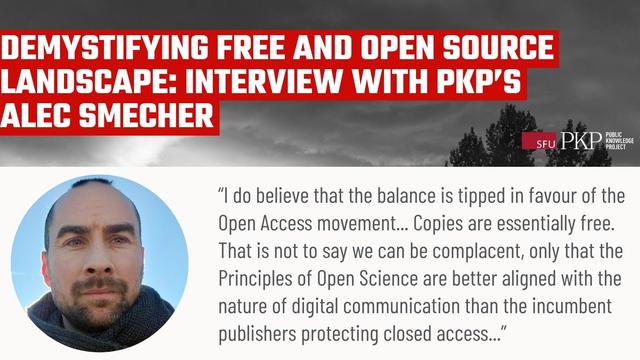
Demystifying #FOSS with Alec Smecher @asmecher

Reflections - 3rd Global Summit on #DiamondOA with Mark Huskisson @markhusk

#OpenJournalSystems OJS 3.6 task history / improved notifications with Magnus Lu

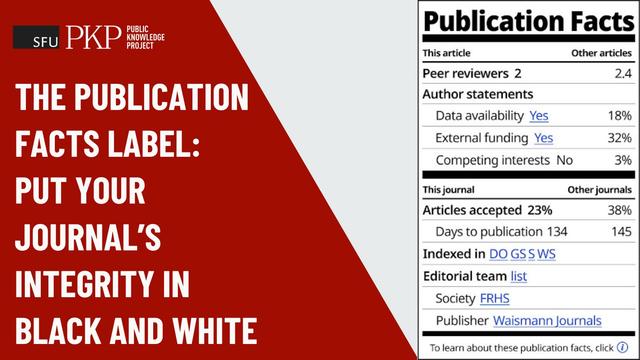
Publication Facts Label #PFLabel with PKP Founder John Willinsky

And more to access all in one place: https://lists.publicknowledgeproject.org/archive/archipelago-issue-10-march-2026-5878

#OpenAccess #ScholarlyPublishing #AcademicChatter

Congratulations to #CERN for hosting #OpenResearchEurope (ORE) and to ORE on backing from 16 national funders and research organizations. PKP is proud to be the developers of the #OpenInfrastructure #OpenJournalSystems (OJS) that ORE will be based on.

Learn more about CERN and ORE: https://home.cern/news/news/cern/cern-host-europes-flagship-open-access-publishing-platform

CERN to host Europe’s flagship open access publishing platform

In an important step for open science, CERN has been selected to host a new phase of Open Research Europe (ORE), an initiative supported by the European Commission and a new funding consortium of European national funding agencies and research organisations. Aligned with the Action Plan for Diamond Open Access (2022)[1], the initiative is a community-led alternative to traditional academic publishing. When the new ORE platform is launched later this year, authorship eligibility will be expanded to include researchers affiliated with institutions in the countries that participate in the consortium. Publishing will remain completely free for both European Commission-funded researchers and authors from participating countries. The aim is to promote equity, diversity and transparency in scholarly communication while maintaining high standards of quality and integrity. The ORE funding consortium currently comprises members from Austria, France, Germany, Italy, the Netherlands, Norway, Portugal, Slovenia, Spain, Sweden and Switzerland[2]. The European Commission participates as a permanent observer in the governance body and provides dedicated financial support. CERN will provide the technical and operational infrastructure for the platform, built on the open source software Open Journal Systems (OJS), while governance and editorial oversight will remain the responsibility of the ORE consortium. ORE follows the innovative publish–review–curate model, which promotes rigour and transparency in the publishing of research. Articles are first checked for integrity and compliance, then published and peer-reviewed openly. Peer-review reports are made public, and articles that successfully pass review are curated into subject-specific collections. This approach combines quality assurance with openness, while also enabling post-publication review. Launched by the European Commission in 2021 to provide beneficiaries of EU research programmes with a no-fee open access publishing platform[3], ORE was designed to make publicly funded research more transparent, accessible and sustainable through an innovative publishing model. In the five years since its launch, the platform has seen steady growth and uptake across the research community, with more than 1,200 articles published and over 6,300 authors from more than 3,000 institutions worldwide taking part. CERN’s role in operating ORE builds on its long-standing experience in developing and maintaining open science infrastructures and community-governed services for the global research community. By hosting ORE, CERN will provide a neutral, reliable and sustainable environment, drawing on expertise gained through flagship open science initiatives such as Zenodo, Invenio and SCOAP3. “For CERN, hosting Open Research Europe is a natural extension of our commitment to an open, community-led scientific infrastructure,” said Mar Capeáns, CERN Director for Site Operations. “The platform supports the rapid sharing of research, while reinforcing Europe’s ability to shape the future of scholarly communication.” “Open Research Europe is a strong example of a shared commitment to fostering the free flow of knowledge across the European Research Area and beyond”, stated Marc LemaĂ®tre, Director-General for Research and Innovation (DG RTD), European Commission. “By ensuring open access to high-quality research, ORE facilitates the circulation of the latest research findings and amplifies public trust in science. Today, as European research funders and research organisations join forces to support ORE, we open a new chapter, one that strengthens open access scholarly publishing and improves research practices across Europe”. Beyond the technical infrastructure, the initiative is expected to deepen collaboration between CERN, the European Commission, national representatives and research organisations. Working in partnership with the OPERAS Research Infrastructure, outreach and engagement activities will be expanded across Europe to attract eligible authors to the platform. ORE is expected to support a growing number of research outputs each year, making publicly funded science more accessible and transparent while setting a benchmark for equitable publishing initiatives in Europe and beyond. More information on the future platform at: https://ore.eu    [1] https://scienceeurope.org/our-resources/action-plan-for-diamond-open-access/ [2] Austrian Science Fund (FWF), European Organization for Nuclear Research (CERN), French National Research Agency (ANR), French National Centre for Scientific Research (CNRS), German Federal Ministry for Research, Technology and Space (BMFTR), Italian Ministry of Universities and Research (MUR), Dutch Research Council (NWO), Research Council of Norway (RCN), Foundation for Science and Technology, Portugal (FCT), Slovenian Research and Innovation Agency (ARIS), Swedish research funders (Forte, Formas and the Swedish Research Council), Spanish Foundation for Science and Technology (FECYT), Spanish National Research Council (CSIC), Swiss National Science Foundation (SNSF) [3] Current platform (operational till fall 2026):  https://open-research-europe.ec.europa.eu  

CERN

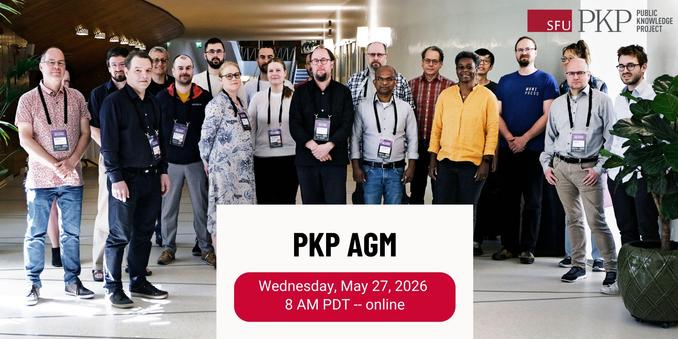
🙌 PKP invites you to join its AGM, Wednesday, May 27, 8 AM PDT

Learn about what PKP has been doing as well as what the future holds: https://pkp.sfu.ca/2026/02/19/pkp-2026-agm-registration/

#OpenJournalSystems #OpenMonographPress #OpenPreprintSystems

You are Invited to PKP's 2026 Annual General Meeting - Public Knowledge Project

Registration is open for the 2026 PKP AGM! Discover the latest in PKP community-driven achievements, connect, and share with us.

Public Knowledge Project

It’s time to sprint!

🚀 The PKP Sprint will take place on May 18 and 19, 2026, alongside the OPERAS and SCIROS conference in Warsaw, Poland!

Sprints are key events bringing together PKP with global communities to advance #OpenJournalSystems, #OpenMonographPress and #OpenPreprintSystems.

We look forward to connecting in person once again. Spots are limited!

Please check PKP’s News Blog for details plus registration page:

https://pkp.sfu.ca/2026/03/06/register-for-pkp-warsaw-sprint-2026/

#FOSS #OpenAccess #OpenInfrastructure

You are invited: Register for the PKP Warsaw Sprint 2026 - Public Knowledge Project

You are invited! Join us in person in Warsaw, Poland, for the next PKP Sprint happening May 18 - 19, 2026. Check the post for registration and details.

Public Knowledge Project
🪩Making OA journals visible: How your journal can shine with OJS Diamond plugins
🪩Martina Dvořáková, editor at Masaryk University Press, introduces the #DiamondOA plugins @PublicKnowledgeProject
#DOAJ #OpenAccess #indexing
🪩 https://blog.doaj.org/2026/03/10/making-open-access-journals-visible-how-your-journal-can-shine-with-ojs-diamond-plugins/

Vous étudiez le système de la communication savante, la diffusion de la #recherche ou vous avez un projet de recherche qui applique des méthodes des #HumanitésNumériques ?

Appliquez aux bourses #CoalitionPublica avant le 19 avril 2026 23h59 HP !

Pour en savoir plus et postuler : https://www.coalition-publi.ca/fr/appel-bourses-recherche-2026/

Appel Ă  candidatures : Bourses de recherche Coalition Publica 2026

Coalition Publica se réjouit d'offrir des bourses de recherche aux étudiant·e·s à la maîtrise et au doctorat qui s'intéressent aux méthodes des humanités numériques ou l'étude de l'écosystème de la publication savante.

Coalition publica

Are you studying #ScholComm, #research dissemination or doing a research project in #DigitalHumanities in Canada?

#CoalitionPublica, an #Erudit + PKP project, is accepting #scholarship applications until April 19 2026, at 11:59 PM PT!

Learn more and apply: https://www.coalition-publi.ca/scholarship-program-call-for-applications-2026/

#Canada #CanadaResearch #CanadaScholComm #OpenAccess #HSS #AcademicChatter

Call for Applications: Coalition Publica Scholarship Program 2026

Coalition Publica is proud to offer research scholarships to students at the Masters and PhD levels interested in applying digital humanities methods or studying the scholarly communication ecosystem.

Coalition publica

📣 PKP announces Max Planck Society support for 2026 - 2028 @maxplanckgesellschaft

"... the MPDL has been a prominent advocate for global transition to #OpenAccess, consistently promoting sustainable approaches to #ScholarlyPublishing that prioritize public value and strengthen researchers’ ability to share and advance knowledge."

Thank you Max Planck for leading by example, and for investing in #OpenInfrastructure!

Learn more: https://pkp.sfu.ca/2026/01/27/max-planck-support-agreement/

Public Knowledge Project Announces Multi-Year Support from the Max Planck Society for 2026 to 2028 - Public Knowledge Project

PKP announces new agreement with Max Planck Digital Library, supporting free, open-source, community-led scholarly infrastructure today.

Public Knowledge Project
In dem @PublicKnowledgeProject Development News Webinar am 23.02.2026 wurden neue Entwicklungen rund um OJS als wissenschaftliche Publikationsumgebung vorgestellt. Unter anderem war auch der neue Body Text Editor ein Thema, welcher von Frederik Eichler von OS-APS / SciFlow als Gastreferent vorgestellt wurde.
Das Webinar wurde aufgezeichnet und ist hier abspielbar: https://www.youtube.com/watch?v=3FAIVkQRmDk. #OA

Leading by example — Sikt of Norway (Norwegian Agency for Shared Services in Education and Research) joins growing global consortia supporting PKP #OpenInfrastructure for #ScholarlyPublishing

PKP extends a huge thank you to 6 institutions in #Norway that have now become Members through PKP’s financial contribution pathway!

#Norge #Forskning #Utdanning #Sustainability #VitenskapeligPublisering #SustainOpen

Learn more about the stories behind these contributions: https://pkp.sfu.ca/2026/01/27/sikt-support-member/

Sikt of Norway Joins a Growing List of Global Consortia Supporting the Public Knowledge Project - Public Knowledge Project

The Public Knowledge Project is pleased to announce Sikt’s support. Recognizing PKP’s impact and strong use in Norway, six institutions have joined as Members

Public Knowledge Project