Marcus Herrmann

43 Followers
63 Following
22 Posts

Statistical seismologist in 🇪🇺.

Analyzing #earthquake #data with #statistics, #brain, and #colleagues in #international projects—to advance #earthquake #forecast-ing.

Projects:
• CSEP (https://cseptesting.org)
• RISE (https://rise-eu.org)

About me:
◦ Curious about all things related to science/research (from the human genome to climate change to distant neutron stars)
◦ Proponent of Open and Citizen Science
◦ Contributing to various BOINC projects (https://boinc.berkeley.edu)

ORCiDhttps://orcid.org/0000-0002-2342-1970
Gitlabhttps://gitlab.com/marcus.herrmann
Research grouphttp://www.distar.unina.it/en/research-macroarea-4/earthquake-forecasting-and-seismic-hazard
In brief🤔📖🤓💻👨‍🎓🌍🪴

RE: https://neuromatch.social/@MolemanPeter/115592889343024406

What really makes me wonder is the fact that many people are not even reading what the chatbot generates. It's not that AI is a tool used for brainstorming or improvement, but just a shortcut to cheat. I'm unsure whether the solution is to ban it completely or to better regulate its use in academia.
One thing that could certainly help is standardized rules among academic institutions, but right now we are seeing different policies here and there.

(... And I guess this is only the tip of the iceberg of the more general crisis affecting education)

#ethics #academia #education #generativeAI

@lbky

Actual paper (paywalled):
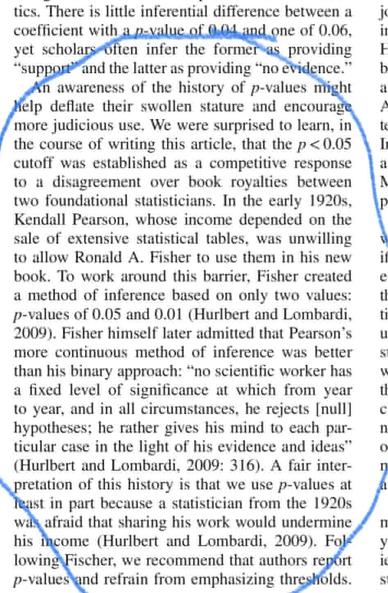
Goldfarb, B. and King, A.A. (2016), Scientific apophenia in strategic management research: Significance tests & mistaken inference. Strategic Management Journal, 37(1), 167-176. https://doi.org/10.1002/smj.2459

Same work published already earlier (free access):
Goldfarb, B.D. and King, A.A. (2014). Scientific Apophenia in Strategic Management Research. SSRN - Robert H. Smith School Research Paper. http://dx.doi.org/10.2139/ssrn.2337682

@paninid

This is our fifth analysis demonstrating that earthquake precursor behavior proposed in the scientific literature does not exist. Our scientific paper analyses are free to read, forever. Comments can be left either on our post or on PubPeer.

If you think this kind of investigative scientific analysis is important, consider supporting our work by becoming a paid subscriber to our blog.

We are independent scientists (not paid employees) and rely on community support.

I guess the takeaway from the xz backdoor situation is:

If you’re an open-source project maintainer, and somebody starts getting on your case for not doing enough free work for them, you reply “big Jia Tan energy there” and then block them forever.

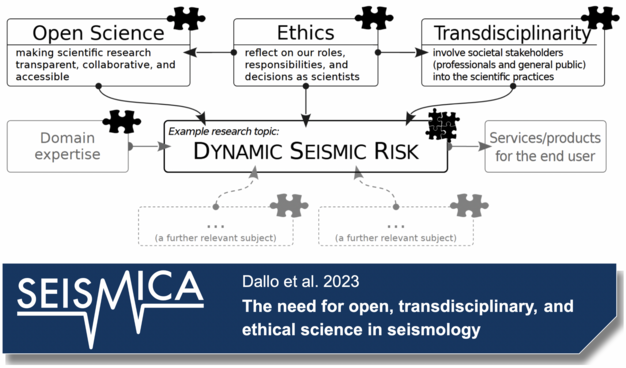
How can we foster the link between scientific knowledge and societal action?

In this opinion piece, Dallo et al. demonstrate how open, transdisciplinary, and ethical science is needed to facilitate it and increase our resilience to disasters.

Read more: https://doi.org/10.26443/seismica.v2i2.470

#Seismology #EarthquakeScience #DiamondOpenAccess #Earthquake #OpenAccess #OpenScience #resilience #scienceandsociety

@Marcus

The need for open, transdisciplinary, and ethical science in seismology

Reducing the seismic risk for societies requires a bridge between scientific knowledge and societal actions. In recent years, three subjects that facilitate this connection gained growing importance: open science, transdisciplinarity, and ethics. We outline their relevance in general and specifically at the example of `'dynamic seismic risk' as explored in a dedicated workshop. We argue that these reflections can be transferred to other research fields for improving their practical and societal relevance. We provide recommendations for scientists at all levels to make science more open, transdisciplinary, and ethical. Only with a transition can we, as scientists, address current societal challenges and increase societies' resilience to disasters.

Seismica

📢 Paper alert:
"Maximizing the forecasting skill of an ensemble model"
https://academic.oup.com/gji/article/234/1/73/6994524
#doi: 10.1093/gji/ggad020

An #ensemble model combines a set of (#probabilistic) #forecasts. To obtain model weights that maximize its skill, we use multivariate #LogisticRegression. This ensemble strategy is superior to weighting forecasts equally or according to their individual skill – as demonstrated for operational #earthquake #forecasting in Italy (15 years of data).

#seismology #NaturalHazard

Maximizing the forecasting skill of an ensemble model

SUMMARY. An ensemble model integrates forecasts of different models (or different parametrizations of the same model) into one single ensemble forecast. This pr

OUP Academic

To all Bachelor students in Geophysics/Geology/Geochemistry (and related fields) out there looking for a #Master course: The University of Naples 'Federico II' (Italy) and the INGV have launched one for #Volcanolgy 🌋🎓.

Read more about the why, what, and how:
https://www.nature.com/articles/d43978-023-00015-w

See also: 🐦🔗 https://twtter.com/WarnerMarzocchi/status/1617241354224164864

A significant site for an active interest in volcanoes

New course in Naples aims to prepare a new generation of experts in volcanic risk, and is open to international students.

@nishtha_srivastava
I have no experience with the #MagnitudeFrequencyDistribution of the #BodyWaveMagnitude. But if you want to get a #bvalue that is consistent with other studies and physically meaningful, then you should convert to #MomentMagnitude (Mw), yes.
See also:
https://doi.org/10.1785/0220200337, where we found inconsistencies among the different magnitude types in high-res catalogs. The simplest remedy is to estimate Mw for every #earthquake, as it scales consistently across all event sizes.
Inconsistencies and Lurking Pitfalls in the Magnitude–Frequency Distribution of High‐Resolution Earthquake Catalogs | Seismological Research Letters | GeoScienceWorld