Rock Friction Research Reframes Earthquake Mechanics
Scientists are studying how rock bonds break to understand earthquakes better. This new research affects how we predict and prepare for seismic events.
#EarthquakeScience, #RockMechanics, #FaultLines, #Seismology, #Geology
https://newsletter.tf/rock-friction-research-changes-earthquake-understanding/
New research shows that the breaking of bonds between rocks, not just rubbing, is key to how earthquakes start. This is a new way to look at fault lines.
#EarthquakeScience, #RockMechanics, #FaultLines, #Seismology, #Geology
https://newsletter.tf/rock-friction-research-changes-earthquake-understanding/

New Rock Friction Research Changes How We Understand Earthquakes
Scientists are studying how rock bonds break to understand earthquakes better. This new research affects how we predict and prepare for seismic events.
🌋🌊📉 Beneath Japan lurks the Kumano Pluton, a mountain of frozen magma bending the crust and steering megaquakes to its flanks. Quakes in ’44 and ’46 proved its pull. Now mapped in 3D, this buried giant may be the key to predicting the next killer tremor.
#EarthquakeScience https://www.sciencealert.com/a-mountain-sized-rock-beneath-japan-could-be-a-magnet-for-earthquakes
Mountain-Sized Rock Hidden Underneath Japan Could Be a Magnet For Megaquakes
A mountain-sized mass of igneous rock beneath the coast of southern Japan could be acting as a sort of magnet or lightning rod for huge earthquakes.
A research from 2023 reveals how large-N infrasound arrays and advanced CLEAN beamforming can detect seismic ground shaking remotely via atmospheric sound waves 🌍🔊. This method enhances earthquake monitoring and hazard assessment over wide areas. Read more:
https://www.nature.com/articles/s43247-023-01058-z #Seismology #EarthquakeScience #Infrasound
Remotely imaging seismic ground shaking via large-N infrasound beamforming - Communications Earth & Environment
Seismic activity can be detected tens to hundreds of kilometers away using an infrasound beamforming technique that overcomes interference in wave analysis and can enhance remote earthquake monitoring and real-time hazard assessment.
🌍🔊 Earthquakes create infrasonic booms—low-frequency vibrations the Earth’s surface sends into the air like a giant speaker! These infrasounds can help quickly assess quake damage and distinguish natural quakes from underground explosions. Fascinating science below human hearing! 👂🌐
#EarthquakeScience #Infrasound #Geophysics https://www.livescience.com/24209-earthquakes-infrasound.html
How Earthquakes Make the Ground Go Boom
Earthquake waves make the earth's surface vibrate like a speaker, producing low-frequency sound in the atmosphere, a study finds.
A study from 2021reveals how infrasound sensors in Japan detect earthquake signals, including unique oceanic coupling via T-phase waves 🌊🌍. Advances in monitoring could enhance early warning systems and seismic research. Dive deeper:
https://pmc.ncbi.nlm.nih.gov/articles/PMC7866150/ #EarthquakeScience #Infrasound #Japan #Seismology
Infrasonic Earthquake Detectability Investigated in Southern Part of Japan, 2019
The Kochi University of Technology (KUT) Infrasound Sensor Network contains 30 infrasound sensors which are distributed all over Japan especially in Shikoku Island. At all infrasound stations installed with three-axis accelerometers to measure the ...
Discover how fault geometry shaped the 2024 Noto earthquake's impact, paving the way for improved seismic hazard assessments. #EarthquakeScience #SeismicResearch #DisasterPreparedness
https://geekoo.news/cracking-the-code-of-earths-movements/

Cracking the Code of Earth's Movements | Geekoo
A groundbreaking study by the University of Tokyo reveals how the complex geometry of fault lines influenced the devastating 2024 Noto Peninsula earthquake, offering new insights into earthquake dynamics and future hazard assessments.
Mid-crustal depth earthquakes in Cochabamba-Bolivia?
Yes, Fernandez et al. provide valuable insights into these earthquakes and show how they are concentrated in the main thrust fault shear zone.
Read now: https://doi.org/10.26443/seismica.v4i1.1380
#Bolivia #Seismology #EarthquakeScience #peerreviewed #DiamondOpenAccess #Earthquake #OpenAccess #OpenScience
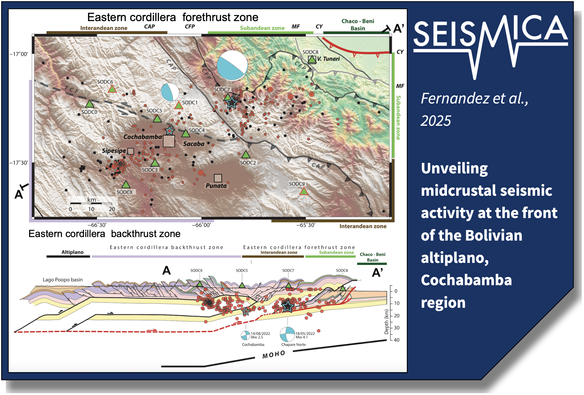

Unveiling midcrustal seismic activity at the front of the Bolivian altiplano, Cochabamba region
Located in the heart of the Bolivian orocline, the Cochabamba department and its two million inhabitants are exposed to frequent seismic activity. However, the tectonic structures causing these earthquakes remain poorly identified. Indeed, Bolivia’s national seismological network does not optimally cover the area and the hypocentral locations of local earthquakes are therefore subject to large uncertainties which hinder their association with specific faults. We established a regional network consisting of 11 broadband and short-period seismic stations, spaced approximately 20 km apart. This study highlights the initial 6-month seismic bulletin made by manual and automated deep-neural-network based seismic phase picking. We also test the network's ability to resolve focal mechanisms of moderate to small events with a combined inversion of waveforms and polarities. Our preliminary results document midcrustal microseismicity located in the Main Thrust fault shear zone, and in its hangingwall, in a region affected by tectonic slivers and transverse faults impacting the sedimentary cover. These outcomes provide fresh insights into the fault system’s seismogenic behavior and potential across the Bolivian orocline.
Bolton et al. show that static stresses induced from a nearby ML 4.0 foreshock significantly perturbed the local stress state and could have triggered the 2020 Mentone Mw 4.8 earthquake in West Texas.
https://doi.org/10.26443/seismica.v3i2.1420
#Texas #mentone #Seismology #EarthquakeScience #peerreviewed #DiamondOpenAccess #Earthquake #OpenAccess #OpenScience
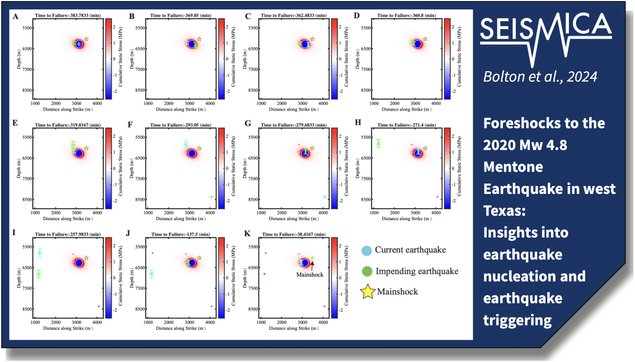
Foreshocks, aftershocks, and static stress triggering of the 2020 Mw 4.8 Mentone Earthquake in west Texas
Foreshocks are the most obvious signature of the earthquake nucleation stage and could, in principle, forewarn of an impending earthquake. However, foreshocks are only sometimes observed, and we have a limited understanding of the physics that controls their occurrence. In this work, we use high-resolution earthquake catalogs and estimates of source properties to understand the spatiotemporal evolution of a sequence of 11 foreshocks that occurred ~ 6.5 hours before the 2020 Mw 4.8 Mentone earthquake in west Texas. Elevated pore-pressure and poroelastic stressing from subsurface fluid injection from oil-gas operations is often invoked to explain seismicity in west Texas and the surrounding region. However, here we show that static stresses induced from the initial ML 4.0 foreshock significantly perturbed the local shear stress along the fault and could have triggered the Mentone mainshock. The majority (9/11) of the earthquakes leading up to the Mentone mainshock nucleated in areas where the static shear stresses were increased from the initial ML 4.0 foreshock. The spatiotemporal properties of the 11 earthquakes that preceded the mainshock cannot easily be explained in the context of a preslip or cascade nucleation model. We show that at least 6/11 events are better classified as aftershocks of the initial ML 4.0. Together, our results suggest that a combination of physical mechanisms contributed to the occurrence of the 11 earthquakes that preceded the mainshock, including static-stressing from earthquake-earthquake interactions, aseismic creep, and stress perturbations induced from fluid injection. Our work highlights the role of earthquake-earthquake triggering in induced earthquake sequences, and suggests that such triggering could help sustain seismic activity following initial stressing perturbations from fluid injection.
What are reliable earthquake magnitudes?
Dahm et al.'s method uses synthetic seismogram peak-values to calculate moment magnitudes of microearthquakes—essential for studying shallow, human-induced seismicity:
https://doi.org/10.26443/seismica.v3i2.1205
#Seismology #EarthquakeScience #peerreviewed #DiamondOpenAccess #Earthquake #OpenAccess #OpenScience
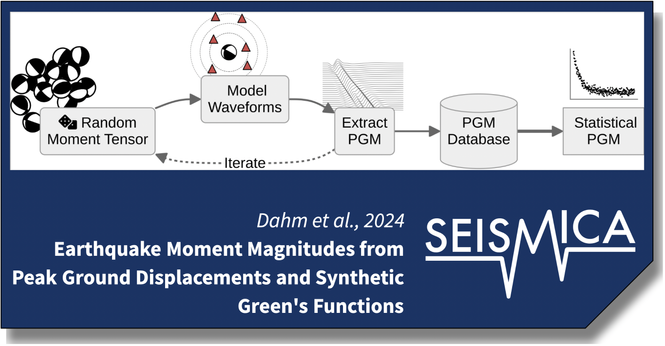
Earthquake Moment Magnitudes from Peak Ground Displacements and Synthetic Green's Functions
We suggest an approach employing full waveforms from synthetic seismograms to estimate moment magnitudes and their uncertainties from peak amplitudes. The new method is theoretically derived. It does not change the established routines of traditional procedures for magnitude determination, while overcoming some of the limitations such as saturation, scattering and source complexity. Attenuation functions are derived on-the-fly for each source-station combination from synthetic seismograms using Green's function databases representing various velocity models if required. In a bootstrap approach, source depth, geometry, dynamic and kinematic parameters are randomly selected within a realistic range. After calibration with observations, attenuation functions can be extrapolated to distances, depths, regions and magnitudes for which no observations exist. Additionally, individual frequency filters and sensor types can be mixed independently of any definition of traditional magnitude scales. Uncertainties of attenuation functions are estimated for every source-station geometry including the sensor characteristics and its potential frequency saturation. Therefore, realistic uncertainties of mean magnitudes can be estimated even in case of only few measurements. The method is especially useful to estimate local and moment magnitudes for temporary deployments or for monitoring induced seismicity in regions with only few tectonic events.
 NewsletterTF
 𝕯𝖔𝖔𝖒𝖘𝖈𝖗𝖔𝖑𝖑™
 🐦🔥nemo™🐦⬛ 🇺🇦🍉
 Geekoo
 WeAreSeismica