| Research | Icy moons, planetary formation and evolution, geophysics |
| Hobbies | Weightlifting, football, boxing, cooking |
| Other socials | Twitter (@IcyMoonsKevin), Instagram (@ktrinh20) |
| Website | https://ktrinh20.github.io |

| Research | Icy moons, planetary formation and evolution, geophysics |
| Hobbies | Weightlifting, football, boxing, cooking |
| Other socials | Twitter (@IcyMoonsKevin), Instagram (@ktrinh20) |
| Website | https://ktrinh20.github.io |
#Fediverse at #AGU22 List so far:
@asrivkin
@coralsncaves
@bjenquist
@prehistormic
@weiji14
@javedali
@GearsLaboratory
@LaMontagneLab
@paulstoy
@celestelabedz
@Sandra_Passchier
@BryhtSky
@tilvi
@N_pavlovic
@PlasmaNerd
@wmhammond
@YoFukushima
@Colleen_Iversen
@saragoeking
@LadiesOfLandsat
@tylere
@kratzert
@IcyMoonsKevin
@geoprofmathews
@repepo
@AriFeinberg
@GeoBioMaggie
@Kaukapakapa_Kid
@simonjgoring
@chrys
@ANZIC
@WoodEcology
@dustsquared
@JoshMend
This is important because Europa's interior evolution affects the seafloor environment. Does Europa have a basaltic seafloor with hydrothermal vents and volcanism? Or is the seafloor cool, hydrated, and chemically inactive? The former is better for life as we know it.
My talk will kickoff an exciting interdisciplinary session on ice and ocean worlds, happening in McCormick Place - S403b at 9 AM. Hope to see you there!
https://agu.confex.com/agu/fm22/meetingapp.cgi/Session/174350
This annual, exciting interdisciplinary session brings together studies of icy and ocean worlds in our own solar system (Earth, Europa, Enceladus, Titan, Ganymede, Triton, frozen dwarf planets like Pluto!) and possibilities in extra-solar systems! We want to understand processes that may be occurring within such worlds from a multi-/inter-disciplinary perspective. What geological, geochemical and/or oceanographic processes might contribute to the evolution of such bodies? The habitability of these icy worlds can be assessed through geophysical measurements of their interior temperatures and compositions. How might current studies relate to, or be tested by, past/ongoing/upcoming missions? We seek to bridge Earth and planetary sciences to enable a mix of ideas and expertise from Mercury to Pluto and all in between. We encourage contributions on any topic relating to the icy/ocean world theme, including geophysics, geodynamic modeling, seismic waveform modeling/inversion, hydrogeology, geochemistry, microbiology, in-situ/remote sensing observations, theoretical/modeling/laboratory work, analog field investigations, and more.
Europa is famously known as an ocean world, but over 90% of the moon's mass comes from rock and metal! To understand Europa's habitable potential, we must understand how the rock-metal interior changed over geologic timescales.
Europa has only ~100x less mass than Earth. Such a small body probably cannot form a metallic core off accretional heat alone. Instead, it's reasonable to speculate Europa's initial state (after accretion) to be a cold mixture of hydrated silicates and metal.
#Welcome everyone! A few tips:
- Yes, servers can be temporarily slow when lots of people join at once. Be kind to your admins, they're working hard and it's worth the wait.
- Fill in your bio!
- Hashtags are your friends. Use them to give more visibility to your posts and to find new people to follow. You can even follow hashtags.
- Boost, boost, boost! There's no algorithm here deciding who sees what.
No idea how I'll use Mastodon quite yet but figured it's time for another #introduction since lots more people are showing up over here.
So hi, hello. I'm Stephanie, a planetary scientist turned full-time science communicator creating digital content for @VRubinObs.
What a fun time to be a social media specialist, amirite??
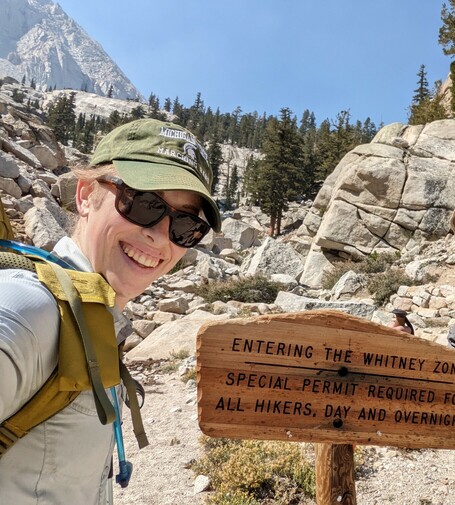
Anyway, I talk a lot about #space #astronomy, as well as #scicomm more generally, and can usually be found #hiking a mountain somewhere. Glad to have ya here! #Astrodon