Arthur Ionescu

@ArthurI
163 Followers
1.3K Following
21 Posts
@jlou So to make it simple, think about yout brain scan argumen since it is the same underlying idea; it is always possible to conceptualize a way to know what somebody means if he is causally related to the world. Which means there is always a way to arrive to a paradox under consequentialism.

@jlou I find your argument about brain scan very interesting; I hadn't thought of that.

What I meant was that, yes, the character of the trickster could theoretically be changed if the judge decided to lie. In the article, I explained that trying to counter undecidable cases by adding them to the theory doesn't prevent the paradox from applying. Trying to make the agent lie for the sake of consistency is like trying to include undecidable cases in the premises of the theory: it doesn't work.

@jlou Hello, if we accept that the Judging Agent can lie, then we must accept that they are somehow altering their language. Indeed, by saying "I am moral" to mean "I am immoral" and thus remain consistent, they are simply swapping the meaning of these words according to their own interpretation. But regardless of the language modification, the paradox persists; they would then have to swap it again, and so on, since the trickster can also theoretically have another understanding.

A moral philosophy paper recently written by me, presenting a new liar paradox-like argument about contradictions within consequentialism:

https://philpapers.org/rec/IONCJP

#philosophy #ethic #consequentialism #deontology #metaethics #morality #paradox #research

@jlou So you are right when you say that we should find less paradoxical theories since I don't want my argument to be seen as a motion only toward more contradictions.

It is more complicated, since the completeness depends on the state of material and knowledge progress.

Indeed, a consequentialist in a world with only the slingshot as a weapon and a consequentialist in a world with the atomic bomb do not contradict themselves the same way.

As I stated in my paper with the germs example.

@jlou I think the incompleteness of consequentialism is to be seen a sort of motor driving human systems evolution; each system has contradictions, thus each system has in itself the seed for its own overcoming (similar to Marx).

@jlou So It is like there is a certain "amount" of consequentialism/expressiveness in each theory assessed by its inclination towards self-contradiction

I think the attitude towards paradoxes in this case are also cultural, indeed it is impossible to have a 100% paradox free theory.

However, in the west we try at all cost to avoid them. But in eastern traditions such as Taoism, they try to embrace paradoxes as a fundamental component of the universe.

@jlou I think you understood my argument pretty well.

My resolution implies a sort of middle way between deontology and consequentialism.

We can imagine that there is no clear border between the two but rather a spectrum.

For ex take the rule: "your actions should never cause the death of someone" is this rule deontological or consequentialist ? Pretty hard to tell.

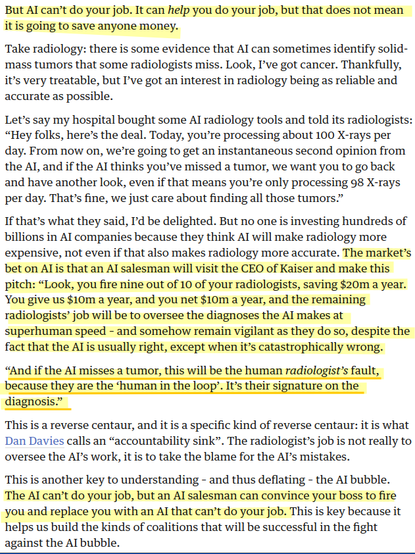
Lecture indispensable : le toujours excellent Cory Doctorow aka @pluralistic dans son article récent du Gardian
https://www.theguardian.com/us-news/ng-interactive/2026/jan/18/tech-ai-bubble-burst-reverse-centaur

C'est sans doute le point essentiel pour comprendre le cauchemar vers lequel tout le délire ai nous entraîne :
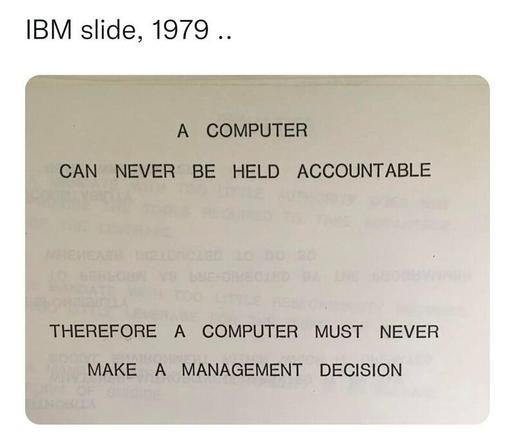
Le capitalisme nous vends des machines qui doivent nous assister. Mais ce sont les humains qui vont devenir les assistants des machines. Et qui recevront le blâme en cas d'erreur.

#ia #ai
#NightmareOnLLMStreet
#noai
#Capitalism

@microglyphics Hi, thank you for your time, I am very pleased to see people read and react to my mork.

I agree with you, in fact this potential counter argument is the thing I hesited the most to include in the paper. The paradox seems to take place for every system attributing predicates in function of future consequences.

However I think that consequentialism is the best example of framework able to do that. The only other examples I can think about are also within consequentialist ethics.