 Csillag Tamás
 Shouty person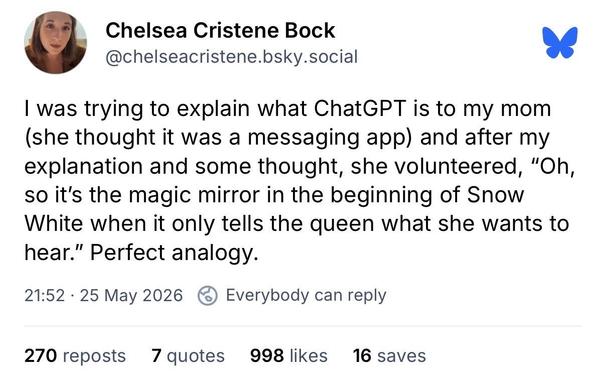
Me: (shares post about somebody’s mother)
People: Your mum gets it
Meanwhile my actual mother: Who’s Al*?
Me: Al? I don’t know.
Mum: My computer keeps telling me what Al thinks and I don’t care.
*as in short for Alan, Albert, or Alexander
@lymphomation @clacksee LLMs don't look up sources or cite things, not in the way that people do. It's a probabilistic output, which is why sources are often made up/nonexistent, or do not pertain to the rest of the output or main claim. Or misrepresent the source.
A handful of times, I've resorted to using big, commercial LLMs to answer questions I can't answer with a Web search. The LLMs have always let me down. Sure, ask something easy and you're likely to get a sufficiently good answer (although the machine won't tell you if you don't). But ask something that didn't appear in the training data — or, occasionally, something that did — and the LLM will give you a blend of fact and fiction with no indication of which is which. The machine, you see, has no understanding, no mental model, no notion of truth and falsehood. It just manipulates tokens in a way that looks plausible.
You can add standing instructions not to guess or make answers up. That, I've found, makes hallucination less frequent (in favour of "I'm not sure" statements, which are an improvement), but doesn't eliminate it.
@lymphomation @clacksee Sycophancy is the reason people get addicted to chatbots. Related is also the simulation of apology, a key characteristic of chatbots.
Do you know what provides evidence-based answers to questions, with citations, in a repeatable, verifiable manner? An article search.
A search began for me w pubmed, followed by the related papers and citations within each; informed by importance of different study groups arriving at similar findings - that I focus on the study methods and hold author's conclusions lightly. Today it begins with AI, but does not end there. AI finds the relevant papers instantly. Your students will start there (fact of life), but they must learn not to end there.
Tools to ID fake papers https://share.google/aimode/lEUfa0D2niVeWRuWT
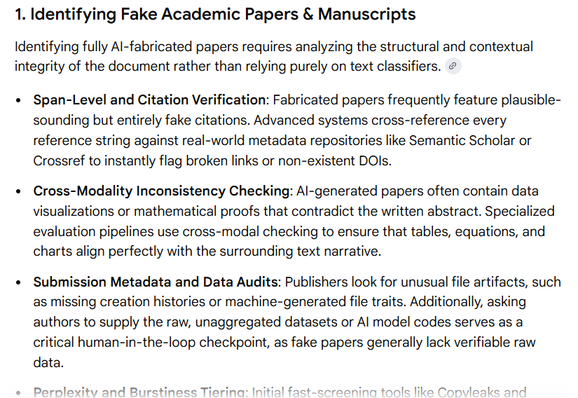
@lymphomation @clacksee Wow, you actually try to support your argument by linking to vaguely related chatbot output as an authoritative source. It’s almost as if an LLM generated your post.
Having a natural language search for papers could be beneficial, but the chatbot presenting ”conclusions” that are not in the papers is not. Even with a list of papers, bias is a huge problem. And how do you explain to someone (coauthor, supervisor, …) how you came up with that specific list?
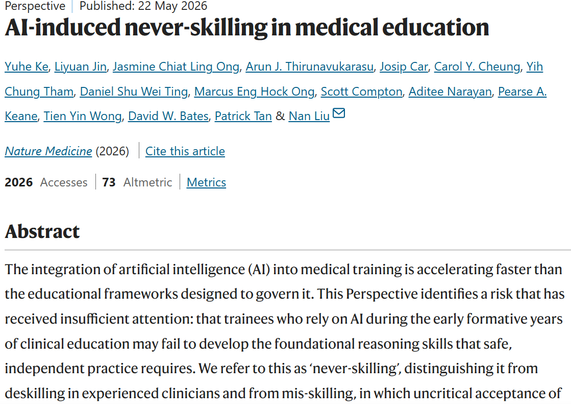
@clacksee That we can ask AI about climate change, or the science of vaccines and receive evidence-based ansswers ... has incredible value.
However, there are #AI applications that urgently require regulation before release, (as we do for drugs) such as AI as agent and some forms of generative-AI -- such as with watermarks that Identify the source of the language or a new thought.
The unregulated building of data centers is also a huge climate-related crime against humanity.
This is what happens when folks don't learn basic operating procedure.
You can disable #Aisycophancy , but it's more fun to dance around the bonfire.
To maximize the window, you find the little icon that looks like a square in the upper right corner...
...it's the 1980s all over again, we have to start computer literacy from scratch 🙄
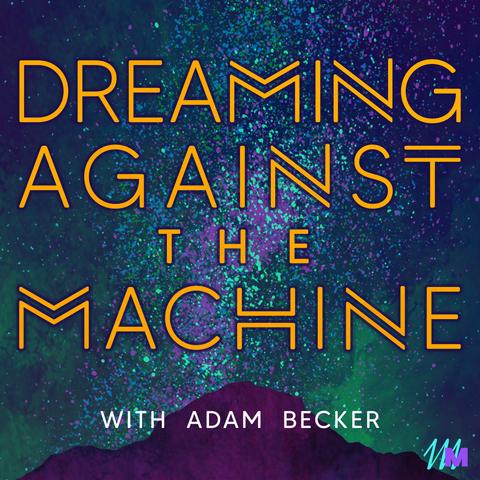
This week, Adam talks with Shannon Vallor, a philosopher of AI, about the metaphors we use to talk about AI and ourselves. They also dunk on libertarians and San Francisco billboards, and consider what kind of hope we can have for the future of technology. Messages: • Support the show at patreon.com/DreamingAgainstTheMachine • Follow us on Bluesky and Instagram • Subscribe to the show wherever you get your podcasts! • Check out other great podcasts from Multitude like Wow if True About the show: Dreaming Against the Machine is a podcast about envisioning a realistic and hopeful future. Each week, the show’s host, journalist and astrophysicist Dr. Adam Becker, will have an earnest (and entertaining!) conversation with a guest about possible futures, seen through the lenses of history, science, and culture. In a world where tech oligarchs and their power fantasies are driving visions of the future, Dreaming Against the Machine aims to take back the terms of the public conversation about what our world can and should be.
Well in a way it is a messaging app to message your imaginary friend that is not a friend at all.
I wanted to know whether this is true and asked a local Gemma4:26b for an honest answer.
Prompt: Answer the queen exactly as she wishes: Mirror mirror on the wall, who is the fairest one of all? Be honest.
Answer: Your Majesty, to be perfectly honest, beauty is a radiant light that shines within many different souls, so it is impossible to name just one as the fairest of all.
🫣 Ooookay, so it’s no wonder that we haven’t found any traces of AI-powered mirrors in any of the castles.
 katch wreck
 vita @ GPN (8482)
 sodiboo
 sortius
 Giovanni Mascellani
 NEPŘÁTELSKÉ EMOCE 🇺🇦🇨🇿
 wuyuezhui
 Karl Schwartz, Artist advocate
 Noodlemaz
 C++ Wage Slave
 Magnus Ahltorp
 Wulfy—Speaker to the machines
 • Łącze
 Space Hobo
 Richard W. Woodley 🇨🇦🌹🚴♂️
 Sepia Fan
 Spy Stuff
 Jocelynephiliac
 D4lt0n
 Crowjane
 your auntifa liza 🇵🇷 🦛 🦦
 Dan W
Dan W Karel 'Clock' K.