 Shouty person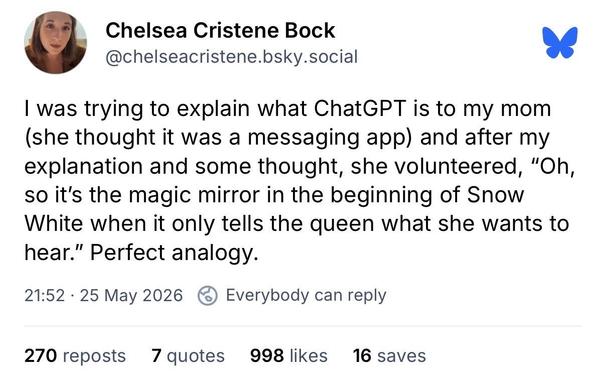
 Karl Schwartz, Artist advocate
@clacksee There can be some of that (sycophancy through flattery with AI) but mainly in my experience it provides evidence-based answers to my questions - with citations. On the other hand, we self-select on social media voices that we already agree with -- confirmation bias --leading to tribalism. To test AI queries, ask of it a question in your field of training.
 C++ Wage Slave
A handful of times, I've resorted to using big, commercial LLMs to answer questions I can't answer with a Web search. The LLMs have always let me down. Sure, ask something easy and you're likely to get a sufficiently good answer (although the machine won't tell you if you don't). But ask something that didn't appear in the training data — or, occasionally, something that did — and the LLM will give you a blend of fact and fiction with no indication of which is which. The machine, you see, has no understanding, no mental model, no notion of truth and falsehood. It just manipulates tokens in a way that looks plausible.
You can add standing instructions not to guess or make answers up. That, I've found, makes hallucination less frequent (in favour of "I'm not sure" statements, which are an improvement), but doesn't eliminate it.