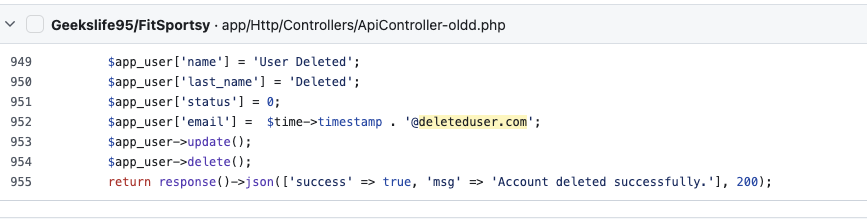
i was quite surprised to discover that no one had registered deleteduser [dot] com, and was curious to see how many emails i'd get if i registered it, assuming many orgs 'delete' logic probably just overwrote the email address with [email protected] or similar.

The answer, is at least 3 different orgs in the hour that I've owned that domain and been listening for email.

And yes, all of those emails contain the actual PII of the person who has been 'deleted' :-D

#infosec

Up to about 24 different orgs now, overnight had some emails containing PII of 'deleted' users from a:

UAE based Gym Chain
South African HR Platform
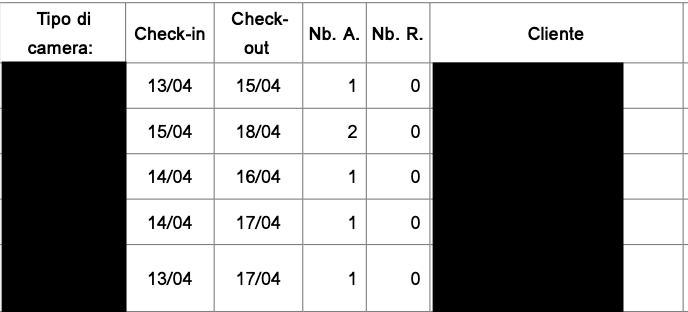
EU based Hotel Reservations Platform
India based Delivery Service

and best of all

US based Antivirus Manufacturer and Cybersecurity Provider

And of course the hotel reservations platform is happily spitting out the name of guests and their contact info to the Deleted User email address
Deleteduser.com —a $15 PII Magnet

When is a delete, not a delete? When it’s an publicly routable placeholder.

Medium
Thursday must be PHI day - a platform that appears to be used by care workers and psychologists is happily sending patient names and details to deleteduser dot com.

Couple of new additions today to the internet dumpster:

- Some internal system at one of the worlds largest and most recognizable consumer electronics manufacturer is telling deleteduser.com all about approved purchase orders, including direct links to the orders, and the names of all the people who are involved.

- More gyms, very common.

- Some platform used to offer temporary shifts to healthcare workers asked a nurse at deleteduser.com if they were available to urgently cover a shift at a South African healthcare facility.

Side note, if you want to see how common of a pattern this is, and I can't believe I didn't think of this earlier, go search Github.com for 'deleteduser.com', lots of examples of delete functions from apps there that do this type of thing.

I added 5 variations on this domain (not going to say what they are just yet to not interfere with the results) and in the first 20 minutes I have 3 more orgs all sending PII to these addresses for now deleted users.

Includes a managed IT services provider in Malaysia's ticketing system which includes the full content of the ticket - system names, IP's etc.

Rather ironically a platform that helps companies "hire the world’s top remote talent without the search" is now on the list
yeah so i registered internaluser.com and wow
oh noe - one of those places what sell knock off viagra does this

Haven’t done this because I’m an ethical sausage, but I do wonder - how many of these sites would happily send a password reset link to [email protected], and after resetting the password, how much order history/other PII and the like would be there?

I’d guess between 98-100% of them.

ok, curiosity won and I tried it on a couple

yes, they all willingly sent the password reset link to the domain

yes, they let me reset the password

no, they didn’t have mfa

yes, they let me log in to the “deleted” accounts

yes, i saw order histories, names, dob’s, last four of credit cards

yes, i disclosed to the security contacts i could find at the companies

yes, one of them was the viagra place

In one of the more ironic welcomes to the internet dumpster, an EU-based Bug Bounty program provider apparently uses a publicly routable placeholder domain for it's "deleted" users email addresses.

one org got back to me and said, 'yeah we effed up - and are fixing'

I was thinking of that scene in the bart falls down the well episode of the simpsons where at the end they say, 'and now to make sure nobody ever falls down this well again', followed by them putting up a small sign that says 'caution: well'.

I bet they'll run something like:

UPDATE users
SET email = REPLACE(email, '@deleteduser.com', '@deleteduser2.com')
WHERE email LIKE '%@deleteduser.com';

So no one ever falls down the well again.

Another good one - a European country's licensing authority for construction workers sends an email to deleteduser.com each time an employee is added to, presumably, the "deleted" users former company.

That email includes the name, trade and license info of the person being added, alongside the PII of the "deleted" user.

Adding an EU based dating app, using deleteduser.com for their deleted user - but not appearing to delete/overwrite any of the other fields.

I guess this from their Google Play listing is technically accurate. "You may request, but what what happen is we'll update your email address."

Australia, if you thought you were immune, I have bad news:

Just got emails from some construction management app based down under.

Special shout out to their footer:

"This email has been sent to Paul of Deleted Company."

oh and yes it turns out owning internaluser.com and service-account.com is a truly incredible way to get access to notifications and logs from various corporate systems. they just email them right to ya.

sadly, serviceaccount.com is taken.

have decided to name this technique “plexfiltration”, which stands for “placeholder exfiltration”
@SecureOwl "...and this is how we managed to send the DPO to the E.R.".
@SecureOwl @Viss
So if a government violates GDPR, do they get fined 4% of GDP?

@FritzAdalis @SecureOwl @Viss It should be 4% of the global annual revenue, and given that Vatican has been violating it ever since GDPR kicked in I sincerely hope so. Sadly, the national data protection agency of my country of origin doesn't care, and I couldn't find any EU body I could actually escalate to (I checked like 5 of them).

(Yes I am aware that Vatican is not a state, just pretends to be one but many are buying into it.)

@rhelune
AFAIR in Poland there is an exception for religious orgs in our implementation of GDPR (if not generally in GDPR).

And you may now interpolate which religious org holds the most SPI.

@FritzAdalis @SecureOwl @Viss

@dzwiedziu @FritzAdalis @SecureOwl @Viss I come from a different Catholic hellhole, but yeah: https://todon.eu/@rhelune/114851927850776987
Enola Knezevic (@[email protected])

@[email protected] @[email protected] @[email protected] Regarding the religious tax, I've been trying to get erased from the records of the Roman Catholic church in Croatia ever since the GDPR kicked in. I asked Croatian data protection authority to investigate. They told me that by the Canon law (Catholic Sharia) I would have to send an "Actus defectionis ab Ecclesiae Catholicae", so I sent both the GDPR erasure request and the Actus defectionis, both notarised, to the parish and to the bishop's office, before I left the country. They received it, I have the certificates of reception, but no response. I asked the data protection authority to investigate again. No response. I asked them to confirm that they have received my complaint and they confirmed it. Asked them a year later what they had done, no response. (My lifestyle consists of multiple grounds for excommunication.) So I just said "no religion" in Germany and I am paying no church tax. I even thought about asking data protection authority in Germany to help me get erased from records in Croatia, but it seems like they let the Roman Catholic church have their own authority 😳 #datenschutz #dataProtection #catholic #church

Todon.eu

@rhelune
Hellhole buddies! ^_^

(I'm returning to mine in two weeks.)

I can only offer you anecdotes that Poles who were too skimpy to pay the church tax in DE found themselves kicked out of the RCC back at home.

@FritzAdalis @SecureOwl @Viss

@dzwiedziu @FritzAdalis @SecureOwl @Viss Oh well, I have nothing to do with Croatia anymore, but was under the impression that the Roman Catholic Church membership was global. In my Actus defectionis I mentioned never having believed in any deities which should be enough to kick me out 🤷

@SecureOwl it appears that deleted.fail is available

yes, .fail is apparently a TLD.
yes, null.fail is taken

@SecureOwl They could use deleted.example.com and be safe from this kind of attack.
@not2b or “invalid”
@revk No, example.com is special and cannot be registered by anyone. This is in the specs. That would also apply to any subdomain. AFAIK someone can register invalid.com and get all the email traffic.

@SecureOwl Fine today, but tomorrow? So I made a rule to let me know if the SEG sends out to *deleted* and similar domains.

You’d think a SEG/Microsoft/Google might, like, make this a feature. Been thinking about using @ifin and Fedi to share blatantly obvious ER/FR #s to dog pile.

And fine, I’ll include AI somewhere so they care.

@SecureOwl I didn’t think I was gonna learn a T-SQL function today, but here I am.
At least that’s something actionable to ease the existential dread and powerlessness.

@SecureOwl If you want to do this, which you shouldn't, you could just use an invalid DNS label in there.

Commonly used are labels with leading underscores.

So renaming [email protected] to foo@_deleted.bar.org would already be a huge improvement.

Not really what "deleted" means, mind you.

@SecureOwl For the sticklers: I'm aware that "invalid" labels in DNS are a complicated matter. I was trying to be brief.
@SecureOwl one of the most interesting fuck ups to read on

@SecureOwl Jesus Christ. Brilliant and depressing as fuck investigation wrapped in a bacon-flavored cluster fuck.

Do people just not know about the many top-level domains that exist that are guaranteed to not exist? I mean it's still an anti-pattern, but at least you are guaranteed THIS scenario won't bite you in the ass.

@lerxst @SecureOwl iirc, the best is example.com but I might be wrong
ds (@[email protected])

@[email protected] hmm having just read some of the relevant RFC (https://www.rfc-editor.org/rfc/rfc6761) the "example" domains are treated differently to e.g. the test domains, in that dns servers "should" try to resolve example domains normally, whereas dns servers should (unless configured otherwise) instantly return negative responses for .test domains. It probably doesn't make a difference to your use case but just an interesting point of distinction (and at the very least my guess that they would have the same behavior was wrong!)

Infosec Exchange

@matthewskelton @SecureOwl If you're not going to blank out the email field, something like "@dontdeliver.test" is probably better (the "test' TLD is IETF reserved to never be a TLD, along with a few others). Still an anti-pattern. If you're going to delete a record by a "marked delete" idea, it's best to have a field defined as such and give production a view to the tables that only show records that aren't.

example.com is actually live, though I don't believe they accept email.

@lerxst @matthewskelton @SecureOwl example.com is a valid domain, but there is no valid MX record for it, so no email delivery is possible. Pretty sure most email systems wouldn't even try for that one, so probably relatively safe even if someone poisons your DNS.
The same is not true for most other example.* addresses, so .test or . invalid are still better if you need to generate a syntactically correct email in code, but want to be sure nothing is actually delivered.
@tkissing @lerxst @matthewskelton @SecureOwl example.com looks live, but it's actually a reserved domain: www.rfc-editor.org/rfc/rfc2606.html#section-3 (together with example.net and example.org)
RFC 2606: Reserved Top Level DNS Names

@lerxst @SecureOwl
Rather than marking the user as deleted (or even better, deleting or moving to an archive table where possible) and deleting data they aren't required to keep (such as email addresses), your solution is to use a slightly less insecure version of the garbage code that caused the problem in the first place?
@leeloo @SecureOwl wow, aren’t you a bundle of joy! I said it was an anti-pattern even with that fix. Sorry I offended your architecture senses in an offhand comment.
@leeloo PS, I suggested pretty much the same thing you do in a comment further down.
@lerxst @SecureOwl
Oh, sorry, I must have skipped the anti-pattern comment.

@SecureOwl if vendor has a bug bounty, that’s cracks the door a bit. Join it.

If someone else (anon, vpn’d) triggers a pwd reset knowing only host and username, you’d be indemnified a bit more.

It feels like a notable issue, worthy of testing.

@SecureOwl if I use `.example` for dummy addresses does that guarantee the email will never be received in this way? e.g. [email protected]
@jackeric i should think so, since .example is a reserved TLD, like .test and .internal. My impression is that .example is intended for documentation and .test for testing but I should think it's the same behavior either way

@jackeric hmm having just read some of the relevant RFC (https://www.rfc-editor.org/rfc/rfc6761) the "example" domains are treated differently to e.g. the test domains, in that dns servers "should" try to resolve example domains normally, whereas dns servers should (unless configured otherwise) instantly return negative responses for .test domains.

It probably doesn't make a difference to your use case but just an interesting point of distinction (and at the very least my guess that they would have the same behavior was wrong!)

RFC 6761: Special-Use Domain Names

@jackeric @SecureOwl i think .invalid is the one intended for stuff like this
@SecureOwl that's mindblowing. You've just discovered a terrible secret that software devs have been committing. PII violations from so many orgs.
@SecureOwl after your post I immediately grep’d deleted, moved, inactive, terminated, user, account, etc for all outbound domains in my SEG. : )
@SecureOwl
Why?! How!? What‽

@RnDanger @SecureOwl Yeah that’s my question(s). Why would someone “delete” users this way? How can you not tell you’re sending craploads of mail?

Something strange is afoot at the Circle K, man.

@SecureOwl there's got to be a few variations of this that might be less obvious and still used enough to be worth investigating?
@SecureOwl the EU based companies are facing gdpr related troubles !
@Vive_Levant @SecureOwl yeah that was my first thought too, they’re potentially in for a world of pain