 Clemens
 R.L. Dane

 🍵
🍵 
Well, that's depressing. :(
https://codeberg.org/small-hack/open-slopware
List of #FOSS projects using #slop (yes, including the Linux kernel and of COURSE systemd)
Well, that's depressing. :(
https://codeberg.org/small-hack/open-slopware
List of #FOSS projects using #slop (yes, including the Linux kernel and of COURSE systemd)
Oh, good thing the repo was forked before being deleted/made inaccessible.
Everything else is unalloyed badness. The list is practically a who's who of free software. There's a lot of packages I won't be updating again ever. Fuck this noise.
I'm not as zealous as some who are putting stops on their updates.
I'll switch to forks as they become available.
I'm going to ride out this garbage the same way I rode out NFTs, CryptoScams, and various #CompSci helltrends. :/
Lord, I hate this timeline.
Yes, that's important: we must encourage people to fork. Lots of competent programmers would gladly quit their day jobs if someone paid them to maintain important software free from slop. We need nonprofits, foundations, governments even, to fund that work.
Just thinking aloud. But it bears considering.
The scale of this crap is just frightening. Sometimes I'm happy I'm old.
Linux is primarily a tool for fortune-500 companies first, and end-users like thee and me, last.
Given the fact that most Linux contributors are on a corporate payroll, no surprise.
Computing as we knew it, is dead. The future has been robbed from us.
OBI-WAN: That boy was our last hope.
YODA: No. There is another.
I mean, there's always the BSDs, Haiku, heck, the Commodore 64 is back, so anything can happen. ;)
@rl_dane Hah :) Haiku gives me some hope. They do actively resist the ai nonsense, so far,...
The c64 might be the better way to go :D
Anything that needs to be general purpose enough to work with modern hardware is always going to be disadvantaged by having to reverse engineer proprietary drivers and hardware.
There used to be enough people to somewhat keep up with that, and some shift in mentality at the manufacturer side to be a bit more reasonable with providing open drivers and/or documentation, but in the past few years or so, none of that is true anymore.
I am seeing projects long considered stable fall apart due to losing maintainers left and right, and projects that are still alive get flooded with new developers pushing bad practices as if it were a personal crusade. The software landscape in general seems to be slowly unraveling into complete dysfunction.
Sticking with an as-simple-as-possible stack where all parts can be maintained by one person seems like the most reasonable way out of the mess. (there's more capable options other than a c64 these days though ;) - reviving something like Wirth's project oberon on a somewhat more modern fpga would be a fun start.. )
NXP seems to be favored by open hardware folks, so maybe?
NXP? They're the ones that make the Coldfire architecture, according to wikipedia.
If you're referring to the actual open hardware project that uses them, I believe the #MNTREform started out with an #NXP processor.
@rl_dane @mirabilos @jns NXP inherited (is that the right word for this?) Motorola’s stuff.
What I’d love to see is a few GHz, few core m68k with a DDR4 controller that can have a full 4 gigs. All that software that can run reasonably well now, in 2026, on m68030 Amigas would absolutely fly.
I’ll just copy and paste something I wrote a while ago:
Imagine explaining this to someome in 1995:
“In thirty years our computers will have sixteen threads of execution at 4.5 GHz each, with 4 IPC or better, along with 16 gigabytes of memory that can move data at 50 gigabytes a second. Practically everyone will have solid state storage that loads and saves at more than a gigabyte per second. Many computers will have GPUs capable of beating the fastest supercomputers in the 1995 world, and most of that capacity will be used for little more than just pushing pixels to a monitor.”
“Wow! I bet Microsoft Word will load instantly!”
“No. It’ll take longer to load than Word 5.1 takes to load on an Amiga with an ‘060 accelerator running ShapeShifter. It’ll be so slow that Microsoft decides to load key parts of Office when the system boots, but only if you have more RAM than can be directly accessed by a 32 bit processor.”
Doesn't seem so:
collapseos-again $ head COPYING
                    GNU GENERAL PUBLIC LICENSE
                       Version 3, 29 June 2007

 Copyright (C) 2007 Free Software Foundation, Inc. <http://fsf.org/>
 Everyone is permitted to copy and distribute verbatim copies
 of this license document, but changing it is not allowed.

                            Preamble

  The GNU General Public License is a free, copyleft license for
I need to spend some time to sit down and read/process the very thoughtful email Michael Dexter wrote me a couple years ago w.r.t. BSD licensing. (I was going to make it into a blog post, but then ran out of time due to family medical stuff).
I don't totally understand the #BSD licensing mindset. In a historical perspective, I totally get it, as it was a University project, but I don't personally understand why a person wouldn't want their license to basically say, "don't use this code to abuse human beings."
Tried to avoid overly rhetorical and drum-beating language in the previous paragraph to limited success. 😅
I understand that FOSS is against restricting use (especially non-commercial restrictions), but I thought the thrust of the #GPL v3 was to fight against the "TiVOization" of Linux (making a closed product from open components).
I know Torvalds was against it, but what was the point of it, then?
I always heard rms talking about it in the context of "TiVOization."
Kinda? I have to ruminate over it some more.
I tend to be so anti-corporate, that the GPL makes more sense to me, but I'm open to thinking about it differently.
@rl_dane @mirabilos I've had similar thoughts wrt licensing in bsd-land. I also always favored copyleft licenses. It just makes sense in the original mindeset we had of: The software we write is a contribution to global human knowledge - thinking it was a cumulative re-usable thing. In such a context, copyleft is definitively more reasonable than permissive licenses, as permissive licenses don't mandate corporations stealing^H^H^Husing the code have to contribute back.
The way things worked out in real life ended up being a bit different, unfortunately.
Software became throw-away. These days, there's very very few devs actually willing to maintain anything older than a few years. Just look at how many people call old codebases 'crusty' and start new rewrites, as opposed to the number of people actually willing to take on maintenance of a larger codebase...
Secondly, the clever hack copyleft used to use the copyright system against itself became defunct. Corporations steal whatever they want now, by having ai harvesting bots slurp up anything regardless of license, and having it regurgitated into codebases with an incompatible license, often closed-source.
We're now living in a world where publishing ANY code online under ANY license is basically a gift to the corporate overlords.
I still think copyleft is superior to permissive licensing, but then, Linux (and Linus) were always about 'Open source' first, not 'Free Software'. They were always pro-corporate, and it should be no surprise that the Linux landscape is now seeing a massive shift towards permissive licensing over copyleft.
That said, over the years I've come to realize that software licensing is secondary to the community aspect.
Currently, the BSD-community is more user-focused than corporate-focused, whether that is a function of being less popular or not is not as relevant than the fact that the signal-to-noise ratio among the BSD's is better. That's ultimately what matters most.
For both the BSD's /AND/ Linux, the software licensing aspect is more historical happenstance than a result of the spirit of the community.
Beautifully well said!
I will say, however, that Torvalds initially used a non-commercial license, but he changed his tune very quickly.
(Can't find a very good source for this, but it's referenced in the first paragraph of the [Wikipedia article].
But that's really a historical technicality. You're 100% right after that initial change, and I'm not sure how long that non-commercial license was around. It might've been weeks. ;)
Oh, here's a slightly better source: https://www.datacenterknowledge.com/business/linus-torvalds-on-early-linux-history-gpl-license-and-money
Basically, the original license was only there for a few months.
@jns @rl_dane I arrive at BSD “copycentre” style licencing instead of GNU “copyleft” style licencing from the same ideas and thought paths, incidentally. (See my other post explaining a bit more of the mindset.)
I do not think copyleft a “clever hack” (nor, actually, really effective; there’s been a legal analysis posted to some Python mailing list (I probably bookmarked somewhere) that shows the GPL is effectively equivalent to the LGPL unless the other part is indeed very derived), and I’ll restate that licences are not the correct venue to fight or even to work on changes to copyright law.
(This not meant as “fighting words”, or even a rebuttal, just as explaining where BSDish people may come from.)
I find it odd that folks get their knickers in a twist over licensing. It's up to the person writing the code to determine what they feel is an acceptable license for their creation (whether a BSD/Apache/MPL or GPL variant or even proprietary); and then it's up to the individual/user to determine whether they find that license acceptable for the purposes they desire.
If generic-you (not specific Mirabilos-you) don't like the terms of a license don't accept it, or create your own code and license it how you see fit? 🤷
Eh, subjectivity isn't in question, but trying to find the avenue to the most good.
It's obvious that these things are subjective, and will be seen in very differing and subjective ways.
The task is to see if it possible to put our heads together and determine the license that results in the most good, or if that is even a possible End for a license.
Saying "it's subjective" (or something to that effect) isn't really helpful, because it's seemingly an attempt to solve an equation by isolating the constants, rather than the variables.
It's like when I talk to my Christian friends about the evils of this present day, and their response is, "Yeah, humanity is sinful."
The sinfulness of humanity, at least in typical Christian belief, is a constant, not a variable, and therefore cannot be the answer to a question seeking to understand why things are so bad now.
Does that help?
Very honestly not wanting to be offputting or parochial. I'm just trying to explain why thr conversation is worthwhile.
🖖🏼
@DrInterpreter @AnachronistJohn @jns
@AnachronistJohn @jns @rl_dane I'm looking for an AI-free, secure OS that will let me pretend to be on Windows when I need to and still run ad blocking Chromium browsers, Zoom and solid free video editing.
I think all three major BSDs can run Chromium. I know for certain #OpenBSD can, pretty sure #FreeBSD can as well. My experience with #NetBSD is very limited, though, but probably.
As far as zoom, I'm afraid that's currently out of the picture on the BSDs, to the best of my knowledge. They used to have a web app, but I think that's gone, as well.
Among the Linux distros, Gentoo seems to have a pretty strongly anti-AI stance.
@rl_dane @DrInterpreter @AnachronistJohn @jns
As far as zoom, I'm afraid that's currently out of the picture on the BSDs, to the best of my knowledge. They used to have a web app, but I think that's gone, as well.
Last I checked, the linux zoom client can run in FreeBSD's linux emulator, and it's packaged, but it has no audio. It is possible to use it for video and use the zoom dial-in option for audio however.
@trashheap @DrInterpreter @AnachronistJohn @jns
Oof, that's rough, but better than nothing, I guess.
I guess we should be thankful that the proprietary zoom app even has a linux build. :P
Is the zoom web client truly gone?
@rl_dane @DrInterpreter @AnachronistJohn @jns
The Web client worked in FreeBSD on chromium last I checked, but haven't had any call to touch zoom in a bit. I dropped it when they had their AI TOS scandle a few years ago. SO if it still exists thats an option.
@rl_dane @DrInterpreter @AnachronistJohn @jns
Zoom may be non negotiable, but just annecodtally I thoiught id mention.
In general web video works very well on FreeBSD, and it works with every telehealth platform ive thrown at it. AND I've got a reocurring tabletop RPG that meets over discord, that works in FreeBSD using the linux dicord client in the linux emulator. AND I regularly chat with friends over signal video on FreeBSD.
@trashheap @DrInterpreter @AnachronistJohn @jns
Nice! I've got Signal on #FreeBSD as well. :)
@rl_dane @trashheap @DrInterpreter @jns (perhaps a separate thread)
I really need a replacement for #Signal that doesn’t require a phone number…
@AnachronistJohn @jns @DrInterpreter @trashheap
Session? Matrix? XMPP? Briar?
I think @terminaltilt might know of some other Signal alternatives that don't require a phone number.
@rl_dane @AnachronistJohn @jns @DrInterpreter @trashheap
I only really know of Delta Chat, Threema, SimpleX, Session, Briar, and Matrix.
Delta Chat is probably the closest 1:1 replacement without a phone number requirement with the lowest barrier to entry.
Session (an actual fork of Signal) is probably the closest for exact UI and feel of Signal.
@terminaltilt @rl_dane @jns @DrInterpreter @trashheap Thanks!
Do you have any thoughts about which might best interoperate with people who are already on traditional platforms?
It wasn’t easy convincing folks to install Signal, but at least it’s well known enough that the people who mattered did. Asking people to install something they’ve never heard of might be a little tough.
I see Delta Chat, for instance, supports chatmail, but I can’t see whether chatmail can be run via already existing email servers… Plus I don’t know what popular chat platforms would also work with chatmail…
This rabbithole might need some time!
@AnachronistJohn @jns @DrInterpreter @rl_dane @trashheap
You're right, the social coordination is always the hardest part. To clarify, Delta Chat only interoperates with email (Chatmail is just an optimized email server profile), so it won't talk to traditional chat apps. If you want to message people on platforms like WhatsApp or Telegram without making them switch, Matrix is your only real option. You can selfhost bridges that pipe their messages directly into your Matrix client, acting as a universal inbox, though maintaining those bridges is definitely a technical rabbit hole. I don't think it would be worth the effort, personally.
@AnachronistJohn @terminaltilt @jns @DrInterpreter @trashheap
I tried out DeltaChat recently, thinking that it could be used as a regular mail client, but it's mostly designed to be used with their own (FOSS, IIRC) server software.
@UrbanDjent @AnachronistJohn @jns @DrInterpreter @trashheap
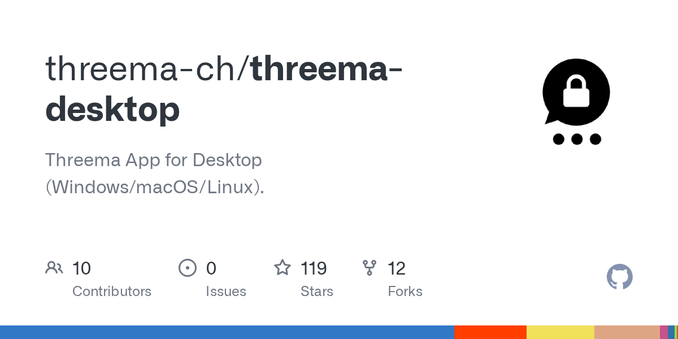
...#Threema is a solid messenger and it also has a great desktop app (for Linux and the others).
It's Electron, no? 🫣
@trashheap @rl_dane @AnachronistJohn @jns @DrInterpreter Ah, I see. Well, I found this (from the app) if you're interested in looking:
https://github.com/threema-ch/threema-desktop
Is there any 'Electron' in there?
@UrbanDjent @trashheap @AnachronistJohn @jns @DrInterpreter
Yeah, that's Electron.
And, I mean, not hating. Sometimes that's all people can manage to do. As soon as you start talking about writing native clients for Linux, you gotta deal with all of the religious wars and silly stuff.
I still give Telegram credit for creating a pretty great native Linux client. I'm not a huge fan of their service for other reasons, but that aspect of them is good.
I tend to just use a website when that's an option, rather than a dedicated Electron app, all eating 1+ GiB RAM apiece.
Matrix lets you do that (and also has decent third-party native client options). SimpleNote as well (a simple note-taking service).

 Ángela Stella Matutina
 jns
jns Moses Izumi
 mirabilos
 Bitslingers-R-Us
 Tim Chase
 Jonathan Downie
 trashHeap

 Terminal Tilt
 Patrick Georgi
 anthropomorphic blast radius