 petersuber
Update. Missed this one from 2021: "Manuscripts written by women as solo authors or coauthored by women were treated even more favorably by referees and editors. Although there were some differences between fields of research, our findings suggest that peer review and editorial processes do not penalize manuscripts by women."
https://www.science.org/doi/full/10.1126/sciadv.abd0299
Update. Missed this one from 2020: "The last three years of reported data all show women leading men in representation in #law schools in the US. This past academic year, however, ushered in a new first: women leading the masthead of each top law journal."
https://www.forbes.com/sites/erinspencer1/2020/02/11/first-all-women-class-of-top-law-journal-editors-leaves-behind-a-byline-and-legacy/
h/t #ArthurBoston

Update. Our data show "promising advancements towards gender equity [in academic publishing]…These findings challenge an initial perception of male prolificacy. The positive trends extend to female-led research teams, highlighting a correlation between gender balance and leadership…Contrary to conventional assumptions, developing countries are exhibiting a pronounced evolution in female authorship rates."
https://www.sciencedirect.com/science/article/pii/S1751157724000695
https://www.sciencedirect.com/science/article/pii/S1751157724000695
Update. The journal 𝘎𝘦𝘯𝘥𝘦𝘳 & 𝘚𝘰𝘤𝘪𝘦𝘵𝘺 is calling for submissions on "the relationship between feminism, metascience, and open science."
https://drive.google.com/file/d/181MycZzTQ5iuHfbbpuDOE59Y-UKejLGD/view
Update. In the humanities, in the period 2000-2014, "male academics published 2917 books (averaging 3.41 books) and the 760 female faculty members published 1918 books (averaging 2.52 books), indicating “gender disparity” in scholarly publishing."
https://link.springer.com/chapter/10.1007/978-3-031-66170-9_3
(#paywalled)
https://link.springer.com/chapter/10.1007/978-3-031-66170-9_3
(#paywalled)

Major Developments and Events in the Humanities and Scholarly Publishing: 2000–2014
A number of substantive trends in the humanities were evaluated, including undergraduate and graduate student enrollments, the number of college faculty members, humanities degrees and major humanities subjects, the impact of the “serials crisis,”...
Update. In the field of medical informatics, "only 25% (8/32) of the EiCs [editors in chief]… are female, while females only represent 32.7% (426/1303) of the EB [editorial board] members across journals."
https://ebooks.iospress.nl/doi/10.3233/SHTI240364
https://ebooks.iospress.nl/doi/10.3233/SHTI240364
Update. "Our results indicate that the ratio of female to male authors keeps increasing steadily across disciplines. The increases are field-neutral —in other words, they are not bigger, for example, in [STEM fields]…The increases are… decelerating in time, which could suggest that the equilibrium of female to male authors may be plateauing. Finally, although the within-field gender gap is decreasing, it actually widened between fields."
https://journals.sagepub.com/doi/abs/10.1177/08944393241270633
https://journals.sagepub.com/doi/abs/10.1177/08944393241270633
Update. New study: "With roughly the same number of men and women in the world, we should expect this [#gender] gap to close in an equal society. But what we see in reality is a persistent gap in #physics over time."
* Summary
https://phys.org/news/2024-09-gender-gap-physics-stable-century.html
* Primary source with proposed explanation
https://www.nature.com/articles/s42005-024-01799-z

Why the gender gap in physics has been stable for more than a century
As a physicist and data scientist with a keen interest in gender inequality, Fariba Karimi was amazed to discover that the gender gap in physics has remained almost unchanged since 1900. As the citation and coauthorship networks in physics expand, women still make up a small proportion—and the gaps between male and female are getting larger in terms of absolute numbers.
Update. The Journal of Cardiac Failure switched from single-blind to double-blind peer review to increase the number of its women authors. Three years later it reports the results.
https://onlinejcf.com/article/S1071-9164(24)00378-6/abstract
(#paywalled)
"The proportion of women first authors increased from 24% in Era 1 to 34% in Era 2 to 39% in Era 3 while the percentage of women authors serving in a senior authorship role remained fairly stable over time around 21-22%."
Update. New study: "Female-led [scientific] teams generate more novel and disruptive ideas. However, they tend to produce articles with fewer scientific impact [sic] compared to their male-led counterparts…Further analysis indicates that this gender bias intensifies in later career stages and with larger team sizes."
https://direct.mit.edu/qss/article/doi/10.1162/qss_a_00335/124962/Female-led-teams-produce-more-innovative-ideas-yet
https://direct.mit.edu/qss/article/doi/10.1162/qss_a_00335/124962/Female-led-teams-produce-more-innovative-ideas-yet
Update. At the Technische Universität Ilmenau, "#gender has a negative influence on the publication frequency but not on the citation rate."
https://tarupublications.com/doi/10.47974/CJSIM-2024-0019
https://tarupublications.com/doi/10.47974/CJSIM-2024-0019
Update. In #EasternEurope "the highest percentage of female authored articles was in journals from #Slovenia (mean = 47.28%) and a lowest in journals from #Azerbaijan (mean = 29.30%)."
https://ieeexplore.ieee.org/abstract/document/10737547
(#paywalled)
Update. "[The] metric called field-weighted citation impact (#FWCI)…compares citations received by individuals or groups with the average from similar papers in the field. In 2022, male materials scientists based in #India had a 10% higher FWCI than women working in the country. The #gender gap is not so pronounced within other fields."
https://www.nature.com/articles/d41586-024-04004-x
https://www.nature.com/articles/d41586-024-04004-x

Update. #AI / #LLMs "tend to recommend literature with greater citation counts, later publication date, and larger author teams. Yet, in scholar recommendation tasks, there is no evidence that LLMs disproportionately recommend male, white, or developed-country authors, contrasting with patterns of known human biases."
https://arxiv.org/abs/2501.00367
https://arxiv.org/abs/2501.00367

Who Gets Recommended? Investigating Gender, Race, and Country Disparities in Paper Recommendations from Large Language Models
This paper investigates the performance of several representative large models in the tasks of literature recommendation and explores potential biases in research exposure. The results indicate that not only LLMs' overall recommendation accuracy remains limited but also the models tend to recommend literature with greater citation counts, later publication date, and larger author teams. Yet, in scholar recommendation tasks, there is no evidence that LLMs disproportionately recommend male, white, or developed-country authors, contrasting with patterns of known human biases.
Update. The _Emergency Medicine Journal_ commits to reporting #clinicaltrial data broken down by #sex and #gender.
https://emj.bmj.com/content/early/2025/01/06/emermed-2024-214743
"Despite…widely reported gender disparities [in medical risks and conditions], we still rarely see the results of clinical trials disaggregated by sex…We must begin now with better data, better approaches to analysis and better reporting…We know that authors don’t always read the not-so-fine print in our guidance, so it will be on us as editors to remind authors to report sex-disaggregated results when possible. We welcome readers to hold us to our word, assuring that this happens."

Sex and gender reporting in scientific papers now strongly recommended by the Emergency Medicine Journal
Editorial linked to: Astin-Chamberlain R, Pott J, Cole E, et al . Sex and gender reporting in UK emergency medicine trials from 2010 to 2023: a systematic review. Emergency Medicine Journal Published Online First: 11 September 2024. doi: 10.1136/emermed-2024-214054. The under-representation of women in clinical trials has been well documented but even less appreciated is the lack of attention to potential differences in outcomes according to sex and gender. Due to differences in body size and composition, sex hormones and metabolism, as well as important social determinants of health, we cannot infer that research findings in men can always be generalised to women. Just like age, race, education, socioeconomic status, comorbidities and many other categories that our patients fall into, sex and gender can have an effect on the way patients present with the same illness, the way patients respond to medications and the potential for toxicity. Studies have suggested that women with acute myocardial infarction are more likely than men to experience symptoms such as dyspnoea or palpitations in addition to chest pain1 and (once diagnosed) women receive evidence-based treatments less often than men.2 For reasons still not clear, we know that men were more likely to have severe …
Update. "The within-discipline differences [of h-index] by #gender are smallest in the humanities and STEM fields and largest in the medical field."
https://journals.plos.org/plosone/article?id=10.1371/journal.pone.0316913
https://journals.plos.org/plosone/article?id=10.1371/journal.pone.0316913

Inequality in measuring scholarly success: Variation in the h-index within and between disciplines
Scholars and university administrators have a vested interest in building equitable valuation systems of academic work for both practical (e.g., resource distribution) and more lofty purposes (e.g., what constitutes “good” research). Well-established inequalities in science pose a difficult challenge to those interested in constructing a parsimonious and fair method for valuation as stratification occurs within academic disciplines, but also between them. The h-index, a popular research metric, has been formally used as one such method of valuation. In this article, we use the case of the h-index to examine how the distribution of research metrics reveal within and between discipline inequalities. Using bibliometric data from 1960-2019 on over 50,000 high performing scientists—the top 2% most frequently cited authors—across 174 disciplines, we construct random effects within-between models predicting the h-index. Results suggest significant within-discipline variation in several forms, specifically sole-authorship and female penalties. Results also show that a sole authorship penalty plays a significant role in well-known between-discipline variation. Field-specific models emphasize the “apples-to-oranges,” or incommensurable, property of cross-discipline comparison with significant heterogeneity in sole-authorship and female penalties within fields. In conclusion, we recommend continued caution when using the h-index or similar metrics for valuation purposes and the prioritization of substantive valuations from disciplinary experts.
Update. New study: "Among nearly 35,000 biological scientists who authored their first paper in 2000, women were more likely than men to have stopped publishing after 5, 10 or 20 years. The size of this #gender gap varies between disciplines."
https://www.nature.com/articles/d41586-025-00021-6
(#paywalled)
https://www.nature.com/articles/d41586-025-00021-6
(#paywalled)

Update. There are many studies of #gender bias in academic publishing. Having tracked them for years in this Mastodon thread (and an earlier Twitter thread), I agree with this new study that "methodological inconsistencies, particularly in author name disambiguation and gender identification, limit the reliability and comparability of these studies." The authors propose a standardized "framework for documenting and reporting key methodological choices in scholarly data analysis, including author name disambiguation and gender identification procedures." This "will facilitate more accurate comparisons and aggregations of research findings."
https://arxiv.org/abs/2501.18129
https://arxiv.org/abs/2501.18129
Revisiting gender bias research in bibliometrics: Standardizing methodological variability using Scholarly Data Analysis (SoDA) Cards
Gender biases in scholarly metrics remain a persistent concern, despite numerous bibliometric studies exploring their presence and absence across productivity, impact, acknowledgment, and self-citations. However, methodological inconsistencies, particularly in author name disambiguation and gender identification, limit the reliability and comparability of these studies, potentially perpetuating misperceptions and hindering effective interventions. A review of 70 relevant publications over the past 12 years reveals a wide range of approaches, from name-based and manual searches to more algorithmic and gold-standard methods, with no clear consensus on best practices. This variability, compounded by challenges such as accurately disambiguating Asian names and managing unassigned gender labels, underscores the urgent need for standardized and robust methodologies. To address this critical gap, we propose the development and implementation of ``Scholarly Data Analysis (SoDA) Cards." These cards will provide a structured framework for documenting and reporting key methodological choices in scholarly data analysis, including author name disambiguation and gender identification procedures. By promoting transparency and reproducibility, SoDA Cards will facilitate more accurate comparisons and aggregations of research findings, ultimately supporting evidence-informed policymaking and enabling the longitudinal tracking of analytical approaches in the study of gender and other social biases in academia.
Update. In the field of public administration, "when women are first authors, the research team is more likely to contain other women and while women are increasingly represented in coauthorship structures, men-only groups of coauthors continue to persist."
https://onlinelibrary.wiley.com/doi/abs/10.1111/puar.13923
https://onlinelibrary.wiley.com/doi/abs/10.1111/puar.13923
Update. "Mixed-gender teams are more likely to face #retractions than all-male or all-female teams, while individual authors are less prone to retractions…Male-led publications are often retracted for serious ethical violations, such as data falsification and plagiarism, while female-led publications primarily face procedural errors and updates in rapidly evolving fields. Promoting women to positions of responsibility in mix-collaborations may not only advances gender equity but also the accuracy of the scientific record."
https://doi.org/10.1162/qss_a_00353
Update. New study: In the social sciences, "male editors-in-chief outnumber females across most fields (66.67%), countries (76.60%), and affiliations (63.16%)."
https://journals.plos.org/plosone/article?id=10.1371/journal.pone.0317931

Editors-in-chief in social sciences: Mapping the institutional, geographical, and gender representation between academic fields
This study systematically maps the network structure of the editors-in-chief in social sciences journals, focusing on their gender representation, geographical distribution, and institutional composition. Drawing upon large-scale data from 3,320 JCR-ranked journals of 57 different fields in the social sciences (4,868 editors-in-chief from 1,485 affiliations of 71 countries), the study aims to illustrate the current connections of editorial leadership in social sciences. Findings reveal that two countries—the U.S. and the U.K.—and their institutions shape almost all fields of the social sciences, with institutions from other geographies, particularly non-English-speaking countries, being substantially underrepresented. However, there is no central institution that dominates across all fields, but within dominant geographies, a reduced number of different affiliations prevail in the most important intellectual terrains. In terms of gender representation, there is a significant imbalance across all dimensions under study. Male editors-in-chief outnumber females across most fields (66.67%), countries (76.60%), and affiliations (63.16%). All in all, by critically mapping the connections of editors-in-chief in social sciences journals, this study seeks to advance our understanding of the current structure of editorial governance and, in turn, stimulate initiatives aimed at fostering a more representative leadership in social science, keeping levels of scientific excellence constant.
Update. From a _Nature_ editorial.
https://www.nature.com/articles/d41586-025-00891-w
"It’s no secret that women’s participation in research is not reflected in the literature on a par with men’s, and that other #gender identities are all but invisible. The gap is particularly wide in some disciplines, notably the physical sciences…as well as at more-senior levels. But are some fields making more progress than others? If so, what can be learnt from them…? These are some of the questions that reporters and data analysts from Nature Index set out to investigate in their project, Nature Index Author Gender Ratio, launched in 2024. This week, they report some early results."

Update. "Data from the Nature Index reveal the slow erosion of the #gender gap in global research publishing over the past decade. But with just 27% of high-quality papers in the natural sciences having female co-authors in 2024, there is a lot of room for improvement. In the health sciences — where women have a stronger presence — that figure sits at 41%."
https://www.nature.com/articles/d41586-025-00553-x
https://www.nature.com/articles/d41586-025-00553-x

Update. In the fields of #NLP and #LIS, "papers with different #gender compositions achieve varying numbers of citations, with mixed-gender collaborations gradually obtaining higher average citation counts compared to same-gender collaborations."
https://doi.org/10.1016/j.joi.2025.101662
https://doi.org/10.1016/j.joi.2025.101662
Update. New study: In #Africa, the percentage of journal articles written by women has "grown significantly, with Engineering and Technology rising from 16% to 21%, Physical Sciences from 19% to 23%, and Life Sciences and Biomedicine from 29% to 35%. In contrast, gains in social sciences were more modest, with Arts and Humanities remaining stable at 28% and Social Sciences increasing slightly from 26% to 28%."
https://onlinelibrary.wiley.com/doi/full/10.1002/leap.2007
https://onlinelibrary.wiley.com/doi/full/10.1002/leap.2007
Update. For research in #Brazil "indexing biases disproportionately affect researchers focusing on locally relevant topics through articles that are written in Portuguese. Given women's overrepresentation in this group, our findings illustrate how indexing biases contribute to gender inequalities in science."
https://www.researchgate.net/publication/391183750_Occluded_Topics_The_hidden_half_of_Brazilian_research
Update. New study: "Male first authors have higher #retraction rates, particularly for scientific misconduct such as plagiarism, authorship disputes, ethical issues, duplication, and fabrication/falsification. No significant gender differences were found in retractions attributed to mistakes."
https://www.sciencedirect.com/science/article/abs/pii/S175115772500046X
https://www.sciencedirect.com/science/article/abs/pii/S175115772500046X
Update. "Since 2017, the #UK has mandated organisations employing more than 250 people to publicly report their annual #gender #PayGap…Every science publisher pays men more than women. In 2024, the lowest median pay gap favouring men was 9.5% (#SpringerNature), followed by #Sage (13.3%), #Wiley (17.7%), and #Informa (formerly Taylor & Francis) (22.7%). #Elsevier remains an outlier in the magnitude of its gender pay gap and in the lack of progress. Eight years ago Elsevier stood out among publishers, with a median pay gap in 2017 of 40.4% in favour of men over women in its UK business…Elsevier’s median pay gap for 2024 is 32.8%, maintaining its position as worst performer among peers over all eight years of mandatory reporting."
https://doi.org/10.1371/journal.pgph.0004673

Update. New study: "Women are more frequently acknowledged than credited as co-authors…To account for status and disciplinary effects, we examined collaboration pairs composed of highly cited (high-status) and less cited (low-status) scientists. In such collaborations, the highly cited scientist is more likely to be listed as a co-author, regardless of gender. Notably, highly cited women in these pairs are even more likely to be listed as co-authors than their male counterparts."
https://arxiv.org/abs/2506.15237
https://arxiv.org/abs/2506.15237
Dissecting the gender divide: Authorship and acknowledgment in scientific publications
The issue of gender bias in scientific publications has been the subject of ongoing debate. One aspect of this debate concerns whether women receive equal credit for their contributions compared to men. Conventional wisdom suggests that women are more likely to be acknowledged than listed as co-authors, a role that carries greater prestige. Here, we analyze data from hundreds of thousands of scientists across nine disciplines and a broad range of publications. Our results confirm persistent gender disparities: women are more frequently acknowledged than credited as co-authors, especially in roles involving investigation and analysis. To account for status and disciplinary effects, we examined collaboration pairs composed of highly cited (high-status) and less cited (low-status) scientists. In such collaborations, the highly cited scientist is more likely to be listed as a co-author, regardless of gender. Notably, highly cited women in these pairs are even more likely to be listed as co-authors than their male counterparts. These findings suggest that power dynamics and perceived success heavily influence how credit is distributed in scientific publishing. The results underscore the role of status in shaping authorship and call for a more nuanced understanding of how gender, power, and recognition interact. This research offers valuable insights for scientists, editors, and funding agencies committed to advancing equity in science.
New study: "More women-led papers receive at least one media mention in women-underrepresented fields, but they are cited less frequently across all fields. Women authors are underrepresented in national outlets and are more often reported by liberal media. Sentiment analysis shows that men-led papers are more often associated with positive sentiment in news text, while women-led papers elicit more negative sentiment."
https://journals.sagepub.com/doi/abs/10.1177/10755470251360187
Update. "Women are significantly underrepresented among highly cited scholars globally (0.255 women per man) and receive fewer citations and have lower h-indexes than men in most regions and disciplines. However, after controlling for productivity and career length, female scholars are cited more than men in the pooled sample, Asia, Europe, and in two fields (natural sciences and exact sciences/physics). Despite this, women’s h-index remains significantly lower than men’s in all regions except Africa and South America, and in all fields except social sciences."
https://journals.plos.org/plosone/article?id=10.1371/journal.pone.0334690

Gender gap in citations, h-index, and representation: Examining the highly cited authors across continents and disciplines in Google Scholar
This study investigates gender inequalities in academia by examining differences in representation, citations, and h-index between male and female highly cited researchers across disciplines and geographic regions. Using a unique dataset from Google Scholar, this study analyzes 21,509 highly cited authors across 191 fields and all continents. We examine gender disparities in citations, h-index, and representation while controlling for research productivity and career length to determine if female researchers experience different outcomes compared to their male counterparts. The findings reveal that women are significantly underrepresented among highly cited scholars globally (0.255 women per man) and receive fewer citations and have lower h-indexes than men in most regions and disciplines. However, after controlling for productivity and career length, female scholars are cited more than men in the pooled sample, Asia, Europe, and in two fields (natural sciences and exact sciences/physics). Despite this, women’s h-index remains significantly lower than men’s in all regions except Africa and South America, and in all fields except social sciences. This study highlights the persistence of gender inequalities in academic representation and long-term impact, as measured by the h-index. The results suggest that while citation rates for female researchers can match or exceed those of male scholars when productivity is controlled for, structural barriers continue to limit women’s long-term recognition in academia. This research contributes to the understanding of gender disparities among top researchers, showing that while citation parity is possible, significant gender gaps remain in overall academic representation and long-term recognition through h-index measures.
Update. "Women are markedly underrepresented among authors of retracted publications, particularly in cases involving multiple retractions."
https://journals.plos.org/plosone/article?id=10.1371/journal.pone.0335059
The article is #OpenAccess. But on the day of publication, this #paywalled comment by Jenna Ahart appeared in Nature.
https://www.nature.com/articles/d41586-025-03796-w

Gender disparities among authors of retracted publications in medical journals: A cross-sectional study
Background Gender disparities in scientific authorship are well documented, yet little is known about gender representation among authors of retracted publications. Methods We analyzed 878 retracted publications from 131 high-impact medical journals across nine clinical disciplines (anesthesiology, dermatology, general internal medicine, gynecology/obstetrics, neurology, oncology, pediatrics, psychiatry, and radiology). Gender was inferred using Gender API for all, first, and last authors. Two analytic samples were constructed based on prediction confidence thresholds (≥60% and ≥70%). We examined gender distribution across authorship positions, number of retractions per author, and disciplinary representation. Wilcoxon rank-sum and chi-squared tests were used to assess group differences. Gender proportions were compared with publication benchmarks from 2008–2017, restricting retraction data to the same period for comparability. Results Among 4,136 authors, 3,909 had full first names, and gender could be assigned to 3,865 (98.9%). In the sample with prediction confidence ≥60% (n = 3,743), 863 (23.1%) were identified as women. They accounted for 16.5% (123/747) of first and 12.7% (87/687) of last authors. They had significantly fewer retractions per author and were less likely to have >5 retractions (all authors: 3 women [8.1%] vs 34 men [91.9%], p < 0.001). Across most disciplines, their representation was below publication benchmarks. Dermatology (retractions = 80.0%, publications = 48.9–51.8%) and radiology (retractions = 40.0%, publications = 31.0-36.8%) were exceptions among first authors, while pediatrics (retractions = 50.0%, publications = 37.0%−42.6%) was an exception among last authors, though all based on small numbers. Conclusions Women are markedly underrepresented among authors of retracted publications, particularly in cases involving multiple retractions. Further research is needed to clarify underlying mechanisms.
Update. "Authors with very feminine and masculine first names respectively get a lower and higher share of citations for every article published, irrespective of their contribution role."
https://arxiv.org/abs/2512.08219
Any Old Tom, Dick or Harry: The Citation Impact of First Name Genderedness
This paper attempts a first analysis of citation distributions based on the genderedness of authors' first name. Following the extraction of first name and sex data from all human entity triplets contained in Wikidata, a first name genderedness table is first created based on compiled sex frequencies, then merged with bibliometric data from eponymous, US-affiliated authors. Comparisons of various cumulative distributions show that citation concentrations fluctuations are highest at the opposite ends of the genderedness spectrum, as authors with very feminine and masculine first names respectively get a lower and higher share of citations for every article published, irrespective of their contribution role.
Update. "In male-dominated fields, women have significantly broader research interests than men, while this gap diminishes and reverses in more gender-balanced fields. Although broader publication trajectories help women increase publication output, this strategy carries steeper citation penalties for women than for men. The results suggest that academic fields act as sites of inequality production, channeling women toward research patterns that boost immediate productivity while undermining long-term scholarly influence."
https://journals.sagepub.com/doi/pdf/10.1177/23780231251396273
Update. In the field of oil pollution research, "female authors accounted for about 32% of the total authors…were significantly underrepresented in most of the African countries [and in] the UK and Norway…Gender variation in oil pollution publications was discovered to be influenced by religion in Africa; Islam had the mean highest rank when compared with Christianity."
https://doi.org/10.4314/jasem.v29i11.22
Update. "We conduct a comprehensive comparison between peer-review scores and citation-based metrics across various scientific fields [in Italy]…While both evaluation methods exhibit sex bias, peer review systematically penalizes women more severely than citation-based metrics."
https://www.sciencedirect.com/science/article/pii/S1751157725001245
Update. A letter to the editor about a study I posted to this thread 11/23/25: "The suggestion that [the lower #retraction rate for women] is because male researchers undergo more scrutiny, propose bolder ideas and lead larger and more dynamic teams than do female researchers implies that male scientists are better at science. As female scientists, our lived experience points to alternative explanations: elevated rigour and scientific integrity by female scientists or more critical peer review of female-led manuscripts."
https://www.nature.com/articles/d41586-026-00120-y
(#paywalled)
Update. "By analyzing all articles indexed in the PubMed database (>36.5 million articles published in >36,000 biomedical and life sciences journals), we show that the median amount of time spent under review is 7.4%–14.6% longer for female-authored articles than for male-authored articles."
https://doi.org/10.1371/journal.pbio.3003574
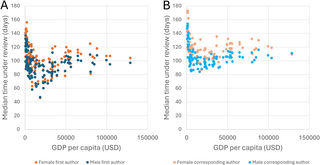
Biomedical and life science articles by female researchers spend longer under review
Women are underrepresented in academia, especially in STEMM fields, at top institutions, and in senior positions. This study analyzes millions of biomedical and life science articles, revealing that female-authored articles spend longer under review than comparable male-authored articles, across most fields.
Update. "Citation counts [for female authors] are on average 5.5% lower than those of comparable male authors…Papers produced by all-female teams receive 56.7% fewer citations than those by all-male teams, while mixed-gender teams achieve a 30.9% citation advantage."
https://ceur-ws.org/Vol-4155/paper10.pdf
Update. Many studies look at the acceptance rate for articles by women at high-impact journals. This one looks at the submission rate, and finds that women submit significantly fewer articles to these journals than men. (The percentages differ by field.) When asked why, the most common response was that "they were advised not to."
https://elifesciences.org/articles/90049

Gender differences in submission behavior exacerbate publication disparities in elite journals
Gender differences in submission behavior, driven by self-perceptions of novelty and peer discouragement, limit women’s representation in high-impact journals and, in turn, their scientific visibility and career advancement.