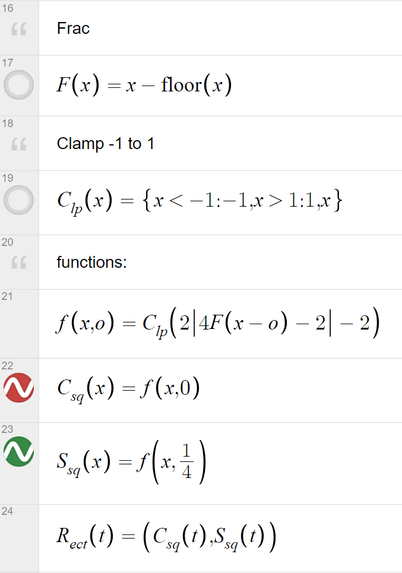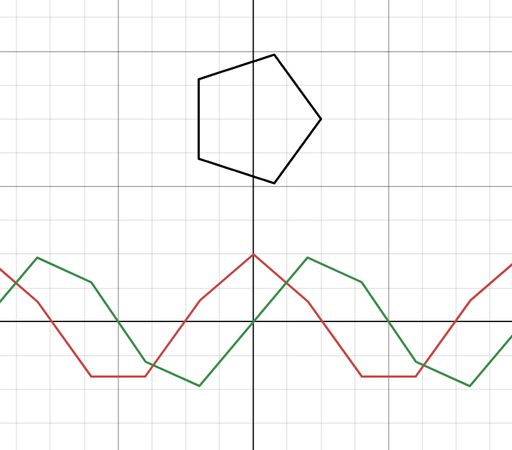

you've heard of sine and cosine

now get ready for uh squine and cosquare

Square cosine/sine

Desmos
i regret exposing myself to the pentagonal trig functions 😭
@acegikmo Oh no I do NOT like that asymmetrical curve one bit
@danana_dread @acegikmo Just like sine and cosine, one has rotational symmetry and the other has mirror symmetry.
@acegikmo I hope you brought some food while descending down that rabbit hole ;-)
@acegikmo you mean we could approach sin(t) and cos(t) by considering the infinite limit of a converging series of squine and cosquine for increasing size of polygonial sides ? (but preferrably with even polygons)

@acegikmo I love how restoring the x=cos(t) in the square example gives you a barrel tracer :P

https://www.desmos.com/calculator/r0iecpgesa

Square cosine/sine

Desmos
@acegikmo what happens if you use star polygons? 🤔
@acegikmo is this the path followed by a point on a pentagon as you roll it along a line? And it varies depending on what point you choose? I now regret you exposing me to them too!
@acegikmo let's generalize all the way through the regular polygons on the way to the limit of the circle?
@acegikmo there must be a whole series of curves, one for each platonic solid. I'm sure they have cool properties. Wonder what they sound like.
@acegikmo AKA as "sine and cosine in the taxicab metric" 😃
@j_bertolotti @acegikmo : The circle in the taxicab metric (l¹) is a diagonal square with half this size. This is the circle in the l^∞ metric (which doesn't have a cute name as far as I can remember).
@TobyBartels @j_bertolotti @acegikmo i think it's sometimes called the chessboard metric, as it's kind of "distance in king's moves"?
@andrewt @j_bertolotti @acegikmo : I haven't heard that before, but I like it.

@TobyBartels @andrewt @j_bertolotti I've usually hear it called Chebyshev distance, but idk how commonly used it is!

or max-norm or something of the kind

there's also rectilinear distance but I always forget if that's taxicab or chebyshev

@acegikmo @TobyBartels @j_bertolotti I think I did use it in my PhD but only really to speed up a calculation, it wasn't actually *better* for anything
@acegikmo @TobyBartels @andrewt @j_bertolotti when i studied maths (in german) it was called supremum norm, but i've also heard it be called chebyshev distance
@spacekatia @acegikmo @andrewt @j_bertolotti : Both ‘max’ and ‘supremum’ strike me as straightforward descriptions, not fun names like ‘Manhattan’ and ‘chessboard’, while ‘Chebyshev’ lies in between. (But it makes a counterpart to ‘Euclidian’, so now I want to know who to name the l¹ metric after.)

@TobyBartels @acegikmo @andrewt @j_bertolotti doctor manhattan of course (minkowsky already has too many metrices named after him)

jokes aside, you could probably name it after frigyes riesz, who first considered it as a distance metric at the same time as minkowsky

@TobyBartels @acegikmo @andrewt @j_bertolotti also i always found manhattan metric a nice illustratine example of why you'd consider metrics besides euclidean even in day to day life tbh
@spacekatia @TobyBartels @acegikmo @j_bertolotti oh yeah, dr manhattan, the guy who invented the bomb, i think they named a street after him or something
@j_bertolotti @acegikmo for a square with sides parallel to axes it would be Chebyshev or L_inf metric. Taxicab/Manhattan/L_1 metric gives a square 45 degrees from axes (a diamond) for points equidistant from origin.
@acegikmo I wonder what they sound like
- posted by Sparkles-Sericea
@Sparky @acegikmo Like a triangle wave oscillator run through the hard clipper or fuzz pedal. So I'd guess sort of a hollow reedy sound (triangle) with a little buzzy higher-frequency edge (the clipped tops). Mostly like a triangle wave. Not particularly interesting, alas.
@munificent @acegikmo for me that's actually quite interesting, thanks
- posted by Sparkles-Sericea
@Sparky @acegikmo Update: I cobbled something together in Ableton Live and, yes, it just sounds like a slightly buzzy triangle wave.

@acegikmo very peculiar (though it took me a while to catch it because the color choice for the plots isn't too colorblind-friendly).

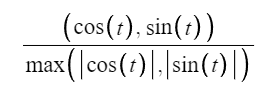
I'm trying to think if they satisfy an equation similar to that of sin/cos, but abs(s) + abs(c) = 1 doesn't work. Is it something like abs(s+c) + abs(s-c) = 1 maybe?

@oblomov @acegikmo max(abs(s), abs(c)) = 1?
@ziks @acegikmo well I was at least missing a /2, and max(x,y) = (x+y+abs(x-y))/2 so maybe mine should have been abs(x)+abs(y)+abs(x-y) = 2
@oblomov this is one way to do it using trig at least! a distance norm friendly solution

@oblomov in my desmos I wanted to make it arc length parameterized though, which the normalization methods aren't

https://mastodon.social/@acegikmo/112852705784240378

@acegikmo oh wow. I'm not sure I want to be exposed to the pentagonal trig functions now 8-D
@oblomov @acegikmo I think you just apply the metric to the point (s,c). So ||(s,c)||_M = 1. If we rotated the square by 45 degrees so it was the L_1 metric (aka taxicab or Manhattan metric), you would get abs(s)+abs(c)=1. This is L_inf (aka Chebyshev) metric, so max(abs(s),abs(c))=1.
@acegikmo how about hexagons? 
A visual programming environment for audio experimentation, prototyping and education ⋅ plugdata

A visual programming environment for audio experimentation, prototyping and education

@acegikmo what about phase? Higher order Lissajous figures?
@lutzray @acegikmo
Man, I’m just gonna go down these responses and recommend https://plugdata.org , aren’t I?
A visual programming environment for audio experimentation, prototyping and education ⋅ plugdata

A visual programming environment for audio experimentation, prototyping and education

@acegikmo seems like this leads to colipses ans silipses? Could it perchance? Sindiamonds? ... :O
My wordplay/math/concepts wires are a little all over today.
@thejikz @acegikmo All of this is true: welcome to the world of squigonometry!
@acegikmo when the cheap solar inverters kick in
@acegikmo I like how if you add a third line that fills in the gap and use them as RGB channels you get a pretty nice color gradient over time!
@acegikmo What if it was the angle, not the travel time, on your x-axis?

@riley @acegikmo I think that gives the “James Tanton" squine

https://www.youtube.com/watch?v=yk-QCbTGNIY

Squine and Cosquine

YouTube

@acegikmo Already did something like this, except generalised to all polygons: https://www.desmos.com/calculator/ya2ph4frsf

I have a lot—and I mean a *LOT*—of random Desmos graphs full of weird maths, physics, and computer science-related experiments.

Polygon Trigonometry

Desmos
@acegikmo this is the pseudo-polar coordinate system used in this paper
@acegikmo I used a function like this for pixel art interpolation. Where you want it mostly blocky with just a little blending at the edges. I never would have guessed how powerful it was as a sin/cos replacement.

@acegikmo deadpan: sin cos tan
hyperbole: sinh cosh tanh
boxy: sins coss tans
secs cosecs cots

¡arccosecs!

@acegikmo in communications engineering, we call that "O-QPSK with a square pulse shape", and I think that's beautiful.

@acegikmo There's a nice Math Magazine article about the analogous functions for \(x^4+y^4=1\).

https://www.tandfonline.com/doi/abs/10.4169/math.mag.84.4.257

Jerobeam Fenderson - Planets

YouTube
@acegikmo Instead of π, you use SheetCake?
@acegikmo Cool :-) I implemented a Mandelbrot that used complex numbers that rotate in squares like this. It was crap and i wouldn’t bother.