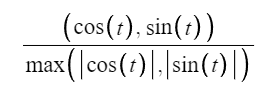
you've heard of sine and cosine

now get ready for uh squine and cosquare

@acegikmo very peculiar (though it took me a while to catch it because the color choice for the plots isn't too colorblind-friendly).

I'm trying to think if they satisfy an equation similar to that of sin/cos, but abs(s) + abs(c) = 1 doesn't work. Is it something like abs(s+c) + abs(s-c) = 1 maybe?

@oblomov @acegikmo max(abs(s), abs(c)) = 1?
@ziks @acegikmo well I was at least missing a /2, and max(x,y) = (x+y+abs(x-y))/2 so maybe mine should have been abs(x)+abs(y)+abs(x-y) = 2
@oblomov this is one way to do it using trig at least! a distance norm friendly solution

@oblomov in my desmos I wanted to make it arc length parameterized though, which the normalization methods aren't

https://mastodon.social/@acegikmo/112852705784240378

@acegikmo oh wow. I'm not sure I want to be exposed to the pentagonal trig functions now 8-D
@oblomov @acegikmo I think you just apply the metric to the point (s,c). So ||(s,c)||_M = 1. If we rotated the square by 45 degrees so it was the L_1 metric (aka taxicab or Manhattan metric), you would get abs(s)+abs(c)=1. This is L_inf (aka Chebyshev) metric, so max(abs(s),abs(c))=1.