 Möfu
Möfu Dan Luu
"Unfortunately, a recent software update was not successful. Your vehicle cannot be driven.
Please call customer support"
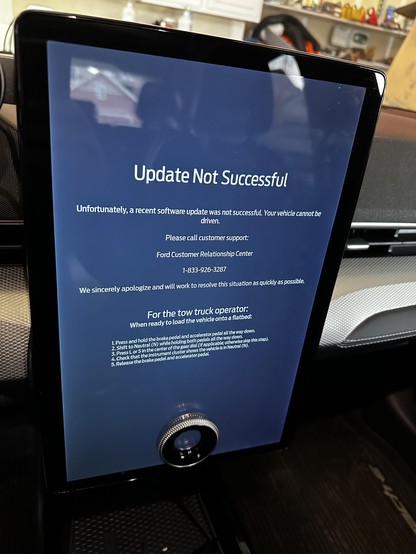
"Unfortunately, a recent software update was not successful. Your vehicle cannot be driven.
Please call customer support"
@eliasp @danluu it is likely that the design of the system makes it so that simply slapping on a second system partition for rollbacks is not enough. In fact it may be already present there.
The car runs a network of computers running a variety of systems. The display in the photo might be a QNX machine running an Android VM and these two systems need to coordinate their updates.
Fork Over Repair Dough.
(More at https://jalopnik.com/the-ten-cars-with-the-most-nicknames-5840926)
@danluu looks like a Ford Mach E
Why are car manufacturers so bad at software? Why are almost all hardware makers terrible at software?
@scottmichaud @nuthatch @danluu
In fairness, the worst software I've ever used, without exception, has been internal-only stuff.
@enobacon @fulminata @passenger @nuthatch @danluu
Of course. The whole reason there is (supposed to be) QA is people fuck up. Anything QA cartches should have been caught in design, but there ARE obscure use cases. Unit and system test should have caught it. But QA is the last stop and probably was shortchanged.
This is a good point and I'll concede it.
For a lot of consumer software, testing is very difficult because you can't possibly test for every device and every configuration that the consumer may be using, and so things do slip through. However, this is not an excuse that the car above has.
@danluu the dealer offered this guy a $30 Lyft card good job everyone
@nuthatch @danluu: In the current environment of software development, those who are good at it are outweighed heavily by those who aren't. And the latter are infiltrating into the automotive software industry as well.
The problem is that quick, slapdash approaches to software are being encouraged over longer development cycles and actual testing.
@danluu the future is awesome.
(full, i mean full).
@danluu Very very early in the history of TiVo, they put out an update and bricked the boxes. Fortunately there were not a lot out there (hundreds?) and all in the Bay Area. So they ended up going to every house and fixing them.
Needless to say, that never happened again.
Also, that was decades ago. There’s really no excuse now.
@nazgul @danluu A similar thing happened recently in Europe, where an update pushed to some in-home built-in appliances was for the wrong type of device, and required an onsite visit to reprogram the bricked units.
The important question of course is why the units even had the proper keys/certs to verify an update intended for a different type of device in the first place.
@danluu Did it prompt for the update? Or just decide to do it without asking?
I do not want any car with a built-in cellular transceiver.
If the car has multiple computers, they should boot over the CAN bus from a central source. That would ensure you cannot brick the whole car, as only that one source has to have A and B partitions.
 Tony Printezis
 Elias Probst
 bttk
bttk Emil Jacobs - Collectifission
 El Tico
 Jeremiah C. Foster 🇸🇪🇺🇸🍥
 Lesley M 🏴 🇪🇺
 Account has moved!
 zen3ger
 John Francis
 Kale
Kale  Ángela Stella Matutina
 Isho'ye
 Corey Taylor
 Peter Bindels
 kira :3
 stephen ryner jr. 🦉
 Jacob Christian Munch-Andersen
 Passenger
 Scott Michaud
 John M
 😀🚲
😀🚲 Imran Nazar ~ عمران نزر
 Thread Tree
 Grandpa Don
 Óscar Morales Vivó
 antipode77
 AT-AT Assault 🏳️⚧️
 uis
uis RAK
RAK Robots can be gay deal with it
 Gabriel Pettier
 Obscuredavid
 Pyperkub
 Andrew Feeney
 Ellen Teapot 🇨🇦🏳️⚧️
 Joe Fabisevich
 Kee Hinckley
 Peggy Heinkel-Wolfe
 Kevin P. Fleming
 Taco Dave
 Charles J Gervasi ⚡🛡️🥥
 Shimrra Shai
 Whiskers 🇦🇺
 mike805
 Robert "Szkodnix"
 @stevewfolds
 Jake in the desert
 Niko
Niko n3wjack
 Martin Vermeer FCD