Morning.

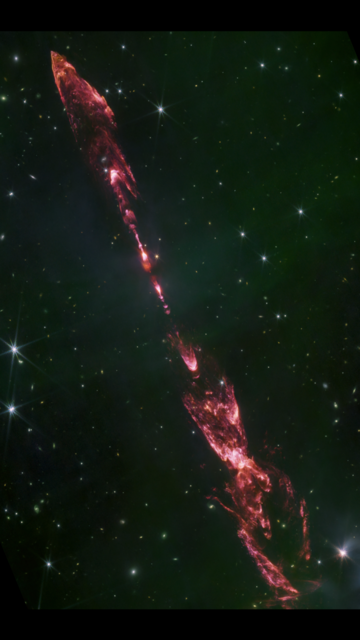
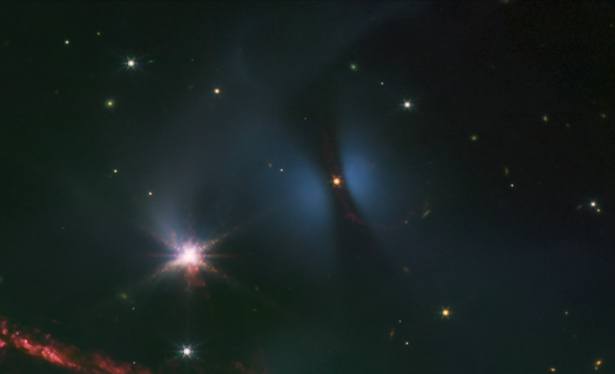
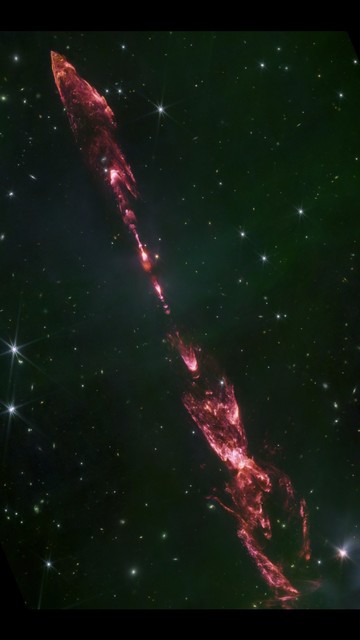
Here it is, several thousand years in the making: the protostellar jet HH212 as seen in the infrared by #JWST.

We discovered this jet in 1993, glowing in the light of shocked molecular hydrogen at 2.12 microns, as gas emerges symmetrically at about 100 km/s from the two poles of a young protostar not far from the Horsehead Nebula in Orion.

Our new JWST image spans six wavelengths & is ten times sharper than any previous infrared image.

#Astronomy #SpaceScience #Astrodon

1/
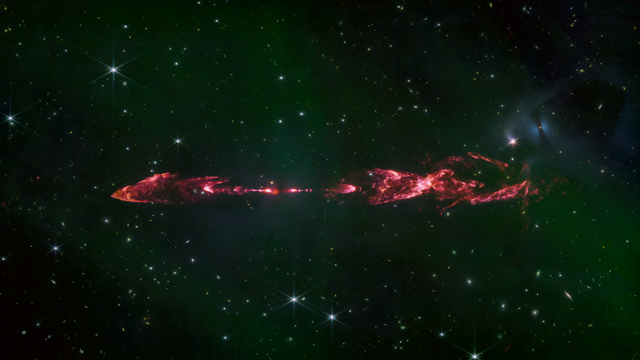
For scale, the image is about 0.7 parsecs or 2.3 light years wide at the 400 parsec distance to HH212, which lies on the outskirts of the Orion B molecular cloud, about 1.5° NE of the Horsehead Nebula near the Belt of Orion.

The full JWST image is over 11,000 pixels wide and can be viewed in detail and downloaded at full resolution from my Flickr account:

https://flic.kr/p/2pde2Nn

2/

JWST image of the HH212 protostellar jet

Flickr

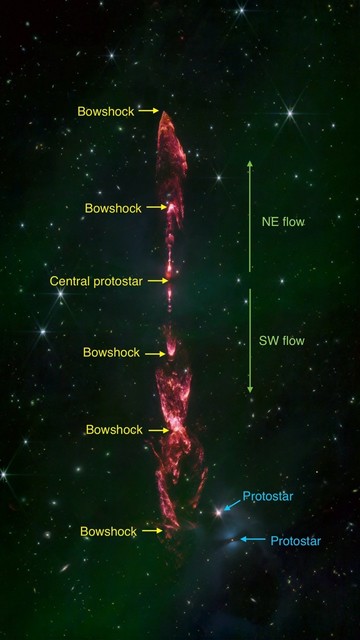
To guide the eye, here’s a rotated and annotated version of the JWST image of HH212.

It shows the location of the central (invisible) protostar and then the quasi-symmetric series of knots and bowshocks caused by periodic expulsions of material from both poles of the protostar.

There are two other protostars in the region marked in blue.

3/

The image is a colour composite of six individual mosaics made through different medium & narrow-band filters with the NIRCam instrument on JWST:

F210M: H2 2.12 microns line + continuum (blue)
F212N: H2 2.12 microns line (blue)
F335M: H2 3.23 microns line + polycyclic aromatic hydrocarbon band (green)
F460M: H2 4.69 microns line + CO bandhead + continuum (red)
F466N: CO bandhead (yellow)
F470N: H2 4.69 micron line (red)

4/

With that colour mix, the jet is mostly red/purple as it is dominated by the various molecular hydrogen emission lines, energised by shocks in the outflowing material. There is also some CO emission in the flow & colour differences arise due to different excitation & dust extinction conditions, especially near the centre where there is lots of dust around the central protostar.

The diffuse green emission is due to polycyclic aromatic hydrocarbon emission associated with tenuous dust.

5/

Despite all this gas & dust however, we know that the protostar at the heart of HH212 is a fairly isolated, not surrounded by big dense molecular clouds.

How do we know that?

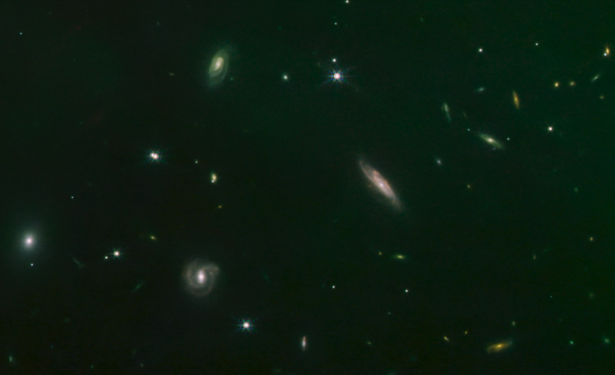
Because there are galaxies *everywhere* in this image, strewn across the image in the far distance.

If there was a dense cloud, we wouldn’t see them.

Here’s a small crop showing a nice group: pan & zoom & you’ll see loads more.

6/

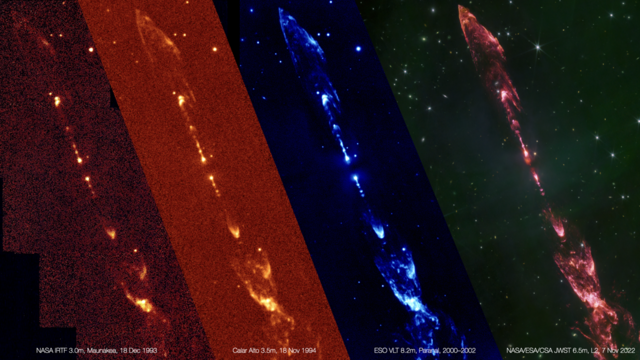
We (Hans Zinnecker, John Rayner, & me) first discovered HH212 in 1993 using the NASA IRTF on Maunkea in Hawai’i.

We’ve observed it many times since on increasingly large telescopes & with better & better infrared cameras & better resolution, including the Calar Alto 3.5m in Spain & the ESO VLT 8.2m on Paranal, Chile.

Safe to say though, the #JWST images blow all that away 🙂👍

Here’s a montage with HH212 oriented “correctly”, ie with north up & east left.

7/

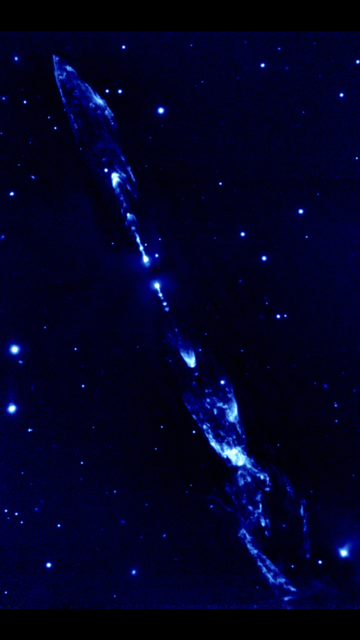
And to show the change in quality over time, here’s the previous best image of HH212, which we made with the VLT about 20 years ago, just in the 2.12 micron H2 line, compared with the new JWST image.

Pretty impressive improvement when you get to use a 6.5m cryogenic infrared telescope in space 🙂👍

8/

But here’s the thing: because we have all of these older images of HH212 … we can see it moving 😱

That is, because the material is moving outwards from the protostar we can see the jet expand over time.

It’s easily visible in this 22 year timelapse that combines three VLT images from 2000, 2007, 2018, & then the 2022 JWST image.

Measuring the changes, we can determine the expansion speed as 50-150km/s in different parts of the outflow.

9/

To view that timelapse in more detail, I’ve also put it on Flickr here:

https://flic.kr/p/2pdcnLK

10/

A timelapse movie of the HH212 protostellar jet

Flickr

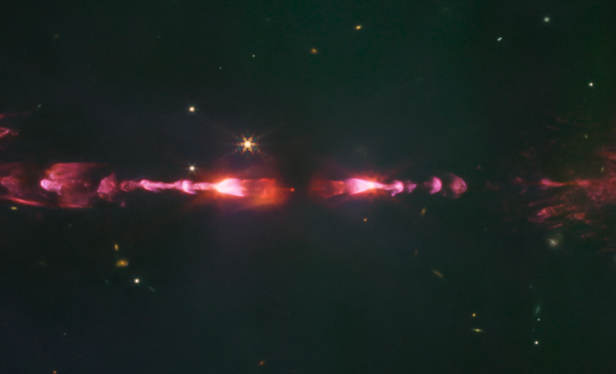
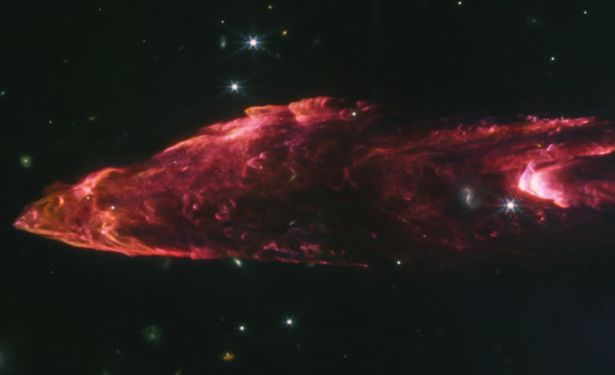
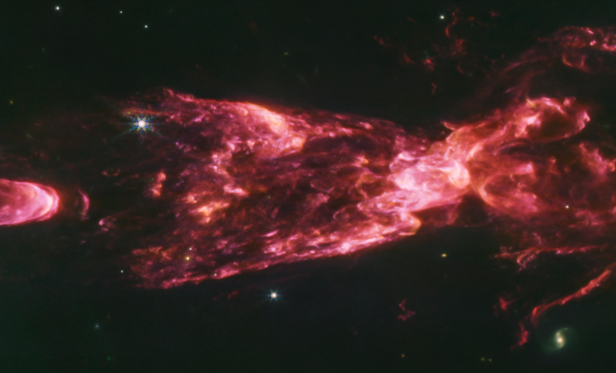
Here are some more full-resolution screen grabs to show the detail in the centre of the jet, in the bowshocks, and the other protostars in the region.

11/

And finally for now, here’s the redoubtable Mr Amos at the BBC with his take on our image of HH212, as well as the partner image we took with JWST of another protostellar outflow, HH211, which was published in Nature a few weeks ago.

We’re working on a paper about HH212 now as well, as you might imagine 😬👍

12/

https://www.bbc.com/news/science-environment-67243772

James Webb telescope: Baby star launches giant jets and shocks - BBC News

The James Webb observatory records the giant jets and shocks created by a birthing star in Orion.

BBC News

Ah, and of course, credit for these JWST images go to:

NASA/ESA/CSA/ Mark McCaughrean & Sam Pearson, CC BY-SA

Credit also to STScI & the NIRCam team for the pipeline processing tools, astropy & IRAF (yes, I’m old school), plus GIMP, @gmic, Adobe PhotoShop, & Adobe LightRoom which were used to make the images.

13/

As a coda, it’s important to note that HH212 has been studied intensively by many others since we discovered it, including a whole series of impressive papers looking at the inner jet & circumstellar disk by Chin-Fei Lee & Claudio Codella & their respective collaborators, using ALMA at millimetre wavelengths.

There’s amazing detail down in the region near the core where we’re blocked by dust, but they see the jet being launched by magnetic fields.

We’ll cite all that work in our paper 👍

14/

@markmccaughrean amazing, thanks for the thread!
@mathildeD_V My pleasure – thanks for the positive feedback 🙂
@markmccaughrean @gmic Thank for the great explanations!
@mike_malaska And thank you, Mike – much appreciated.
@markmccaughrean These image descriptions are a great added value to this thread. For someone like me who doesn't know about astronomy, it's hard to understand what I'm actually seeing on the images, but it makes more sense with the alt texts. 👍
@maxi Thank you. There’s certainly more to be said which should help further explain what’s being seen in these images & why it’s important, so I’ll probably post some more notes later on 👍
@markmccaughrean Amazing thread and images and explanations, thank you!
@c_9 My pleasure – thanks for reading through it. There’s a lot more to be said about HH212 (& I forgot to mention that it extends considerably further on both sides, albeit not covered by JWST this time), so look out for the paper when we submit it.
@markmccaughrean The improved resolution of JWST is amazing.

@JanPV Indeed. The VLT data are pretty good for ground-based & the 2018 VLT image even used ground-layer laser AO, but it’s hard to beat a fully diffraction limited telescope in space, even if it’s smaller than each VLT unit telescope.

A laser guide star driven 39m ELT will be something though: might be worth returning again to HH212 with that in a few years 🙂👍

@markmccaughrean So not much worse than a storm off the Dutch coast then😂
@tanepiper What’s a factor of 3600 between friends, eh? 🙂
@markmccaughrean That’s pretty cool Mark! 😊

@markmccaughrean

Thank you for this diagram!

It's interesting that the two outer bowshocks are differently shaped. Is this the result of the orientation of the arms in regard to our galactic rotation?
(I have no idea if that makes sense)

@Ralph My pleasure.

No, this is all happening on too small a scale & too rapid a timescale for galactic rotation to be involved.

The asymmetry between the outer bowshocks & the lack of clear counterpart in the north to the last one in the south is likely due to the different amounts of ambient medium the jet is running into.

The two protostars at the south end (right in the main image) have material associated with them, while the north end is clear.

@markmccaughrean

Awesome! It's turbulence writ large.

“Big whirls have little whirls,
That feed on their velocity;
And little whirls have lesser whirls,
And so on to viscosity.”
― Lewis Fry Richardson

@Ralph Indeed, one of the new things we can see in the JWST images is all the turbulent structure in the bowshocks: exactly how that arises is something we’re looking into.

@markmccaughrean very interesting, thanks for sharing.

It looks like there is some laminar to turbulent transition going on. I suppose the density of the jets must be minuscule and wonder what is the main contribution to viscosity.

Can you please elaborate on this point? Thanks!

@ciclotrone Yes, that's an important point – the JWST data have much higher spatial resolution than any previous H2 images & the turbulent structure of the big bowshocks (even with smaller bowshock structures inside them) is something well worth investigating.

Densities are very low in these flows, say 10^3–10^6 hydrogen atoms per cc.

As for viscosity, gas turbulence has long been held to be dominant, but recent reviews revive the key role of MHD, e.g.
https://www.frontiersin.org/articles/10.3389/fspas.2019.00054/full

The Role of Magnetic Fields in Protostellar Outflows and Star Formation

The role of outflows in the formation of stars and the protostellar disks that generate them is a central question in astrophysics. Outflows are associated with star formation across the entire stellar mass spectrum. In this review, we describe the observational, theoretical, and computational advances on magnetized outflows, and their role in the formation of disks and stars of all masses in turbulent, magnetized clouds. The ability of torques exerted on disks by magnetized winds to efficiently extract and transport disk angular momentum was developed in early theoretical models and confirmed by a variety of numerical simulations. The recent high resolution Atacama Large Millimeter Array (ALMA) observations of disks and outflows now confirm several key aspects of these ideas, e.g., that jets rotate and originate from large regions of their underlying disks. New insights on accretion disk physics show that magneto-rotational instability (MRI) turbulence is strongly damped, leaving magnetized disk winds as the dominant mechanism for transporting disk angular momentum. This has major consequences for star formation, as well as planet formation. Outflows also play an important role in feedback processes particularly in the birth of low mass stars and cluster formation. Despite being almost certainly fundamental to their production and focusing, magnetic fields in outflows in protostellar systems, and even in the disks, are notoriously difficult to measure. Most methods are in...

Frontiers

@markmccaughrean That looks way more like a Klingon Bird of Prey than it has any right to.

(That, or an electric guitar. Did SPG's Space Giant leave his guitar made out of the cosmos lying around?)

@markmccaughrean
Excellent!
Few Qs -
How did you estimate the age of the star as 50,000 years, as stated in the BBC article?
How long will it take for HH212 to become a main sequence star?
Can you tell whether this is a single star at the center or a binary?
Thanks.

@AkaSci All good questions. The dynamical age of the jet (which extends out beyond this picture to ~1 parsec on either side) is about 7000 years, ie just how long does it take material to get that far at 100-150km/s.

The “full” age of the protostar is harder to calculate, but based on its total spectral energy distribution & evolutionary models, numbers around 50,000-100,000 are typical.

@AkaSci As for the total pre-main sequence duration, it depends on the final mass. The HH212 protostar is around 0.7 solar mass now, but if it ends up at 1Msolar, it will take a total of about 40 million years to reach the main sequence.

https://www.aanda.org/articles/aa/full_html/2017/03/aa28260-16/aa28260-16.html

Revisiting the pre-main-sequence evolution of stars - I. Importance of accretion efficiency and deuterium abundance | Astronomy & Astrophysics (A&A)

Astronomy & Astrophysics (A&A) is an international journal which publishes papers on all aspects of astronomy and astrophysics

@AkaSci There have been claims that the central protostar in HH212 might be binary, based on millimetre dust continuum observations & also analysis of the proper motions in the outflow, but the general wisdom is that it’s single.
@markmccaughrean
What is this object in the image with the distinct symmetric "shadow" on two sides and a red line of gas/dust that curves almost 180 degrees?
Is it a protoplanetary disk?
Or some artifact due to gas/dust in the line of sight?
Or something else?

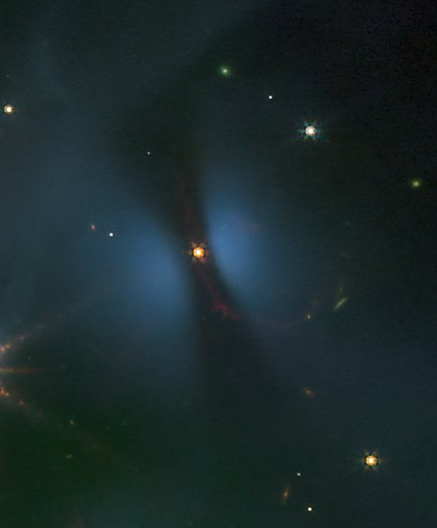
@AkaSci It’s a bipolar reflection nebula & yes, I’d say that it’s illuminated by a central protostar embedded in a disk.

What’s weird is that the star in the middle is visible: normally with edge-on disks the midplane extinction is so high, you can’t see the central source in the near-IR.

It could just be a chance superposition, but it’s reddened & that even weirder red line of H2 makes me wonder. We have no idea what that is at the moment: it’s bizarre.

@AkaSci There’s no clear evidence for a protostar there though, while the brighter object nearby with the wisp of nebulosity is clearly seen in dust continuum by Herschel so is a protostar.
@markmccaughrean
Fantastic image, but I almost like this other protostar more. Is that the shadow of the accretion disk?
@brunthal The blue one at left? Yes, it’s pretty too, but mysterious. Very large, but no obvious dust continuum from Herschel to mark a protostar. And if that is an edge-on accretion disk, then it begs the question of if / how we’re seeing the central star. The band of red H2 emission in the midplane is really strange too.
@markmccaughrean
Left? I mean the 'Hamburger' source with blue buns and a dark patty to the right of the first image (where the jet is horizontally). Or the bottom right protostar in the image where the jet is vertically. Very intriguing source.
@brunthal Apologies – my directional typo. Yes, that’s the one 🙃
@markmccaughrean
I wish NASA could release images always in RA/DEC, to avoid confusion 😀

@brunthal Well, in this case, this image wasn’t released by either NASA or ESA, just me, & to be fair to them, they usually have orientation information & a compass rose with their releases. Similarly, the JWST images in ESASky including my Orion ones are located in RA,dec space.

To maximise the science in HH212, I chose a specific telescope orient to lie it along the main detector axis. And rotating it to N up, E left as below also crops it 🤷‍♂️

There’s no winning 🙂

@markmccaughrean
Sorry, I keep forgetting that most non-radio telescope don't have a circular field of view, and that these released images are mainly for the public, where orientation and coordinates don't really matter.

I'm glad that the 🍔 protostar was in the field of view.

@brunthal That wasn’t by accident – we’ve known about it for decades 🙂
@brunthal I hope to get this image into ESASky at some point, but there’s more politics around that than I’d like 🤷‍♂️
@markmccaughrean just heard you on BBC World, very good explanation, thanks!
@bert_hubert Ah, thank you, Bert – I didn’t have time to flag it in advance, so am happy someone heard it 🙂👍
@markmccaughrean "BBC World Service English audiences rose by 8% to 97 million.". https://committees.parliament.uk/writtenevidence/10939/html/
@bert_hubert I’m on the World Service quite a lot – they take science quite seriously still – so I’ll take credit for the tiniest smidgeon of that increase 🤪