Morning.

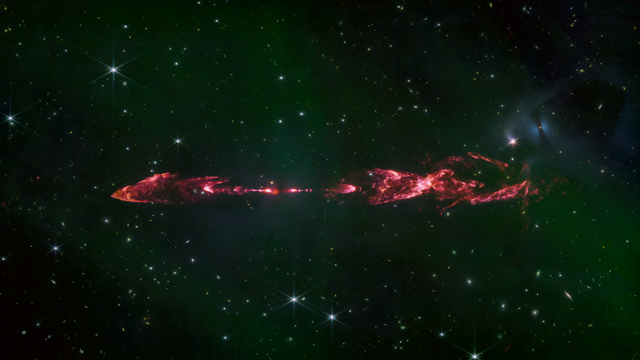
Here it is, several thousand years in the making: the protostellar jet HH212 as seen in the infrared by #JWST.

We discovered this jet in 1993, glowing in the light of shocked molecular hydrogen at 2.12 microns, as gas emerges symmetrically at about 100 km/s from the two poles of a young protostar not far from the Horsehead Nebula in Orion.

Our new JWST image spans six wavelengths & is ten times sharper than any previous infrared image.

#Astronomy #SpaceScience #Astrodon

1/
@markmccaughrean
Got spectra?
@AkaSci Not with #JWST for HH212, no – but it is definitely something we should propose doing with NIRSpec IFU & MIRI IFU, as that has proved a very powerful diagnostic tool in our other outflow, HH211.
@AkaSci There is quite a bit of ground-based near-IR spectroscopy for HH212, however, including some in our 1998 discovery paper.
@markmccaughrean
Does JWST have the capability to use NIRSpec and/or MIRI spectrometers concurrently with NIRCam for the same FOV? Or does it require a separate measurement cycle?
@AkaSci The JWST instruments can operate in parallel, but they don’t see the same FOV. Here’s the way the focal plane is laid out. https://jwst-docs.stsci.edu/jwst-observatory-characteristics/jwst-field-of-view
JWST Field of View - JWST User Documentation

Each JWST instrument observes an area on the sky bounded by the coordinates given in the telescope's (V2, V3) coordinate system. Figure 1 shows NIRSpec, NIRCam,