Morning.

Here it is, several thousand years in the making: the protostellar jet HH212 as seen in the infrared by #JWST.

We discovered this jet in 1993, glowing in the light of shocked molecular hydrogen at 2.12 microns, as gas emerges symmetrically at about 100 km/s from the two poles of a young protostar not far from the Horsehead Nebula in Orion.

Our new JWST image spans six wavelengths & is ten times sharper than any previous infrared image.

#Astronomy #SpaceScience #Astrodon

1/
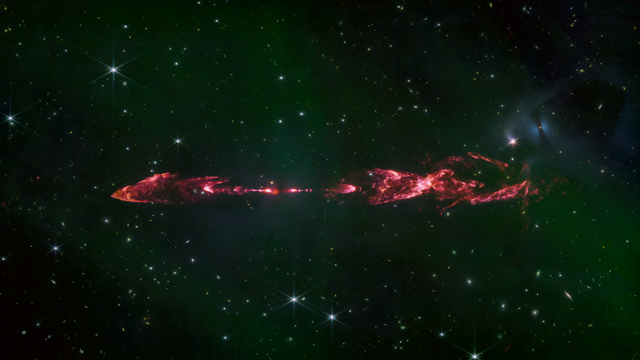
For scale, the image is about 0.7 parsecs or 2.3 light years wide at the 400 parsec distance to HH212, which lies on the outskirts of the Orion B molecular cloud, about 1.5° NE of the Horsehead Nebula near the Belt of Orion.

The full JWST image is over 11,000 pixels wide and can be viewed in detail and downloaded at full resolution from my Flickr account:

https://flic.kr/p/2pde2Nn

2/

JWST image of the HH212 protostellar jet

Flickr

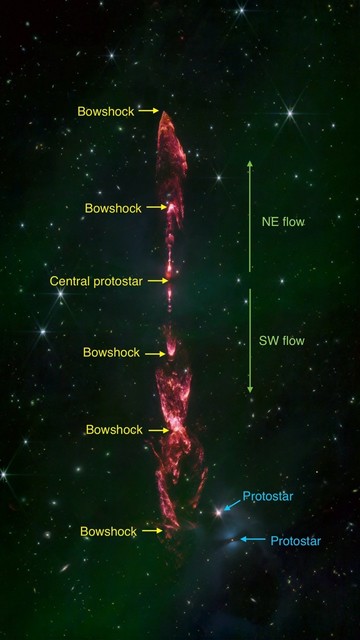
To guide the eye, here’s a rotated and annotated version of the JWST image of HH212.

It shows the location of the central (invisible) protostar and then the quasi-symmetric series of knots and bowshocks caused by periodic expulsions of material from both poles of the protostar.

There are two other protostars in the region marked in blue.

3/

@markmccaughrean

Thank you for this diagram!

It's interesting that the two outer bowshocks are differently shaped. Is this the result of the orientation of the arms in regard to our galactic rotation?
(I have no idea if that makes sense)

@Ralph My pleasure.

No, this is all happening on too small a scale & too rapid a timescale for galactic rotation to be involved.

The asymmetry between the outer bowshocks & the lack of clear counterpart in the north to the last one in the south is likely due to the different amounts of ambient medium the jet is running into.

The two protostars at the south end (right in the main image) have material associated with them, while the north end is clear.

@markmccaughrean

Awesome! It's turbulence writ large.

“Big whirls have little whirls,
That feed on their velocity;
And little whirls have lesser whirls,
And so on to viscosity.”
― Lewis Fry Richardson

@Ralph Indeed, one of the new things we can see in the JWST images is all the turbulent structure in the bowshocks: exactly how that arises is something we’re looking into.