Morning.

Here it is, several thousand years in the making: the protostellar jet HH212 as seen in the infrared by #JWST.

We discovered this jet in 1993, glowing in the light of shocked molecular hydrogen at 2.12 microns, as gas emerges symmetrically at about 100 km/s from the two poles of a young protostar not far from the Horsehead Nebula in Orion.

Our new JWST image spans six wavelengths & is ten times sharper than any previous infrared image.

#Astronomy #SpaceScience #Astrodon

1/
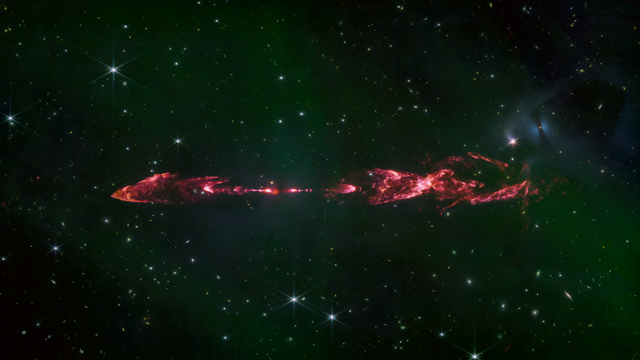
For scale, the image is about 0.7 parsecs or 2.3 light years wide at the 400 parsec distance to HH212, which lies on the outskirts of the Orion B molecular cloud, about 1.5° NE of the Horsehead Nebula near the Belt of Orion.

The full JWST image is over 11,000 pixels wide and can be viewed in detail and downloaded at full resolution from my Flickr account:

https://flic.kr/p/2pde2Nn

2/

JWST image of the HH212 protostellar jet

Flickr

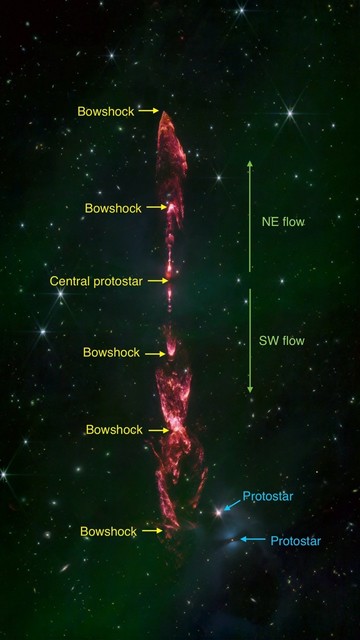
To guide the eye, here’s a rotated and annotated version of the JWST image of HH212.

It shows the location of the central (invisible) protostar and then the quasi-symmetric series of knots and bowshocks caused by periodic expulsions of material from both poles of the protostar.

There are two other protostars in the region marked in blue.

3/

@markmccaughrean very interesting, thanks for sharing.

It looks like there is some laminar to turbulent transition going on. I suppose the density of the jets must be minuscule and wonder what is the main contribution to viscosity.

Can you please elaborate on this point? Thanks!

@ciclotrone Yes, that's an important point – the JWST data have much higher spatial resolution than any previous H2 images & the turbulent structure of the big bowshocks (even with smaller bowshock structures inside them) is something well worth investigating.

Densities are very low in these flows, say 10^3–10^6 hydrogen atoms per cc.

As for viscosity, gas turbulence has long been held to be dominant, but recent reviews revive the key role of MHD, e.g.
https://www.frontiersin.org/articles/10.3389/fspas.2019.00054/full

The Role of Magnetic Fields in Protostellar Outflows and Star Formation

The role of outflows in the formation of stars and the protostellar disks that generate them is a central question in astrophysics. Outflows are associated with star formation across the entire stellar mass spectrum. In this review, we describe the observational, theoretical, and computational advances on magnetized outflows, and their role in the formation of disks and stars of all masses in turbulent, magnetized clouds. The ability of torques exerted on disks by magnetized winds to efficiently extract and transport disk angular momentum was developed in early theoretical models and confirmed by a variety of numerical simulations. The recent high resolution Atacama Large Millimeter Array (ALMA) observations of disks and outflows now confirm several key aspects of these ideas, e.g., that jets rotate and originate from large regions of their underlying disks. New insights on accretion disk physics show that magneto-rotational instability (MRI) turbulence is strongly damped, leaving magnetized disk winds as the dominant mechanism for transporting disk angular momentum. This has major consequences for star formation, as well as planet formation. Outflows also play an important role in feedback processes particularly in the birth of low mass stars and cluster formation. Despite being almost certainly fundamental to their production and focusing, magnetic fields in outflows in protostellar systems, and even in the disks, are notoriously difficult to measure. Most methods are in...

Frontiers