I'm going to try _a thing_. There are two related phenomena regarding #cars and #PublicTransport that I basically never see discussed. I wrote an article about these two things which includes two very clear definitions. I want to see if I can get some reach to disseminate these two things like a mind virus.

Boost if you like. Or don't. I'm not your boss.

The premise: when you own a #car, it is cheaper to drive the car. But: we want to get people out of their cars, even while they still own cars.

The definitions:

- Sunk cost discount: for as long as you own a car, it is cheaper relative to public transport to use that car for individual journeys, even though you would save money if you got rid of the car and exclusively used public transport.

- Trip cost scaling problem: for each additional passenger taking a journey together, the cost per passenger becomes lower when travelling by car, but higher when travelling by public transport.

The article: https://www.carmenbianca.eu/en/post/2023-07-27-the-sunk-cost-discount-and-the-trip-cost-scaling-problem/

Shamelessly tagging @notjustbikes @TheWarOnCars @ianwalker

#cycling #bancars #urbanism #train #bus #metro #tram #SunkCostDiscount #TripCostScalingProblem

The sunk cost discount and the trip cost scaling problem

Cars are more expensive, but not when you already own one

Carmen Bianca Bakker

A tiny addendum update after receiving a lot of warm feedback on the article :) Thank you.

There are many, many, many reasons why people take the #car over #publictransport. The two phenomena outlined in the article are barely a factor in some cases. I am aware of this, but wanted to hyper-focus the article on one thing only: the cost of public transport for car owners. I did this for a simple selfish reason; I want my family to visit me more often. They don’t much like long car rides, but the alternative journey by #train makes no economic sense for them.

Furthermore, I’m aware of the externalised costs of taking a car, and did mention them in the article, but it bears repeating: the only reason car journeys are so cheap is because we subsidise the hell out of cars and their #infrastructure and off-load all the damages incurred by them (opportunity cost, productivity loss, #health, #environment, #climate) onto society. But everything else remaining the same, I’d still like my family to be able to visit me by train more cheaply than by car.

#bancars

I’ve also learnt the word I would have needed to type into DuckDuckGo to learn about the economics involved: #MarginalCost. It’s jargon related to economies of scale, that when translated to transportation means loosely the following: the increase in total cost [of a mode of transportation] by increasing the [journeys taken] by one. I could rephrase the definitions in terms of marginal cost, but I’m afraid to get it wrong, so I’m not going to.

There are also a few ways around the sunk cost discount (some good, some bad).

- Car rentals: By not owning a car, and only renting one as needed, you get rid of the sunk cost, freeing you up to take the mode of #transportation that makes the most sense for your journey.

- #Bikes: #Bicycles have a near-zero per-journey cost. Hard to beat. #Cycling 🚲

- #ElectricCars #EVs #EV: I really didn’t account for these, but electric cars, too, have an extremely low per-journey cost. In a world where most cars are electric, the sunk cost discount is going to be especially egregious. From this perspective, I think that the sunk cost discount merits a lot more attention than it currently doesn’t have.

#bancars

@carmenbianca I'll just blather a bit, maybe I ought to use the blog I've already got for that. One way to help get people out of cars would be to take all the sunk and/or lump costs and "marginalize" them. For example, in the US, drivers or car owners pay for automobile insurance in a form that is a large lump cost and then a small (reported) per-mile extra. (I know this because I got a quote for insurance on a 1000 mile/year car). If we could measure miles and turn that into /
@carmenbianca a per-mile cost, then we just un-sunk that annual cost. We could (this is deranged, but bear with me) institute universal health care for cars -- a state-run repair insurance company settles the costs of auto repair, and it's paid for through a per-mile fee. Again, we just un-sunk that cost. The car itself, that's a problem, not sure I want a state-run car-replacement company.
@carmenbianca A different problem is that I am not sure that people appreciate the investment necessary to comfortably ride a bicycle. I utility-bike about 5000km/year, I raced for a bit when I was a kid, have been several kinds of cyclist over the years, never a unicyclist or track cyclist. Riding with other people near Boston, it is common for me to "size them up", judging how they hold a line, the cadence they pick, posture, bike fit, all that. And it varies, not everyone's comfortable or /

@carmenbianca skilled. It takes time to get better, and I've even seen this in people over time (I recognize other people on bikes) and seen them get better. They wobble less on a start, track a straight line better, have a smoother cadence, that sort of thing.

So, a few years ago, spouse has work trip to Copenhagen, I go along, one day I rent a DonkeyBike to get our dirty clothes to a laundry, and I'm riding near rush hour. EVERYBODY ELSE ON A BIKE IS GOOD AT IT.

@carmenbianca and by good at it, I mean not just skilled, but riding really close together. In the US this is pretty rare outside of a race (I think), you have to be really confident in your ability to track a line, and your ability to not totally lose control if you touch something else while riding, lots of daily utility riders here *can* do it, but don't. But there, they're all good, and know it, so they ride close.

(Note that this is a complete non-starter on a wide-barred mountain bike.)

@carmenbianca A lot of these skills accumulate slowly, so you don't notice, but when you have them, biking is easier, feels safer, etc, but you don't necessarily know that you have them. My "best" daily route includes a sharp turn onto a sidewalk from a crosswalk, and it turns out that not everyone is comfortable doing that, which I discovered after recommending (and guiding) someone who wanted to bike to the office more. "That thing you do turning off the crosswalk onto the sidewalk, I can't."
@carmenbianca it's like buying a car is an investment in the promise of that public subsidy, which can only be collected by driving. So the low marginal cost is matched like 10x with subsidy (especially in the US) and Engineered threats to your safety / status / dignity should you choose not to collect it. (Recently, a librarian waiting at a bus stop in Portland was hit with a car by a four-lane stroad, which we know is deadly, but refuse to change without ten years & ~$50M to "add safety" 💸)

@enobacon Good point. Through that lens, any money spent on improving the safety of a road for other road users (incl. separated bike lanes) can be viewed as a #subsidy to cars. This is what people mean when they say '#bike lanes are car #infrastructure'.

The only reason these safety features are needed is because cars need to be accommodated in that space, and cars are murder machines.

(Of course, the features aren't strictly 'needed' if you're sufficiently much of a sadist, but I think the point stands.)

This is incidentally why I'm a little critical of the praise the #Netherlands receive for their bike infrastructure. It's better in so much as it's doing the bare minimum to accommodate other modes of transportation alongside cars. But the Netherlands are still a car paradise all the same.

#bancars #cycling

@carmenbianca isn't about 90% of the NL bikeway network actually just streets which have had car traffic reduced and tamed, e.g. by simple modal filters, like bollards that divert car traffic back to main roads? The #ontvlechten, or separating routes for cars from bikes, makes driving slightly less convenient, but if enough people bike/bus, you have less congestion despite reduced number of car lanes. Car users have access, but not in five redundant ways and to the exclusion of all others.

@enobacon As with all things, It Depends™.

Where I grew up: absolutely not. 90% of the bicycle infrastructure is, well, the street. There is no bicycle infrastructure. But the streets are sufficiently narrow, low-volume, and low-speed that it makes sense. The main road through the village just has a painted bicycle gutter, which becomes a separated bike lane along the rural arterial road outside of the village boundaries.

But in a minority of Dutch cities, yes, cars have reduced access/priority in some areas. The caveat is that this also happens to be to the motorists' benefit. It's quicker to take the indirect route, and it's quicker now that fewer people are in cars. It's not car-_centric_, but they're not exactly being disadvantaged, either.

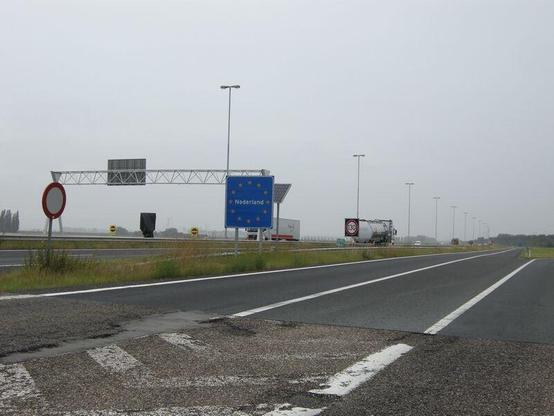
Besides, having moved to #Belgium (a far more car-centric country), it's hard to say that Dutch motorists get a second-grade experience. Dutch car infrastructure is absolutely world-class quality, second to none. Find attached a representative picture of the Dutch-Belgian border.

The Netherlands are a paradise for motorists.

@carmenbianca @enobacon that lovely photo would benefit from an alt text description (alt text added, thanks so much).
@dr2chase @enobacon Done, thank you!
@carmenbianca @enobacon I think I will delete my suggestion, you're clearly better at words than I am.
@dr2chase better to just edit into thanks for the alt text?
@carmenbianca @enobacon In my Dutch neighbourhood (built in ‘90/‘00) a separate bike path runs through the middle, cars have to go around. Cars can use a ‘ring road’ but that is the long way round. Where cars and bikes share the residential streets the speed limit is 30 km/h. Since these streets are used only by residents, traffic volume is very low.