Turning your house into a #smarthome can look like a great idea on paper...

BUT it's also a total #privacy and #security nightmare: depending on what you decide to use, you're putting live feeds of your home on the internet, a complete map of your house, voice recordings of your kids, and a lot more.

Let's see why the smart home is, in most cases, a dumb idea (unless you spend some time doing it right, of course):

https://youtu.be/l6TOCUfkAmQ

#linux #opensource #home

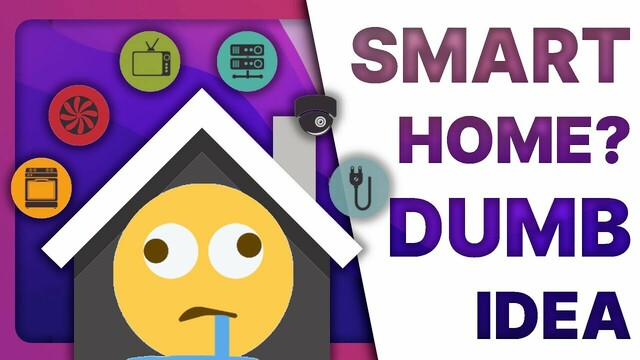
The SMART Home is a DUMB idea, and a privacy and security NIGHTMARE

YouTube
@thelinuxEXP nice timing, I was just looking into security camera options for a friend. Picking one that is private and secure is very difficult. I'm strongly encouraging them to use local storage for video footage instead of the company's cloud service
CUBE | PINE64

Single-core Allwinner S3 @ 800MHz 128MB DDR3 RAM Optional battery Built-in speaker and microphone Power Over Ethernet Bootable microSD Go to Store The CUBE is a small, low-powered…

PINE64
@thelinuxEXP I can’t wait to watch this one. I’m in the market for security camera however the lack of privacy & security friendly options is appalling.
@xsecur I’m never adding any of these devices to my house until I’m 100% certain they do not call home to any server!
@thelinuxEXP I understand the sentiment. As described in the video, it’s a matter of convenience and I can deal with getting up to turn the lights off. For the majority however setting up a local automation is a hard one and for them convenience trumps everything.
@thelinuxEXP I use home assistant with Unify products personally Local only
@thelinuxEXP I want more smart devices wich are open source and only in my local network. I don't need to turn on my tv when I am not at home. It could be offline except for the video streams. Same with light switches and so on. Some times there will be a year of the Linux smarthome.
@thelinuxEXP
I use a lot of smart devices w/ homeassistant but I don't know if I'll ever be comfortable with putting a camera in my apartment
@thelinuxEXP I get your point. this is why i use #homeassistant #zigbee light bulbs, buttons, door sensors, smart plugs. And flash all wifi smart plugs and devices with #tasmota, but tasmota can bee hard to flash so I zigbee.
I have no smart speakers or robot vacuums like u stated in your video
@thelinuxEXP also I have #adhd, so my executive function is limited.
It is also nice to turn on a kettle remotely while working at my desk so I won't be like the dog from UP and Chase after squirrels while the kettle is heating up
@thelinuxEXP Yeah! Spotted the #fairphone4 with @e_mydata installed 😀👍
@thelinuxEXP tfw you break into a house because a lock is vulnerable to a well known exploit

@thelinuxEXP To combat this you must go #SelfHosted . It requires more work and being diligent. That's what #BigTech is capitalizing on, is that people are lazy and want convenience, so they'll give up their freedom for these luxuries.

#DIY #SelfHosting #HomeAssistant

@cslinuxboy Yeah, that’s the conclusion of the video!
@thelinuxEXP Oops, sorry. Guess I should watch before I reply ;) Keep up the great work.
@thelinuxEXP *And my parents wonder why I won't talk to their Amazon speakers...* :)))
@thelinuxEXP @RTP its mostly cause lack of too many open source alternatives and people are forced to use corporated products.
@thelinuxEXP the stock videos section crack me up, had to rewind the video and not watch to put attention
@thelinuxEXP
Been looking into this... I think mainly my wife just wants to be able to control the lights from her phone. I probably won't bother with security cameras.

@thelinuxEXP I like this video. I've avoided smart appliances for the exact reasons mentioned in this video. I don't want hackers to see me staring at pictures of Emma Watson.

But it's a losing proposition to secure this stuff. The "it won't happen to me"-mentality will always win out. There are people still pirating without a VPN even though lawyers have been sending out letters for 20 years.
So you'd be asking people to do extra work and get less features, for something they see no value in.

@ludicdave Yeah, as always, people will think they’re small and their data is irrelevant and that they’re not a target, and convenience will win…
@thelinuxEXP I haven't watched your video yet (no, not even the one on #PeerTube https://tilvids.com/videos/watch/8e6b9fa6-a898-494a-b652-10aa27f38822) but I agree on premise; a house should be automated, not "smart". Motion sensors go a long way and rudimentary "smart" can do rest (some local database about sunrise/-set to alter start/stop time(rs) of time based switches, or light intensity)
The SMART Home is a DUMB idea, and a privacy and security NIGHTMARE

PeerTube
@thelinuxEXP good content. I have a Home Assistant Blue coming in a month or so. The explanation of the limits of that was helpful!
@thelinuxEXP Well you could go completely DIY and make every smart home thing yourself with many Arduino boards and raspberry pis XD
@thelinuxEXP Dumb homes are the best homes. Everything just works and no amount of alexa/siri/routines/schedules can screw it up...
@thelinuxEXP In *most* - not all - cases, you *can* actually use “smart” appliances *without* sacrificing #privacy … The “catch 22” though, is that it’s *not* a matter simply unboxing something and clicking the “Keep everything private” option; to maintain privacy almost always involves a *lot* of work / work-arounds and in *some* cases, highly technical knowledge. | #smarthome
@thelinuxEXP Home Assistant + Tasmota firmaware
@thelinuxEXP
I'm surprised that no one has pointed out that electric window blinds exist that don't rely on the cloud. Just saying ;)
Also, agree with your points. I use HA for my home alarm, and am glad my sensors are radio-based. The exception being 2 IP cameras that, for sure, are accessible from the cloud. For now I'm okay with them being off when we're in the house (but they could be hacked on I guess), but my goal is to cut their access to internet if I can manage it (not so far).
@thelinuxEXP Another comment: I got confused about HA's private cloud thing... If the goal is just to access your home from outside, between VPNs and reverse proxies there are tons of options. Or did I miss something? We're talking HA anyway, so not super mainstream.
@thelinuxEXP That's why I don't want to use purchased products; puts it on the Internet, subscriptions required and they have the keys to the kingdom.

@thelinuxEXP I think that your opinion on the self-hosted solutions didn't consider some self-hosted FOSS alternatives to HomeAssistant.

I like HA for many of its design choices, but I agree with you that it's increasingly becoming a hub to connect different clouds rather than a truly self-hosted solution. It creates the illusion of privacy, when actually it just introduces one local layer of indirection, and your data still freely moves among proprietary clouds.

But HA is not the only available self-hosted option. OpenHAB has been around for a long time too and, being more "scriptable" than HA, it makes it easier to run truly self-hosted solutions - with a bit of tinkering.

And of course I'm a bit biased here being the main developer of Platypush, but your video convinced me even more that I'm going in the right direction. I started Platypush also with the idea of building a hub for clouds (initially I mainly wanted to connect Google Assistant, Hue lights and Spotify controls), but over time I reduced the integrations with larger clouds to focus instead on open-source (and completely self-hosted) alternatives.

This means more focus and support for the NextCloud integration over Dropbox/GDrive.

mopidy/mpd/Snapcast over Spotify Connect.

Native mplayer/vlc/Kodi integrations over Chromecast.

Jellyfin over Plex.

RPi or USB cameras over Nest.

Mycroft/Mozilla DeepSpeech over Google Assistant.

Zigbee/Z-Wave USB dongles over Hue/SmartThings hubs.

The downside of doing things this way is a steeper learning curve - you can keep your data locally, but you have to know how to set up e.g. the MQTT+Postgres integration with your plugins, and maybe run a Grafana server; you can run your own Zigbee controller instead of buying a proprietary hub, but that requires flashing a USB dongle with the zigbee2mqtt firmware through a hardware debugger.

People who want the advantages of a smart home, but without any data points even leaving the home, have alternatives already as of today. But I definitely can't say that embracing those alternatives, as of today, is a smooth path.