I didn’t realize that the Dutch fought for their bike lanes. There’s a lot of history within this that I’m currently naive about but excited to learn!

Here’s the article I’m starting with — How the Dutch got Their Cycle Paths: https://www.pps.org/article/how-the-dutch-got-their-cycle-paths

#bikes #urbanism

'How the Dutch Got Their Cycle Paths'

The extensive cycling infrastructure of the Netherlands didn't happen by magic. It was the result of a lot of hard work, including massive street protests and very deliberate political decision-making.

@dariohudon that’s a great image! I had no idea thanks for sharing

@dariohudon indeed, early seventies the Netherlands was en route to become a very car centric society.

We are still recovering from it. A lot of infrastructure esp in poorer or less populated areas are still very car centric despite most people using bikes there. An average village will have a "village square" that is a big parking lot, oft empty. Yet bike parking is always full.

Once there are funds to redo, it will become a communal center again. For leasure, pedestrians and cyclists

@dariohudon In case of interest to the infamous @CyclingMikey

@kaveh1000

Just saw @CyclingMikey's YouTube channel! https://www.youtube.com/c/CyclingMikey

Thanks for this :)

CyclingMikey

Life on the road from a helmet camera. Sometimes interesting, sometimes scary, but almost always fun. I'm a driver too, I love cars, but I don't like dangerous driving and people taking risks with vulnerable road users. Someone has to stand up against the endemic road crime on our public highways and try to change it for the better. Thankfully I'm not alone - there are tens of thousands of us reporting road crime with video.

YouTube
@dariohudon Thank you for sharing. This video is fascinating... https://youtu.be/XuBdf9jYj7o
How the Dutch got their cycle paths

YouTube

@derek This is fascinating! In my city of Calgary, Alberta, cycle paths were a divisive topics which was very hard to wrap my head around without rendering opponents to 'short term thinkers'.

This did a disservice to discussions and understanding the why. This video helps to comprehend the climate that needs to take place during expansion of bikes as a cultural norm.

Thanks for this :)

@dariohudon

Les néerlandais ont dû se battre pour avoir leurs fameuses pistes cyclables dont leurs élus sont si fiers, actuellement.

Faut en prendre de la graine !

#vélo #vélotaf @velotaffeuse @jeanneavelo @gulan @velomagus

The battle for the Ferdinand Bolstraat

BICYCLE DUTCH
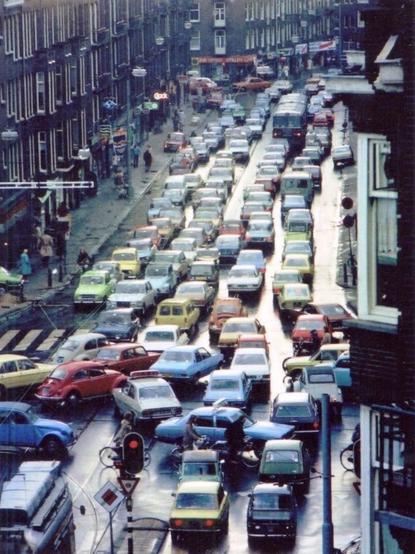
@dariohudon This was Amsterdam in the 1970s.
@alexband @dariohudon Every time I visit Amsterdam it's still like that for cars, but at least you can avoid it if you're on a bike 😁
@dariohudon
QP : "non, mais ce sont les feministes modérées qui font avancer la cause"
@dariohudon We still do! The Dutch Cyclist's Union defends what exists and fights to improve upon it. https://www.fietsersbond.nl/english-info/
English info

We are Fietsersbond, the Dutch Cyclists' Union. We campaign for better cycling conditions in the Netherlands.

Fietsersbond

@dariohudon This reminds me of similar looking forms of protests in Germany at the moment which have the goal to make people wake up to the need to switch to climate-neutral energies. The twist is that social democrats call them
extremists, conservativess call them terrorists and particularly Bavaria throws such protesters in jail for 30 days without a proper charge.

#letztegeneration

@dariohudon amazing. I visited Amsterdam and cycled on the cycle paths at this very spot, and under the Rijksmuseum (top of the image) on a bike tour exactly 4 weeks ago today !
@dariohudon
@joerg_spengler
Vielleicht interessiert dich das Jörg ☝️
@dariohudon
I've thought a lot about the differences between the US and the Netherlands, and it seems like the presence of the American auto industry is a huge factor. The large US auto industry successfully lobbied hard against safe streets both locally and nationally, and crushed grassroots movements. The Netherlands lacked such a powerful auto industry, and grassroot safety movements didn't have to face such fierce and well-funded opposition.
@forpeterssake @dariohudon the Netherlands had DAF, but they weren’t too powerful back then.
@forpeterssake @dariohudon The opposition was fierce enough though! It was a decades-long struggle, against entrenched political resistance

@almodozo @forpeterssake Do you remember what the arguments against it were?

I wonder where those who opposed it are today? And especially, what they think of it now?

@dariohudon @almodozo
Do you mean the arguments against safe streets in the Netherlands, or in the US?

I think in both countries, there was this narrative of the automobile being "the future," and walking or biking was portrayed as antiquated and backward. I think that was 50% natural optimism for new technologies, and 50% advertising spin by auto manufacturers that realized they could create a massive market if they convinced everyone that they needed a car and destroyed the alternatives.

@almodozo @forpeterssake Indon’t think I’v ever read a more succinct and salient explanation of ‘why’.

Usually, it’s covered solely with negativity but your addition of our optimism for new technologies is something we, as humans, have suffered multiple times ie. social media.

As someone in marketing, our role when creating markets exchanges a positive for a negative ie. diamonds and social pressure, vehicles and the negative appeal for alternatives

1/

@forpeterssake @almodozo You’ve got me thinking in a perspective now and I’m fascinated.

Optimism as a problematic approach. An all or nothing focus that steals an important piece of ourselves, green space, compassion…

I’m sure it’s been discussed but I’m curious what this is called? And how many times we’ve done it as a society.

Thanks for this Pete ☺️🙌

@dariohudon @forpeterssake

Where they are now:

— aged out (it's been a while!)

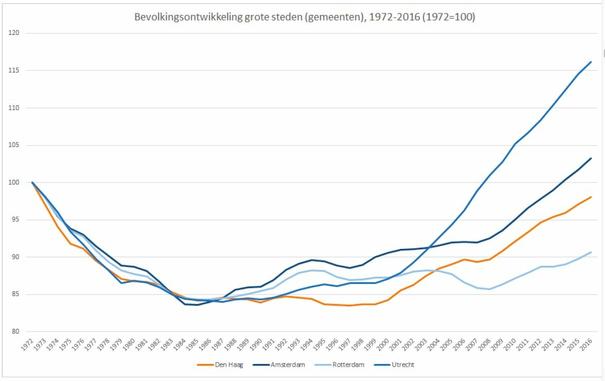
— and/or moved out to the suburbs/commuter towns (there was a big exodus from cities like Amsterdam in the '70s/80s! See attached chart and https://twitter.com/almodozo/status/1017078006945320960)

— and to some extent of course the resistance is still there, just the Overton Window has moved what the debates revolve around.

Joost on Twitter

“This chart about the population of the 4 large #Netherlands cities (via https://t.co/YQNGnFxlpb) helps me more consciously realize why; I was in my teens right when the numbers hit rock bottom. It wasn't quite like Budapest, but there's an echo.”

Twitter

@dariohudon @forpeterssake

As for what the arguments against it were — same as anywhere I guess. Shopkeepers complaining that reducing or eliminating car traffic would destroy their business. Car owners complaining that it would make the everyday life of "regular working people" harder.

@dariohudon @forpeterssake

Some of that was in bad faith of course (a lot of working class people relied on public transport). Some of it was disproven (pedestrian zones turned out to boost commerce — though it's true that there were probably segmentated differences, in that the shops that flourished weren't necessarily the same ones as were there before). But the arguments are evergreen.

@dariohudon @forpeterssake

But @forpeterssake makes a good point, though. It's hard to imagine now how deeply entrenched the belief in urban government was that cars, and direct traffic in general, were the future, and responsible governance meant literally paving the way for that future.

In Amsterdam, whole historical neighbourhoods that are now cherished tourist destinations were destined for the chop to make way for highways right into the city.

@dariohudon @forpeterssake

And we're talking about Labour and Communist politicians, who saw it as part of a greater vision of working class prosperity, replacing inner city slums with life in modern suburbs.

It took literal riots to stop some of this destruction (tho tbf it revolved primarily around a new subway line in that case). And a cultural and generational seachange to change the mindset, as some rebels of the 1970s became policy makers and urban planners in the 1980s.

/Sorry, long.

@almodozo @forpeterssake Thank you so much for sharing this Joost!

I’m going to process and then reply :)

@dariohudon *takes bike, heads to 5th Avenue* 😁 #nyc
@dariohudon You can also read about Denmark and their bikes
Why Many Cities Suck (but Dutch Cities Don't)

YouTube
How Highways Almost Destroyed Amsterdam - Plan Jokinen

YouTube
@dariohudon 太有意义,也太震撼了!我一直把荷兰和德国比较,狂赞荷兰的自行车道修得宽大漂亮,德国骑自行车的几乎没有车道,基本被汽车占领了,想不到荷兰还有这段抗议的历史、果然不论在任何国家,不管任何政权 都不会主动让利于人民,不管多么微小- 所有的权利都是人们一点点抗争出来的
@dariohudon suggest you follow @hembrow and read his large library on Dutch Cycle infrastructure including history and design improvements.
@Dave42W Cheers for the suggestion Dave :)
@dariohudon in #germany if you block streets and you are not a car driver causing a traffic jam you may be jailed and treat as terrorist
@dariohudon frustrating: the article talks about a video which I can't find...
@dariohudon Alright: found it on the other blog post.
@dariohudon I love the Dutch in large part because of their infrastructuur. Wish the U.S was more like this.
@dariohudon
The picture is great. Would you mind adding more information (alt text), or have I overseen it?

@interplanetarisch I did add some alt-text however, it may not have been as descriptive as it could have been. I will do better moving forward. It seems I can’t edit it once posted.

Here’s an addition to the current alt-text:

A black & white photo where hundreds of cyclists & their bikes are lying down on a road in a Dutch city.

They lie down in protest for safer roads for cyclists.

This moment is considered one of many that helped the Netherlands become so bike friendly.

@dariohudon
It is such an impressive picture! Thanks for the description. Do you also know the date of the event?
So cool, @mhaenggi
have a look!

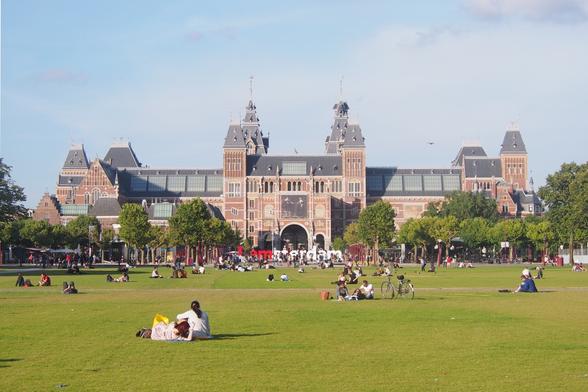
@interplanetarisch @mhaenggi It’s from a National demonstration on the Museumplein against traffic safety, 1977 (see picture of Museumplein today)

My original description of a road was incorrect, as the Museumplein in Amsterdam is a large public space. I found more information on the history of dutch cycle culture here: https://www.amsterdam.nl/nieuws/achtergrond/strijd-tussen-auto-fiets/

De strijd tussen auto en fiets

Eerst kwam de fiets en daarna de auto. Er volgde een keiharde strijd tussen de twee vervoersmiddelen.

Amsterdam.nl
@dariohudon das sollten wir in Wien auch tun!
@dariohudon Alles Terroristen, die sich da mit ihren Fahrrädern auf die Straße legten – nicht wahr, Herr #dobrindt ?

"Mass protests against the domination of cars were one factor that led to the superb cycling infrastructure of today's Netherlands."

Link to article in the above toot by @dariohudon

@dariohudon that’s logic when there is no hill anywhere why paying for petrol just for getting from A to B?