
So, it's time to talk about #aliens.

Is the search for #intelligent #life just an impossible search for a microscopic pin within a mountain-sized haystack? Or is there a way to try and be smart about how we search?

A thread about some work I've been involved with that addresses this question... (1/n)

If you enjoy the thread, and you think others may do too, then please #boost it!

Before we get into the nitty gritty, a little digression. You'll see the relevance shortly.

Imagine being offered a suitcase full of money if you manage to meet up with a complete stranger that day in #NewYork city. You don't know where. You don't know when. And you know nothing about the stranger other than that they have been made the same offer as you.

Somehow you need to #cooperate to win, but you can't #communicate because you don't know who to communicate with.

What do you do? (2/n)

This is a famous problem posed by #ThomasSchelling, a #Nobel prize winning #economist and a founding father of #GameTheory. He's also credited with the #ColdWar doctrine of #MutuallyAssuredDestruction, but that's another story.

This is an example of a game of cooperation between two non-communicating participants. And Schelling argued that there is a strategy that maximises the chance of success. (3/n)

The idea is that both need to consider likely meeting points. Natural choices would be famous landmarks or meeting spots. Outside the #EmpireStateBuilding? The lobby of #GrandCentralStation? There's maybe a few dozen spots people might go for. But that's a lot less than the number of buildings in #NewYork.

And a meeting time? Maybe noon, or 6pm. Maybe not 2.27 or 4.38. There seem to be preferred choices. #Schelling called these #FocalPoints. Today they're often called #SchellingPoints. (4/n)

So where do #aliens come into this? The Search for #ExtraterrestrialIntelligence, or #SETI, is a two player game involving us and them. Whoever they are.

We are basically playing an #interstellar version of the strangers meeting in #NewYork. But the incentive in this case isn't a suitcase full of money. It's the opportunity to establish contact.

Both parties must want to do so of course. But it'd be amazing if intelligent life is common yet we're the only ones wanting to say hello (5/n)

In 2018/19 I asked my Masters student, Andreea Dogaru, to investigate the potential #detectability of #Earth from other #star systems, assuming other #civilisations might use similar techniques to those we use to find #exoplanets. She did a great job and her dissertation showed from what regions of the sky Earth might be most detectable. (6/n)
https://www.research.manchester.ac.uk/portal/en/theses/a-new-strategy-for-seti-earth-as-an-exoplanet(8504194f-af3a-4e19-abf1-5bbe5f51b46b).html
A New Strategy for SETI: Earth as an Exoplanet | Research Explorer | The University of Manchester

One of the very few upsides of the #covid #pandemic is that it gave me more time to think a little more about Earth's detectability. Borrowing directly from the strangers in New York problem, i wrote a paper that put forward the idea of #MutualDetectability as a strategy for deciding which directions of the sky we might focus on to listen or for #SETI signals. (7/n)
So let's imagine there's an #alien #civilisation who, like us, wants to know if anyone else is out there. A good starting point might be to make use of naturally occurring signals at both ends that both sides can see and that indicate life could exist at the other end. If both sides recognise the natural signal and both realise the other may too then that's a strong #SchellingPoint. (8/n)

Even if one side is far more advanced, for the chances of #FirstContact to be maximised there needs to be #cooperative game play. This means both need to choose a #signal the other side may know about, even if they aren't as advanced.

A pretty simple signal is the #transit signal that occurs when a #planet passes directly in front of its #HostStar as seen by a distant observer. The #NASA #Kepker mission found thousands of #exoplanets this way (9/n)

The #transit signal allows us to know the size of an #exoplanet. It can also tell us whether the #planet is at the right temperature to allow liquid #water. We can also probe the #atmospheres of transiting planets, and potentially look for #chemical #signatures suggestive of #life. That's a lot of info from a very simple signal.

So, what if both sides live on planets that are visible as transiting planets to each other? That's a situation of #MutualDetectability. Both sides know it. (10/n)

They both know they can see each other. They could both know that each other's #planet is potentially #habitable. They can even figure out who sees the stronger transit signal. The one with the clearer signal may feel the onus of responsibility to transmit a #signal whilst the other listens out for one.

It turns out that most stars in our #Galaxy are fainter than the #Sun so have weaker transit signals. And we already know that these are relatively rich in potentially habitable planets. (11/n)

So, i #proposed in a paper that we should conduct a #survey for potential habitable transiting planets around low mass stars that are located close to the #ecliptic plane. Previous studies had already noted that #star systems near the ecliptic, the plane of #Earth's orbit of the #Sun, would be able to view the Earth in #transit.

Such a survey would give a short list of mutually detectable targets. We can then listen or look out for signals from them. (12/n)
https://iopscience.iop.org/article/10.3847/1538-3881/abcc5f

It's exciting that the #BreakthroughListen #SETI survey is monitoring for signals from #stars on the #ecliptic plane, though it's not focusing on transiting systems specifically. #NASAs #TESS transit mission is also looking for transiting planets on the ecliptic plane, though it may not have sufficient sensitivity to the most common stars in our #Galaxy, which are quite faint. (13/n)

The upcoming #NASA #Roman mission could do such s survey, perhaps focusing on a small area of the #ecliptic close to the #Galactic Centre where's there's a lot of stars. Such a survey would harvest a lot of exciting exoplanet science in itself, quite apart from the #SETI objective.

It'll be interesting to see if we find evidence for anyone out there. If they're game theorists, our chance of success may be better than we think.

End of thread.

@eamonn_kerins Fascinating thread! Thank you for this
@eamonn_kerins what would the signal constitute? A tight beam of some sort?
@alisca Most of the universe is made of hydrogen, which emits a natural signal at a frequency of 1.4GHz. but due to gas motions, and the expansion of the universe, that signal gets smeared out over a broad frequency range. In fact most astrophysical signals are broad band. So a very narrowband signal at 1.4GHz would be significant. Another possibility is a laser signal sent right at the time a planet starts to transit, right as others would be watching.

@eamonn_kerins talk about blink and you miss it.

It's such an interesting thought experiment: "if I was an alien, what would I do? Where would I look?" Where you and your team arrived is absolutely fantastic.

@eamonn_kerins That’s fascinating, thankyou. I imagine you’re much more familiar with the Fermi Paradox than I - we have been directly detectable, via radio signals, for about a century. Probably the nearest planet with advanced life is a good 100 light years away. By the time they sent a signal back, at the rate we are going with global heating etc, we would no longer be here to receive it, perhaps?
@onebiskuit yes i think communication is always likely to be one way. Like sending a message in a bottle.
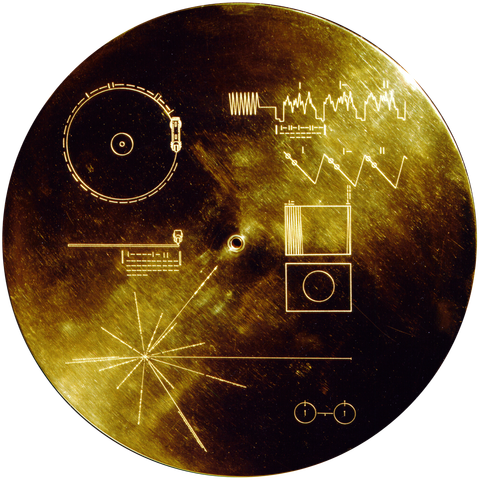
@eamonn_kerins Which I suppose is what the two Voyager spacecraft are, with their engraved plaques. Of course, it would take them millions of years to reach another world, unless a “USS Enterprise” boldly goes past it.
@eamonn_kerins Another idea is 'celestial opportunism.' Find things in our galaxy that would naturally attract alien attention - rotating neutron stars, novae, whatever. See if perchance our solar system is along the line-of-sight between potential exoplanets and those things. Direct a signal towards those aliens on the assumption that they might just be looking our way to observe those more distant celestial phenomena.

@eamonn_kerins

I do hope we find intelligent life somewhere, as there is very little evidence of it amongst the so-called "dominant" species on Earth. ...

🤔🤪🛸👽🧐

@eamonn_kerins How about placing an absorbing object at L4/L5? It could be done with large 100m lightsails that change position over time to creat a cadence. The matched set at L4 and L5 could transmit 2 bits of data per year, and not affect Earth satellite traffic.
@hendric if this is to block out our sunlight to other observers then 100m is very small. Earth is 12,000km in diameter but blocks only 80 parts per million of the sun's light during transit.
@eamonn_kerins i meant each individual sail, not the total area. I would target 10% of the earth's diameter since anyone who could detect us at that level should be able to detect a 10% drop at the lagrange points. That's only 1250 km, totally doable with solar sails. Probably need to be 2km each though, only need 400,000 of them. 😂
@eamonn_kerins intriguing, thank you. No doubt I'll be thinking about this most of the weekend.
@eamonn_kerins Thanks for this thread, very interesting. The odds for other technological civilizations hanging around in the galactic neighbourhood at the same time as we do may be very low, but it can't do any harm looking for them in a more targeted way, given that resources for doing so are limited.

@eamonn_kerins thanks for an informative thread.

Given #darkforest theory and the risk it poses, I imagine passive detection is the only safe bet for now. If other civs arrived at the theory as well, they’d likely be hiding also. Another interesting solution to #fermiparadox is that we’re under quarantine, that or a radical misunderstanding of the nature of reality means we’re barking up the wrong tree entirely. Lots to ponder.

@eamonn_kerins this is better than scifi
@eamonn_kerins Eamonn don't stop 👍🏻

@eamonn_kerins The problem as I see it though - is let's say that we happen to be the advanced civilisation (yeah I know - imagine...)

Let's say the other planet is roughly where we were around the 14th century. There is a significant chance that any signal we send could arrive before they are advanced enough to spot it.

And the same in the other direction, surely the signal they send would have to be at least 300+ years ago for it to arrive when we started looking.

@asjmcguire if nobody else is out there then we learn by looking that we are remarkable. If they're out there but not interested in communicating then we learn that we are remarkable as communicators.

Time is indeed a barrier. Only a handful of stars are within 300 light years of us. #SETI is like throwing a message in a bottle, but instead of traveling the ocean our signals traverse both time and space.

Discovering bottles aren't coming our way teaches us a lot about ourselves.

@asjmcguire @eamonn_kerins it’s worse than that. If you consider the age of our galaxy and even just consider a very generous species duration of 10M years, it’s very unlikely to find another species whose existence overlaps with ours temporally within a short enough distance to communicate at the speed of light. I love the idea of SETI, but even just our galaxy is too big and life too brief for species to connect.
@jeffkirvin @asjmcguire i think your conclusion of very unlikely depends on the density of intelligent civilisations at any given time. And we are only just beginning to place interesting limits on that. We learn by looking.
@asjmcguire @eamonn_kerins Fair enough, and I wish you luck! I’d love to be wrong here.
@jeffkirvin @eamonn_kerins oh absolutely - I'm just enjoying the conversation, it's not often we get the chance as "lay people" to have these discussions. Obviously I hope very much that we find that we are not alone.
@asjmcguire @jeffkirvin enjoyed the chat. I'll sign of for bed i think. Thanks for the interest.
@jeffkirvin @asjmcguire @eamonn_kerins there might be species that live a lot longer than we.
@jpmaertens @asjmcguire @eamonn_kerins That brings up the Great Filter and whether it’s even possible for any technological species to avoid destroying themselves. I’d like to believe it’s possible.
@eamonn_kerins My thought is, "Make our star blink." Set up big, impermanent solar sails. They have to be huge - say 25 trillion square miles - but they can be simple, just giant molecule-thin carbon tissues. Set up a factory on the back of Mercury to spit them out on a regular period. They unfurl and slowly get blown away from the sun by the solar wind in a widening spiral orbit along the plane of the ecliptic. /1
@eamonn_kerins From the perspective on any planet in our galactic plane, the brightness of our sun would begin to periodically decrease and resume - to blink - as the sails briefly pass in front of the star. If we wanted to get fancy we could vary the production of the sails to encode simple messages in the blinking - binary math or Fibonacci sequences. /2
@eamonn_kerins There are more robust, long-lived solutions that take a lot more tech - ringworld structures, etc. But this is comparatively 'inexpensive' and 'low tech.' Whether we could manufacture these using particles collected from the solar wind itself, or if we'd have to mine Mercury for the mass, I'm not sure. /x
@Albatross 25 trillion square miles is 40 times more than you need to block out the sun completely! That's a lot of carbon...
@eamonn_kerins eh, I looked at the area of Jupiter and raised it a couple orders of magnitude. I may have gone overboard...
@eamonn_kerins it's Friday evening. It's horrible out. You wanna tell us about SETI and aliens? Let's do it
@eamonn_kerins How do you boost it?
@ianmaher2011 it's the one that looks like the retweet button on Twitter (or i suppose i should say the #BirdSite as they call it here 😊) There's no "algorithm" on mastodon and favouriting a post (or "toot") does not put into the timeline of your followers. So the way to circulate toots to others is to boost them.
@eamonn_kerins thanks this is interesting!
@eamonn_kerins I’ve seen a UFO, so they exist. But not sure about getting in contact with them - would be like one of the remote Amazon tribes being “contacted” by Western civilisations in the past, where the tribe was in effect killed off (and we are the tribe)
@tmyerscough @eamonn_kerins
I don’t understand why we would encourage aliens to come to planet earth. Stephen Hawking warned against it, if they were intelligent enough to be able to travel here, they would want to be the dominant species.
@lovehonestyrespect @eamonn_kerins and pillage the earth of all its resources and kill most of us - there may be a few intellectuals they would take with them
@eamonn_kerins How far away do you think an intelligent communicating civilization can be before their signals get lot in the background radiation?

@eamonn_kerins

Excellent thread, great thinking...