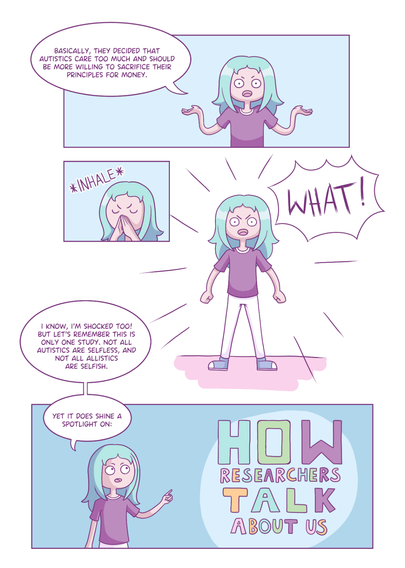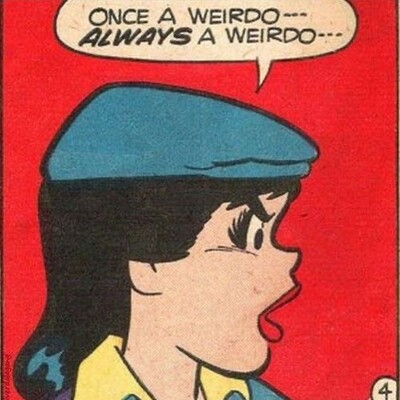
There has been a lot of research about autistics over the years, but this one really took the cake! 🍰

Find out what happened when researchers attempted to compare the moral compass of autistic and non-autistic people... (1/2)

#actuallyautistic #autism #neurodivergence #comic #art #MastoArt

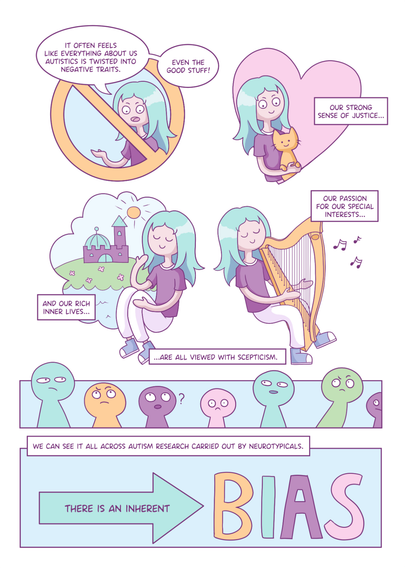
The research was fundamentally flawed and should not be used as evidence that one group is better than the other. It does, however, highlight the problem of biased research that stigmatises everything about us.
@newtsoda In other cultures this would be called siddhahood.

@rimibchatterjee @newtsoda

I’d never heard that term before.

Very interesting concept.

@newtsoda Do you have an URL for the research itself?

I'm interested in the results even if the conclusion seems as flawed as you mention.

Right Temporoparietal Junction Underlies Avoidance of Moral Transgression in Autism Spectrum Disorder

Autism spectrum disorder (ASD) is characterized by a core difference in theory-of-mind (ToM) ability, which extends to alterations in moral judgment and decision-making. Although the function of the right temporoparietal junction (rTPJ), a key neural marker of ToM and morality, is known to be atypical in autistic individuals, the neurocomputational mechanisms underlying its specific changes in moral decision-making remain unclear. Here, we addressed this question by using a novel fMRI task together with computational modeling and representational similarity analysis (RSA). ASD participants and healthy control subjects (HCs) decided in public or private whether to incur a personal cost for funding a morally good cause (Good Context) or receive a personal gain for benefiting a morally bad cause (Bad Context). Compared with HC, individuals with ASD were much more likely to reject the opportunity to earn ill gotten money by supporting a bad cause than were HCs. Computational modeling revealed that this resulted from heavily weighing benefits for themselves and the bad cause, suggesting that ASD participants apply a rule of refusing to serve a bad cause because they evaluate the negative consequences of their actions more severely. Moreover, RSA revealed a reduced rTPJ representation of the information specific to moral contexts in ASD participants. Together, these findings indicate the contribution of rTPJ in representing information concerning moral rules and provide new insights for the neurobiological basis underpinning moral behaviors illustrated by a specific difference of rTPJ in ASD participants. SIGNIFICANCE STATEMENT Previous investigations have found an altered pattern of moral behaviors in individuals with autism spectrum disorder (ASD), which is closely associated with functional changes in the right temporoparietal junction (rTPJ). However, the specific neurocomputational mechanisms at play that drive the altered function of the rTPJ in moral decision-making remain unclear. Here, we show that ASD individuals are more inflexible when following a moral rule although an immoral action can benefit themselves, and experience an increased concern about their ill-gotten gains and the moral cost. Moreover, a selectively reduced rTPJ representation of information concerning moral rules was observed in ASD participants. These findings deepen our understanding of the neurobiological roots that underlie atypical moral behaviors in ASD individuals.

Journal of Neuroscience

@newtsoda @Lrrr

thank you for the source. it’s even more disgusting than I thought. It’s so glaring that as researchers, they should have become AT LEAST as interested in the poor moral decisions of one group, instead of pathologising the other for their „inflexible“ consistency in Not! Taking! BRIBES!

#actuallyautistic

@newtsoda I'm sorry if this is perhaps slightly off topic but those image descriptions are beautiful. I just wanted to thank you for putting in the time for writing them so detailed. Thank you so much!
@talon Thank you! I tried my best 😂
@newtsoda I have to rely on image descriptions and I thought they were excellent! 
@talon I don't *need* the image descriptions, but it always makes me happy to see that people are putting them! Thanks @newtsoda! 😇

oh wow, yes! Those alt texts are an excellent summary. I'd skipped over the images because I found them hard to parse on my phone and I'm so glad I went back to read.

Thanks @talon for mentioning it and thanks so much @newtsoda for the effort you put in!

@newtsoda So extremely infuriating. "Personal failing: avoids hypocrisy."

@newtsoda fabulous work, thank you for that! And thank you for image descriptions ✊🏽

Great to have you here! 🙂

@newtsoda This sort of reminds me of how, for a long long time we where discussed as though we didn't have empathy, where as if anything we, the issue we have an overabundance of empathy & are frequently overwhelmed by it.
@ABrightGreenCity
So true! I have a comic on this that I'll be posting soon.
@newtsoda this is really good, thank you

@newtsoda

Honestly, I just like your last page there.

@newtsoda i am autistic and i think that a high percentage of autistic people care about social justice, but let us remember Elon is supposedly autistic tio and hos a self serving a-hole.
@Preston @newtsoda I initially read that as "self driving" instead of "self-serving". 🤭
Need to slow down with the Elon-memes, maybe. 🙈
@Preston Autistics, like everyone else, are capable of a vast range of personalities, beliefs and behaviours. And, like everyone else, should be held accountable for their actions.
@Preston @newtsoda he also liked a post that said "sterilize autistic kids"
Like what the fuck
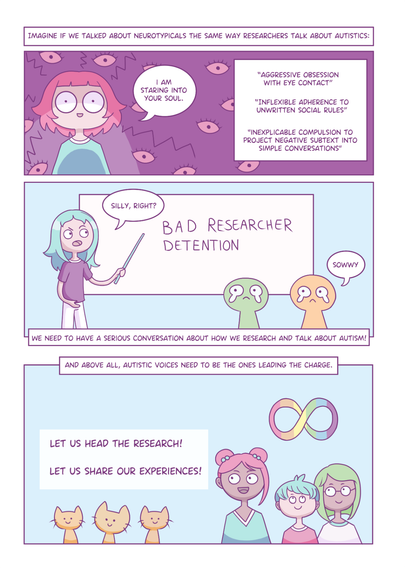
@newtsoda wow, this really puts things clearly. Also I love the descriptions on the last page! "Inflexible adherence to unwritten social rules" indeed!
@newtsoda "INEXPLICABLE COMPULSION TO PROJECT NEGATIVE SUBTEXT INTO SIMPLE CONVERSATIONS" oh jeez this ruins me
@catboyslim @newtsoda I don't think I'm autistic, but I experience this a lot. Well, mainly online. Why are "normal" people like that?

@newtsoda
Great work! :-)
So the story basically is: people are assholes (at least if there is a benefit in it) and therefore not being an asshole makes you not “normal”.

Besides of the evil framing they decided to give this about autistic people: think about what this tells about how we perceive, build and expect societies to be.

@newtsoda This isn't just biased, it's terrible science. The hallmark of autism is a lower engagement with social norms. Of course autistic people were less likely than allistics to have different views in public than private. (As for higher general morality, that wouldn't shock me either. And I say this as someone who's allistic.)

@newtsoda

Flawed study, but as an anecdote, it does resemble my real world observation that we behave with a more consistent conviction than NTs (which I contest that they are 'typical', rather they're favoured for being easier to exploit under capitalism)

I remember reading a study showing we've a lower representation among hate groups, attributed to having trouble handling the cognitive dissonance that keeps someone entrenched in bigotry
But he'll if I can find the bloody thing again

@Skovheks @newtsoda
Bigotry is illogical. 🤷‍♀️
It fails before even getting to the morals around it.

@newtsoda

I am perfectly OK with being "too concerned about my moral compass" because at least I don't have to have a bad memory to have a good conscience

@newtsoda I love that last panel. “Inexplicable compulsion to project negative subtext into simple conversations” indeed!
@newtsoda I teach a behavioural public policy class for cognitive science students, and I prepare a session about neurodiversity.
I'd like to (i) ask permission to provide my students with these panels (strictly in an academic setting, and as a cautionary tale) and (ii) know the reference of the research paper. Would that be possible?

@MathieuP @newtsoda

I came to ask for the research paper's name as well, as I couldn't with good consience share the comic forward just because it fits my bias :)

So in case you get an answer (and I realise this is an old thread and the author might well have it muted), please tag me as well, if you can be bothered.

EDIT: Source https://wandering.shop/@newtsoda/109314849992881056

Newtsoda (@[email protected])

@[email protected] https://www.jneurosci.org/content/41/8/1699

The Wandering Shop
Right Temporoparietal Junction Underlies Avoidance of Moral Transgression in Autism Spectrum Disorder

Autism spectrum disorder (ASD) is characterized by a core difference in theory-of-mind (ToM) ability, which extends to alterations in moral judgment and decision-making. Although the function of the right temporoparietal junction (rTPJ), a key neural marker of ToM and morality, is known to be atypical in autistic individuals, the neurocomputational mechanisms underlying its specific changes in moral decision-making remain unclear. Here, we addressed this question by using a novel fMRI task together with computational modeling and representational similarity analysis (RSA). ASD participants and healthy control subjects (HCs) decided in public or private whether to incur a personal cost for funding a morally good cause (Good Context) or receive a personal gain for benefiting a morally bad cause (Bad Context). Compared with HC, individuals with ASD were much more likely to reject the opportunity to earn ill gotten money by supporting a bad cause than were HCs. Computational modeling revealed that this resulted from heavily weighing benefits for themselves and the bad cause, suggesting that ASD participants apply a rule of refusing to serve a bad cause because they evaluate the negative consequences of their actions more severely. Moreover, RSA revealed a reduced rTPJ representation of the information specific to moral contexts in ASD participants. Together, these findings indicate the contribution of rTPJ in representing information concerning moral rules and provide new insights for the neurobiological basis underpinning moral behaviors illustrated by a specific difference of rTPJ in ASD participants. SIGNIFICANCE STATEMENT Previous investigations have found an altered pattern of moral behaviors in individuals with autism spectrum disorder (ASD), which is closely associated with functional changes in the right temporoparietal junction (rTPJ). However, the specific neurocomputational mechanisms at play that drive the altered function of the rTPJ in moral decision-making remain unclear. Here, we show that ASD individuals are more inflexible when following a moral rule although an immoral action can benefit themselves, and experience an increased concern about their ill-gotten gains and the moral cost. Moreover, a selectively reduced rTPJ representation of information concerning moral rules was observed in ASD participants. These findings deepen our understanding of the neurobiological roots that underlie atypical moral behaviors in ASD individuals.

Journal of Neuroscience
@newtsoda
This keeps getting shared but never cites the publication from which it came. Please feel free to include.

@ReneMeadowbloom @newtsoda

I was concerned about the lack of citation myself, but apparently OP delivered: https://wandering.shop/@newtsoda/109314849992881056

Newtsoda (@[email protected])

@[email protected] https://www.jneurosci.org/content/41/8/1699

The Wandering Shop
Right Temporoparietal Junction Underlies Avoidance of Moral Transgression in Autism Spectrum Disorder

Autism spectrum disorder (ASD) is characterized by a core difference in theory-of-mind (ToM) ability, which extends to alterations in moral judgment and decision-making. Although the function of the right temporoparietal junction (rTPJ), a key neural marker of ToM and morality, is known to be atypical in autistic individuals, the neurocomputational mechanisms underlying its specific changes in moral decision-making remain unclear. Here, we addressed this question by using a novel fMRI task together with computational modeling and representational similarity analysis (RSA). ASD participants and healthy control subjects (HCs) decided in public or private whether to incur a personal cost for funding a morally good cause (Good Context) or receive a personal gain for benefiting a morally bad cause (Bad Context). Compared with HC, individuals with ASD were much more likely to reject the opportunity to earn ill gotten money by supporting a bad cause than were HCs. Computational modeling revealed that this resulted from heavily weighing benefits for themselves and the bad cause, suggesting that ASD participants apply a rule of refusing to serve a bad cause because they evaluate the negative consequences of their actions more severely. Moreover, RSA revealed a reduced rTPJ representation of the information specific to moral contexts in ASD participants. Together, these findings indicate the contribution of rTPJ in representing information concerning moral rules and provide new insights for the neurobiological basis underpinning moral behaviors illustrated by a specific difference of rTPJ in ASD participants. SIGNIFICANCE STATEMENT Previous investigations have found an altered pattern of moral behaviors in individuals with autism spectrum disorder (ASD), which is closely associated with functional changes in the right temporoparietal junction (rTPJ). However, the specific neurocomputational mechanisms at play that drive the altered function of the rTPJ in moral decision-making remain unclear. Here, we show that ASD individuals are more inflexible when following a moral rule although an immoral action can benefit themselves, and experience an increased concern about their ill-gotten gains and the moral cost. Moreover, a selectively reduced rTPJ representation of information concerning moral rules was observed in ASD participants. These findings deepen our understanding of the neurobiological roots that underlie atypical moral behaviors in ASD individuals.

Journal of Neuroscience
@raboof @ReneMeadowbloom theres actually a cool comment on it lol
@lena @ReneMeadowbloom ha I hadn't noticed that yet, nice
@newtsoda I'd love a link to the study, thanks! :)
@newtsoda We get to use it as research on researchers. Luckily, you don't need an ethics committee approval to research the researchers while they're duped into thinking that it is them who are the researching.
@newtsoda Very interesting! Could you provide a reference to that study, btw?
@newtsoda @sheromon I used to work in an autism research lab, and the way they explained the difference between my (non-autistic) interest in video games and an autistic "circumscribed interest" in video games was that the latter was "excessive". It took me a couple of years to think "excessive for whom?"

@newtsoda

I feel like there's an inherent issue with labels, given that words are both subjective and general.

The word tree definitely means something, but there are a lot of types of trees.

For example, somebody with an addiction to their smartphone might become hyperactive for stimulation when they're left without it.

We might call them ADHD, but the exact causes and effects are debatable.

@newtsoda
Obvious result when you start with a bias that the group you are studying is the unhealthy group and the control group is obviously the healthy group, because they are "normal".
@newtsoda This is really interesting!! Can I ask the reference about the study you're talking about?
@newtsoda That's some very flawed research there
@newtsoda I remember this study and it makes me so angry.
@newtsoda I spotted this research a little while ago at the beginning of my self-dx journey and was shocked. After a year+ of following #ActuallyAutistic peeps I am no longer surprised but still saddened.
Also, is this your comic? It's beautiful 😍
@joyful It is, thank you! I'm so glad we have #ActuallyAutistic voices starting to fight back against these unfair representations. ^^

@newtsoda if there's a way to talk about #autism negatively, you can bet a researcher has done it.

#Morality #ethics #ActuallyAutistic