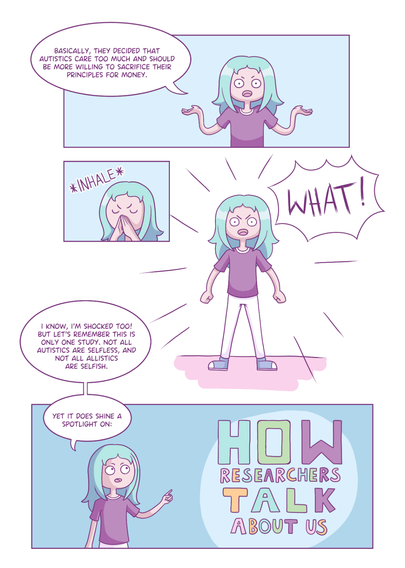
There has been a lot of research about autistics over the years, but this one really took the cake! 🍰

Find out what happened when researchers attempted to compare the moral compass of autistic and non-autistic people... (1/2)

#actuallyautistic #autism #neurodivergence #comic #art #MastoArt

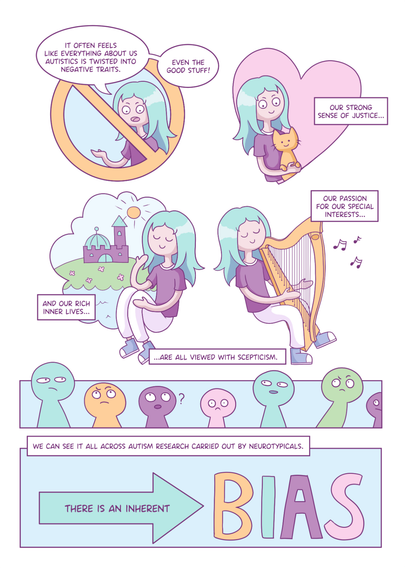
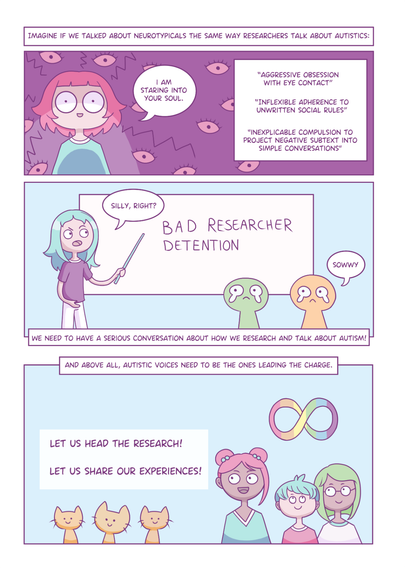
The research was fundamentally flawed and should not be used as evidence that one group is better than the other. It does, however, highlight the problem of biased research that stigmatises everything about us.

@newtsoda Do you have an URL for the research itself?

I'm interested in the results even if the conclusion seems as flawed as you mention.

Right Temporoparietal Junction Underlies Avoidance of Moral Transgression in Autism Spectrum Disorder

Autism spectrum disorder (ASD) is characterized by a core difference in theory-of-mind (ToM) ability, which extends to alterations in moral judgment and decision-making. Although the function of the right temporoparietal junction (rTPJ), a key neural marker of ToM and morality, is known to be atypical in autistic individuals, the neurocomputational mechanisms underlying its specific changes in moral decision-making remain unclear. Here, we addressed this question by using a novel fMRI task together with computational modeling and representational similarity analysis (RSA). ASD participants and healthy control subjects (HCs) decided in public or private whether to incur a personal cost for funding a morally good cause (Good Context) or receive a personal gain for benefiting a morally bad cause (Bad Context). Compared with HC, individuals with ASD were much more likely to reject the opportunity to earn ill gotten money by supporting a bad cause than were HCs. Computational modeling revealed that this resulted from heavily weighing benefits for themselves and the bad cause, suggesting that ASD participants apply a rule of refusing to serve a bad cause because they evaluate the negative consequences of their actions more severely. Moreover, RSA revealed a reduced rTPJ representation of the information specific to moral contexts in ASD participants. Together, these findings indicate the contribution of rTPJ in representing information concerning moral rules and provide new insights for the neurobiological basis underpinning moral behaviors illustrated by a specific difference of rTPJ in ASD participants. SIGNIFICANCE STATEMENT Previous investigations have found an altered pattern of moral behaviors in individuals with autism spectrum disorder (ASD), which is closely associated with functional changes in the right temporoparietal junction (rTPJ). However, the specific neurocomputational mechanisms at play that drive the altered function of the rTPJ in moral decision-making remain unclear. Here, we show that ASD individuals are more inflexible when following a moral rule although an immoral action can benefit themselves, and experience an increased concern about their ill-gotten gains and the moral cost. Moreover, a selectively reduced rTPJ representation of information concerning moral rules was observed in ASD participants. These findings deepen our understanding of the neurobiological roots that underlie atypical moral behaviors in ASD individuals.

Journal of Neuroscience

@newtsoda @Lrrr

thank you for the source. it’s even more disgusting than I thought. It’s so glaring that as researchers, they should have become AT LEAST as interested in the poor moral decisions of one group, instead of pathologising the other for their „inflexible“ consistency in Not! Taking! BRIBES!

#actuallyautistic