PrimeFaces ist eine Komponentenbibliothek für Jakarta Faces, früher meistens unter dem Namen JavaServer Faces oder kurz JSF bekannt. Die ganz kurze Antwort wäre also: PrimeFaces ist ein Framework beziehungsweise eine UI-Bibliothek für Java-Webanwendung...

https://magicmarcy.de/primefaces-in-java-praktischer-baukasten-oder-versteckte-magie

#PrimeFaces #Java #XHTML #Komponenten #Jakarta #Bean #Faces #JavaScript #Framework #Webentwicklung #Baukasten #Komponentenbibliothek #Coding #Programming

PrimeFaces in Java: Praktischer Baukasten oder versteckte Magie? | magicmarcy.de

PrimeFaces ist eine Komponentenbibliothek für Jakarta Faces, früher meistens unter dem Namen JavaServer Faces oder kurz JSF bekannt. Die ganz kurze Antwort wäre also: PrimeFaces ist ein Framework beziehungsweise eine UI-Bibliothek für Java-Webanwendungen. Diese Antwort ist nicht falsch, aber sie ist zu grob. Sie erklärt nicht, warum PrimeFaces anders funktioniert als viele moderne Frontend-Frameworks und warum man damit in Java-Projekten recht schnell brauchbare Weboberflächen bauen kann.

magicmarcy.de

La historia de Internet no fue obra de una sola mente brillante, sino de una comunidad de ingenieros que construyeron, probaron, corrigieron y estandarizaron cada pieza.

𝐑𝐚𝐠𝐠𝐞𝐭𝐭 merece estar en esa conversación.

#daveraggett #worldwideweb #html #http #XHTML #W3C #INTERNET #retrocomputingmx #InternetHistory

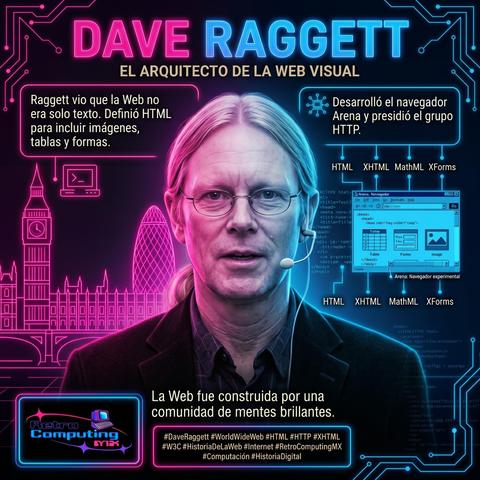
También fue clave en el trabajo temprano alrededor de 𝗛𝗧𝗧𝗣: ayudó a lanzar y presidió el grupo de trabajo HTTP en la IETF. Más adelante participó en estándares como 𝖧𝖳𝖬𝖫 4, 𝖷𝖧𝖳𝖬𝖫, 𝖬𝖺𝗍𝗁𝖬𝖫, 𝖷𝖥𝗈𝗋𝗆𝗌 y otros proyectos del W3C.

Mientras Berners-Lee imaginó la Web, 𝐑𝐚𝐠𝐠𝐞𝐭𝐭 ayudó a darle forma técnica, estructura y posibilidades reales de publicación.

#daveraggett #worldwideweb #html #http #XHTML #W3C #INTERNET #retrocomputingmx #InternetHistory

servidores experimentales, participó en la evolución de HTML, impulsó propuestas como HTML+ y HTML 3.0, y desarrolló Arena, un navegador experimental que servía para probar nuevas capacidades del lenguaje.

Su visión era clara: la Web no debía ser solo texto enlazado. Debía permitir documentos más expresivos, con imágenes, tablas, formularios y estructuras capaces de parecerse más a una publicación digital moderna.

#daveraggett #worldwideweb #html #http #XHTML #W3C #INTERNET #retrocomputingmx

Detrás de la evolución real de la Web hubo otros nombres decisivos. Uno de ellos fue 𝐃𝐚𝐯𝐞 𝐑𝐚𝐠𝐠𝐞𝐭𝐭, un pionero británico de la computación que ayudó a convertir la Web primitiva en una plataforma mucho más rica, visual y funcional, nacido por cierto en la misma fecha que Berners-Lee (08/Jun/55)

𝐑𝐚𝐠𝐠𝐞𝐭𝐭 comenzó a involucrarse con la Web en 1992. Desde Hewlett-Packard Labs trabajó en navegadores y...

#daveraggett #worldwideweb #html #http #XHTML #W3C #INTERNET #retrocomputingmx #InternetHistory

Edit: Aaaaaa I got like 100 really good offers about this already, you can stop sharing and replying now this is getting overwhelming D:

Okay, let me be random for a second.

This being Fedi, I know there will be someone reading this who is a chronically depressed, poly disaster transfem always narrowly avoiding poverty by being a somewhat-but-not-really successful self-employed freelance web developer, who has strong opinions about the modern web, free software, the semantic web and structured data, and who kind-of-but-not-really mourns what XHTML could have been while actually thinking HTML5 as written is kinda neat, but who is constantly forced by Society (tm) to work with React, Wordpress and awful bloated web app frameworks to create terrible, non-semantic style-first web applications for ungrateful clients.

I can't guarantee anything but let's say, I know someone who needs a static website for their business. Hypothetically, uh, where could that someone reach out to you? Paid, of course.

#webDev #webDesign #askFedi #trans #xhtml #semanticWeb #freeSoftware #queer #getFediHired

It turns out that I’ve mostly been writing #XHTML when I thought I was writing #HTML for the past 25 years.

I was never cognizant of the fact that it was closer to XHTML than HTML.

But that does help explain why I thought that the HTML that I’ve been writing was so close to #XML.

🤔💡😁

@gugurumbe

Yes, thank you. It is a bit of everything. Where I worked in Print production at the time we used all the XML standards to max extent and got great benefit from doing so. It all crumbled down very quickly with the take-off of Web where #JSON mapped way better to JS than #XML did, esp. when also honoring the intricate web of (de-facto) standards that had emerged, and how the XML ecosystem got captured by corporations peddling expensive products, such Enterprise service buses and the like.

It would have been great if #XHTML had stuck around. In hindsight the shift to HTML5 may be seen as a move by the WHATWG to establish their dominance over the #browser market.

As for #JSONLD it must see to rewin hearts and minds, must inspire and convince people to take the bet of adopting it.

Right now I like the #indieweb #webmentions / #microformats more than #activitypub / #jsonld, because the author chooses which replies appear below their post. I think it would be better if there was an expectation to regularly validate the webmentions (we have HTTP caching for that), and also for #xhtml instead of html. I’m not familiar with the LD markup languages, but maybe there exists something more interoperable than microformats (with proper URIs for properties).