Finished writing up my notes from the deployment of our latest home server and our switch to uCore: https://github.com/scottsweb/hamlet

Highlights include local SSL, an in home Steam server with Wolf and services that scale to zero when not in use (thanks to Sablier).

#selfhosting #homelab #universalblue #ucore

GitHub - scottsweb/hamlet: uCore home server with podman quadlets for Home Assistant, VPN, Pi-Hole, MQTT, Caddy and more...

uCore home server with podman quadlets for Home Assistant, VPN, Pi-Hole, MQTT, Caddy and more... - scottsweb/hamlet

GitHub
Finally buckled down to learn how to set up #Ucore (based on #CoreOS). The biggest challenge was figuring out that trying to run the LiveISO from a USB 2.0 port was causing it to timeout and drop into recovery mode.

@vavakado I'm in a similar situation for my servers and have been experimenting with #ublue #uCore.

I only need Podman so i went with the ucore-minimal:stable image (Docker is also included) but ucore-hci:stable-nvidia has everything you mentioned wanting.

So far everything is running great on my test machine so i think i'm going to switch in the next week or so.

https://github.com/ublue-os/ucore

GitHub - ublue-os/ucore: An OCI base image of Fedora CoreOS with batteries included

An OCI base image of Fedora CoreOS with batteries included - ublue-os/ucore

GitHub
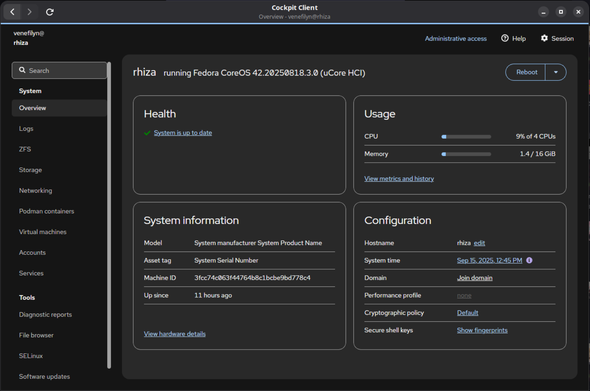
I has now finally deployed my homelab server. It's called rhiza and uses CoreOS-based uCore from Universal Blue.

Already got some services up and running and I've also configured it to redirect traffic from my home assistant subdomain to the home assistant server too.


Still have a few services to configure, and I kinda want a Cockpit bootc integration now instead of ostree as it doesn't fully work as it should. Oh and I should poke sssd folks about passkeys and if we can use sssd for passkey auth in Cockpit..


#cockpit #sssd #homelab #coreos #universalblue #ucore

Had a uncomfortably large aha moment when I realized that, based on the way #fcos / #ucore works, I don't have to tear down and rebuild the VM to update configurations on everything, but instead define my own OCI/ostree image to load all my container configuration.

I've literally been destroying and rebuilding the image every time I've wanted to make a config change, or add a new service to the homelab. 

Cert creation was actually super smooth, thanks to my gateway device being on #opnsense . Defining the CAs and leaf certs was very straightforward through the interface.

Need to figure out a way to make sure the "tear down the vm and rebuild" cycle on the #ucore host it's running on doesn't blow away the stuff on the persistent volume. I thought it behaved, but apparently not so much. Fortunately, it's currently just RSS feeds, and I can always just reset via OPML file.

Thought bubble: Custom uCore as my NAS 🤔

Everything I do on my FreeBSD NAS is doable on uCore, but the main thing I have to think about is how to replicate my ISP-proof-FreeBSD-jail-using-ProtonVPN-for-torrenting setup. I could try using a VM, but I'm thinking LXC/Incus would be better.

As I recall, LXC was kind of not really straightforward to configure. If I could just edit a single configuration file for everything like I do with FreeBSD jails that would be great. Or even a modular, per-container configuration file setup.

I also should look into Cockpit as a web UI. I haven't used it in a while, so there's liable to be new features I haven't tried yet. It would be pretty cool if there was a Cockpit module for Incus/LXC containers.

#ucore #ublue #fedora #Linux #FOSS #containers #NAS #coreos

I’m running out of computers to put #universalblue images onto. My laptop has been on #bluefin since I think F38, and my home server is moving to #ucore when I get some spare time (I have already practiced in a VM what I want to do there).
I’m eyeing up other computers in the house now, like my kid’s windows laptop that won’t run Win11… :D
I’m a bit of a fanboy at this stage, but I really like the direction these system are going in.
#Linux

Let's see how things go with my #UniversalBlue #ZFS image now.

Updated to install the #CoreOS stable kernel, along with ZFS kmod from #UCore akmods-zfs image.

Great that @jorge and friends put the work for CoreOS style bi-weekly kernel cadence, thank you very much 👍

https://github.com/0ranki/silverblue-zfs

GitHub - 0ranki/silverblue-zfs: Universal Blue with preinstalled ZFS module

Universal Blue with preinstalled ZFS module. Contribute to 0ranki/silverblue-zfs development by creating an account on GitHub.

GitHub

@bitprophet seems very similar to what @UniversalBlue is doing, especially with #Bluefin. But so far I love using Bluefin. I do also love #Debian so might try VanillaOS on another computer or VM.

But yeah still looking to experiment with a headless immutable #homelab server OS that is, first of all, easy to install, and second, easy to manage (e.g. via Cockpit). I think Universal Blue’s #uCore does a lot of that but it’s confusing to install unless I’m just an idiot (likely).