“A bill of rights is what the people are entitled to against every government on earth, general or particular, and what no just government should refuse, or rest on inference.”*…
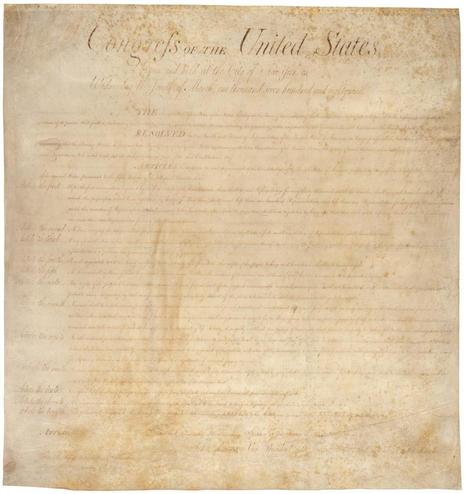
First page of an original copy of twelve proposed articles of amendment, as passed by Congress in 1789, and engrossed by
William Lambert (
source and transcription of the full document)
Following the often heated debate between Federalists and their opponents that led to the the ratification and adoption of the U.S. Constitution, the Anti-Federalists were still unsatisfied. Then-Representative James Madison, who studied the deficiencies of the Constitution pointed out by Anti-Federalists, collected proposals (16 in all), and then crafted a series of 12 proposed corrective amendments. Congress approved the twelve articles of amendment on September 25, 1789, and submitted them to the states for ratification. 10 were ultimately ratified– the first 10 amendments to our Constitution… or as we know them, The Bill of Rights.
In an excerpt from his book, Constitutional Myths: What We Get Wrong and How to Get It Right, Ray Raphael elaborates…
The Constitution of the United States, drafted in 1787 and ratified in 1788, did not follow the precedent set by these state constitutions. Despite spending almost four months drafting their new plan, the framers did not include within it a thoughtful listing of rights but only a scattering of guarantees. On September 12, just five days before the end of the Convention, George Mason finally suggested that delegates add a “Bill of Rights” similar to the state declarations of rights, but his motion failed to garner the support of a single state delegation.
Although state conventions ratified the Constitution, several included a caveat: the new plan should be amended as soon as possible. In fact, they proposed scores of amendments, some resembling provisions of what we now know as the Bill of Rights, but many others altering or even deleting structural features of the Constitution. New York’s convention coupled its list of proposed amendments with a demand for a second federal convention to consider these various proposals. The profusion of proposed amendments, plus the prospect of a second convention, frightened supporters of the Constitution, who feared that a new convention, if it met, would revise the fledgling Constitution before it could be put into effect and gut some of its major provisions.
Most leading Federalists hunkered down. In arguing against a second federal convention, they insisted that a bill of rights was not necessary and could even jeopardize rights that were not included. The job of the Constitution, they said, was to state what government could do, not what it couldn’t do. Rights already were secured because the government possessed no power that allowed it to impinge upon them. In fact, any catalog of specified rights would imply that rights were limited to those in the catalog, and not others.
James Madison and George Washington agreed with this argument, but they also took an accurate measure of people’s displeasure. It was strong and it was widespread. Rather than fight a rearguard action against the wave of discontent, they preferred to channel and control it. Article V of the Constitution stipulated that either Congress or state conventions might propose amendments. If Congress acted first, Madison and Washington reasoned, it could take charge of the issue and protect the substantive features of the new plan–congressional taxation, for instance–while giving ground elsewhere. Madison, meanwhile, pledged to his Virginia constituents that he would work to add a bill of rights if they elected him to represent them in Congress.
Once elected, in the First Federal Congress, Madison whittled down the large list of amendments suggested by the states’ ratifying conventions. With President Washington’s blessing, he proposed nineteen that did not endanger key constitutional components. After considerable debate and some revision, Congress pared Madison’s list down to twelve amendments, which it sent to the states for approval. Ten of these, which we call today the Bill of Rights, were ratified by three-quarters of the states, as required by the new Constitution. The genesis of the Bill of Rights, like the origins of the Constitution, was political as well as theoretical.
The short-term effect of the framing and ratification of the Bill of Rights was to put a Federalist stamp on the amendments and to doom the attempts by the Constitution’s opponents to modify the substantive or structural features of the new plan. The long-term effect was to reinforce America’s culture of rights and to infuse specific rights into American jurisprudence. After more than two centuries, the Bill of Rights, which had been so casually dismissed by the framers, figures so prominently in our minds that it often eclipses the Constitution itself. In an era when the word “government” has a bad name, the ten amendments that circumscribe the federal government’s authority over individuals are often viewed more favorably than the Constitution the framers created in 1787…
The backstory of the Bill of Rights, via the always-illuminating Delanceyplace.com
For more on the process that yielded them, and the texts of all 16 proposed amendments, see here.
* Thomas Jefferson, a critic of Federalists, in a 1787 letter to James Madison (who had originally been opposed to the idea of a “bill of rights,” both because he believed that the Constitution as written did not grant the federal government the power to take away people’s rights, and because he [and some other Framers] believed that we have natural rights too numerous to list– and that anything not explicitly included in a Bill of Rights would be unprotected.)
###
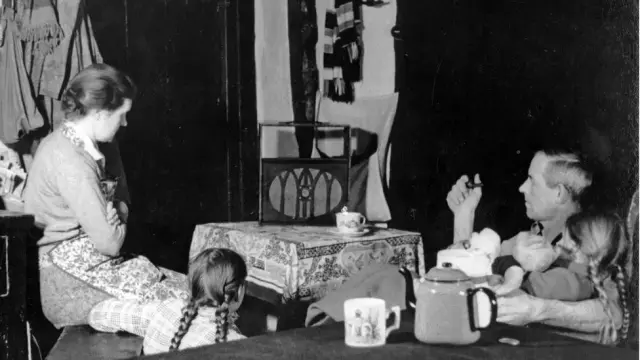
As we ponder precedent, we might recall that it was on this date in 1930 that a BBC newsreader had nothing to communicate. His entire script for the 8:45 pm news bulletin was: “There is no news”… after which piano music was played for the rest of the 15-minute segment. The wireless service then returned to broadcasting from the Queen’s Hall in London, where the Wagner opera Parsifal was being performed.
This was how most British people got their news in 1930 – listening to radio; TV broadcasts started six years later (
source)
#AntiFederalists #BBC #BillOfRights #Constitution #culture #dayWithNoNews #dayWithoutNews #Federalists #history #JamesMonroe #news #radio #rights #ThomasJefferson #wireless Liam O'Mara IV, PhD
 Lucas Bentley
 Italian News by RSS
 Wisdom in Space
 Front Page [Unofficial]
 YYYY in Canada
 Hublai (charismatic megafauna)
 www.MarekBennett.com
 (Roughly) Daily