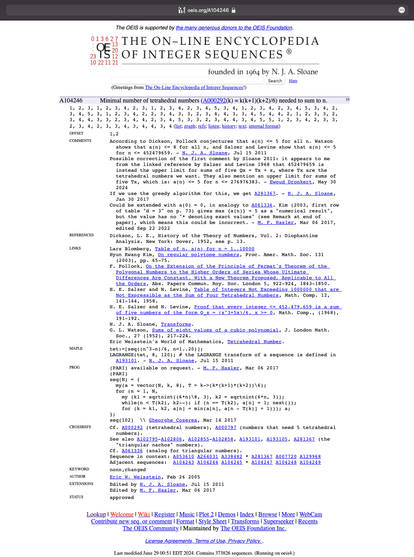
Very proud to have been published on Neil Sloane's Online Encyclopedia of Integer Sequences where I sent in a small correction after watching James Grime's Numberphile video on tetrahedral numbers https://youtu.be/CK3_zarXkw0 and reading the links at https://oeis.org/A104246

#tetrahedral #oeis #numberphile #mathematics

343867 and Tetrahedral Numbers - Numberphile

YouTube

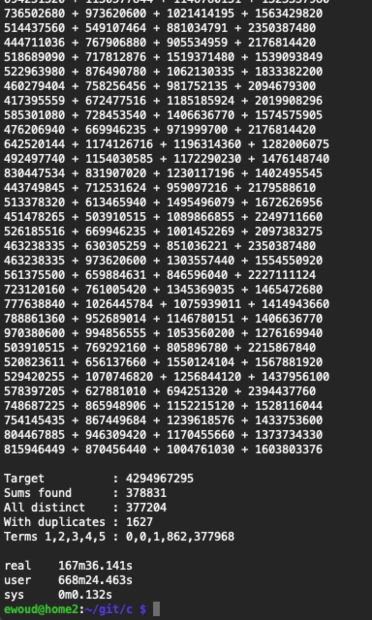
It took a little under 3 hours for my program on a #RaspberryPi 5 with 4 cores at 2.4 GHz to calculate that there are 863 #tetrahedral sums of up to 4 terms for the number 2^32-1, and another 377968 sums of 5 terms.

#programming #C #Clanguage #C_lang #mathematics #maths #math #numberphile #JournalOfRecreationalMathematics #compsci #PollocksConjecture

A couple of days ago I made a "combinations" function in #C that works the same as #Python itertools.combinations. I used it to help with a #Numberphile challenge, however I misunderstood: duplicates WERE allowed. So I binned it all, went back to nested loops and added multi-threading. Now it only takes about 0.01 s to calculate all #tetrahedral sums (up to 5 terms) of 343867 which is supposed to be the last one that requires more than 4 terms.

Works on #Mac and #Linux: https://github.com/ednl/tetrahedral/blob/main/tetrasum.c

tetrahedral/tetrasum.c at main Β· ednl/tetrahedral

Pollock's conjecture: any integer can be written as a sum of at most five tetrahedral numbers. - ednl/tetrahedral

GitHub

Heads-up! to https://arxiv.org/abs/2302.12209
"How to detect the spacetime curvature without rulers and #Clocks"
(A. V. Nenashev, S. D. Baranovskii)

-- which investigates the question (p. 2)
"Is it possible to figure out that a spacetime [region] is curved [instead conformally flat] by testing #CausalRelations only ?"

-- and provides proof of a positive answer through a criterion in terms of causal relations among any set of eight #events (#StitchConfiguration).

Closely related is the question
"Is it possible to figure out whether two (or more) participants are sitting still wrt. each other in a flat region (or whatever is equivalent in a conformally flat region) by testing causal relations only ?",

(referring to the notion of #InertialFrame in the sense of W. Rindler as "set of point particles sitting still wrt. each other"; cmp. http://www.scholarpedia.org/article/Special_relativity:_kinematics),

-- which is presumably solved by #tetrahedral-octahedral #PingCoincidenceLattices, closely related to #OctetTruss #PingCoincidenceLattices; see e.g. https://en.wikipedia.org/wiki/Tetrahedral-octahedral_honeycomb and https://www.google.com/search?q=%22octet+truss%22&tbm=isch&prmd=ivnbz

-- and where, notably, eight events in one particular variant of the #StitchConfiguration do indeed occur as integral part of those mentioned #PingCoincidenceLattices (namely, not surprisingly, depicted as #Octahedra in the familiar drawings of the corresponding "plain 3D" lattices).

#Relativity #Spacetime
How to detect the spacetime curvature without rulers and clocks

We demonstrate how one can distinguish a curved 4-dimensional spacetime from a flat one, when it is possible, relying only on the causality relations between events. It is known that it is possible only for spacetimes that are not conformally flat. We prove that if a spacetime is not conformally flat, then its non-flatness can be verified by only a few (sixteen) measurements of causal relations. Therefore the results of this paper clarify what can be said about flatness or non-flatness of the spacetime after a finite number of measurements of causal relations.

arXiv.org

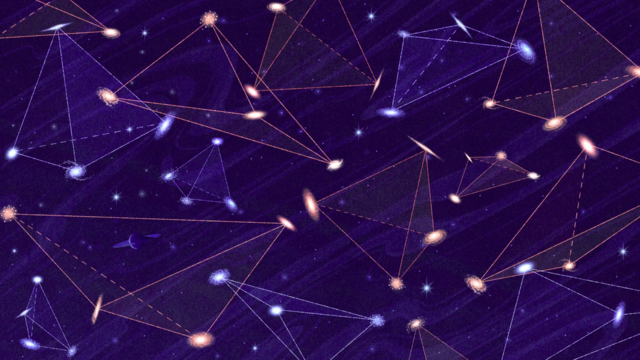
Asymmetry Detected in the Distribution of #Galaxies

https://www.quantamagazine.org/asymmetry-detected-in-the-distribution-of-galaxies-20221205/

Two new studies suggest that certain #tetrahedral arrangements of galaxies outnumber their mirror images, potentially reflecting details of the #universe’s birth. But confirmation is needed.

Asymmetry Detected in the Distribution of Galaxies | Quanta Magazine

Two new studies suggest that certain tetrahedral arrangements of galaxies outnumber their mirror images, potentially reflecting details of the universe’s birth. But confirmation is needed.

Quanta Magazine