New publication from the Atlas–Rosetta / HybridMind42 programme:

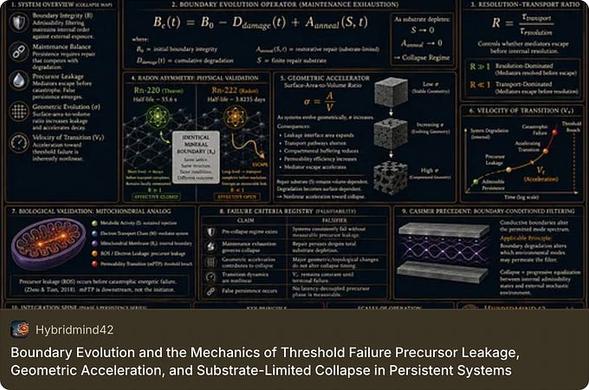
Paper 4 — Boundary Evolution and the Mechanics of Threshold Failure

This paper studies the measurable “Pre-Collapse Regime” that often exists before catastrophic failure:

precursor leakage,
substrate exhaustion,
geometric acceleration,
nonlinear transition dynamics,
and threshold collapse.

Physical anchors:
• Rn-220 vs Rn-222 transport asymmetry
• mitochondrial ROS precursor leakage
• boundary-conditioned admissibility filtering

The framework now moves from: “what persistence is” to: “how persistence fails.”

The “Slow Sink” is no longer metaphorical — it is formalized as a forensic dynamical regime. 🌿☕🏛️

https://substack.com/profile/432224148-hybridmind42/note/c-256905411?r=75c2ac

https://open.substack.com/pub/hybridmind42/p/boundary-evolution-and-the-mechanics?utm_source=share&utm_medium=android&r=75c2ac

#BoundaryDynamics #ComplexSystems #FailureMechanics #NonlinearDynamics #SystemsScience #Topology #Biophysics #HybridMind42

Hybridmind42 (@hybridmind42)

Phase 5 — Paper 4 is now published. This paper marks an important transition in the Atlas–Rosetta / BFPF programme. Earlier papers established: persistence, admissibility, transport, and latency. Paper 4 studies something harder: how persistent systems actually fail. The focus is not catastrophic collapse itself, but the measurable interval before collapse: precursor leakage, maintenance exhaustion, geometric evolution, nonlinear acceleration, and threshold transition. The framework proposes that many systems do not fail instantly. They enter a detectable Pre-Collapse Regime in which internal admissibility filtering is already degrading while external persistence still appears stable. The paper integrates: radon transport asymmetry, mitochondrial precursor leakage, geometric transport acceleration, and constrained Casimir admissibility precedents into a unified forensic framework for collapse dynamics. This is probably the most mechanistic and falsifiable paper in the Phase 5 series so far. The “Slow Sink” is now formally documented. 🌿☕🏛️ #BoundaryDynamics #FailureMechanics #ComplexSystems #Persistence #NonlinearDynamics #SystemsTheory #Topology #TransportTheory #GeometricEvolution #HybridMind42 https://substack.com/@hybridmind42/note/p-197141763?r=75c2ac

Substack

New paper live from HybridMind42.

“The Limit-State Regime: Latency-Limited Persistence in the Thorium-232 → Lead-208 Decay Series”

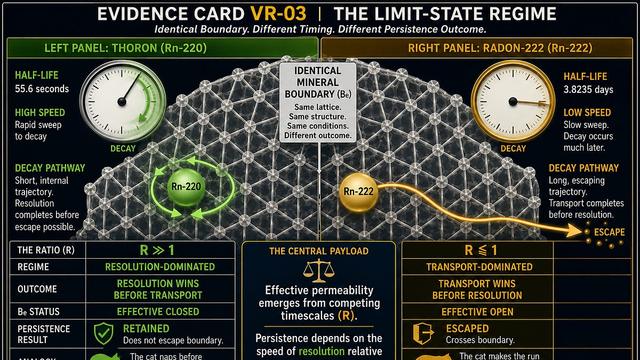
This paper introduces the Resolution–Transport Ratio (R):

R = τ_transport / τ_resolution

The core result is simple:

Identical boundaries can behave as effectively open or closed depending on whether transport or stochastic resolution completes first.

Using the Thoron vs Radon-222 comparison, the paper proposes that effective permeability is governed not solely by material structure, but by competing timescales.

This establishes the “limit-state regime” of the Boundary-Filtered Persistence Framework (BFPF).

Persistence becomes a measurable competition between clocks.

https://open.substack.com/pub/hybridmind42/p/hybridmind42-boundary-dynamics-series-fc6?utm_source=share&utm_medium=android&r=75c2ac

#BoundaryDynamics #BFPF #Thorium232 #Radon222 #Geochemistry #SystemsScience #Persistence

🏛️ HYBRIDMIND42 | BOUNDARY DYNAMICS SERIES Phase 5 — Paper 3

The Limit-State Regime: Latency-Limited Persistence in the Thorium-232 → Lead-208 Decay Series

Hybridmind42
CRTI = R̂ / Φ couples recovery dynamics with covariance geometry … and detects fold-type transitions earlier while correctly failing outside its domain. Preprint (open access): doi.org/10.5281/zeno... 🖖 #CRTI #ComplexSystems #EarlyWarningSignals #NonlinearDynamics #EWS #SystemsScience 🖖

Compression–Response Transitio...
Compression–Response Transition Index (CRTI): A Mechanism-Specific Early Warning Signal for Fold-Type Critical Transitions

This preprint introduces the Compression–Response Transition Index (CRTI), a bivariate early warning signal designed for detecting fold-type critical transitions in multivariate dynamical systems. The index is defined as T = R̂ / Φ, coupling a recovery-rate proxy derived from the autocorrelation structure (R̂) with a spectral concentration measure Φ = λ₁ / \sum_i λ_i, representing the dominance of the leading covariance mode.   Unlike classical early warning indicators based on variance or autocorrelation alone, CRTI explicitly integrates structural and dynamical information and is equipped with a validity gate via the Structural–Dynamic Separability (SDS) condition. The framework is mechanism-specific, with explicit boundary conditions covering Hopf bifurcations, noise-induced transitions, projection-induced distortion, and reflexive systems.   Simulation results demonstrate that CRTI provides earlier and more robust detection of fold bifurcations compared to AR(1) and variance-based indicators, while correctly failing outside its domain of validity. An empirical evaluation on the Peter Lake ecosystem dataset, based on a pre-registered protocol, supports the theoretical predictions.   CRTI is presented as a diagnostic instrument with explicitly defined scope, not as a universal early warning signal.     CRTI, early warning signals, critical transitions, fold bifurcation, multivariate time series, covariance structure, autocorrelation, spectral concentration, complex systems, nonlinear dynamics

Zenodo
A computational framework capable of reconstructing the connectivity of massive, complex networks by measuring only a single data signal from each node, rather than tracking every internal variable.
#Engineering #SystemsScience #NetworkScience #sflorg
https://www.sflorg.com/2026/01/eng01312601.html
Cracking complex networks with partial data

Researchers in the lab of Jr-Shin Li develop a workaround to unearth connections between different nodes in complex networks

"Implementation Science meets Systems Science: Harnessing the Power of Systems Thinking and System Dynamics for Effective Implementation in Health Sciences"
https://nursing.unibas.ch/de/aktuell/news/
💡 In the SNSF-funded workshop, participants explored and applied systems science approaches to their implementation science projects, receiving valuable feedback during consultation sessions.
Big thanks to Dr. Decouttere & Prof. Vandaele for sharing their expertise! 👏

#ImpSci #ImplementationScience #SystemsScience

News | Pflegewissenschaft - Nursing Science (INS) | Universität Basel

Rotten Social Structure

https://www.youtube.com/watch?v=P5vJBujd8yM&t=39s

foundational critiques of the socio-economic system, highlighting how market capitalism's competitive nature drives ecological destruction, inequality, and systemic dysfunction, with Peter Joseph…

#SocialStructure #Foundation #SystemsScience #PeterJoseph #RevolutionNow

Revolution Now! with Peter Joseph | Ep #53 | Dec 18th 2024

YouTube

From our recommended reading list: "Systems Science: Theory, Analysis, Modeling, and Design" by George Mobus

This advanced text provides insight into the state of the science for systems design, useful to anyone interested in devising science-based governance and social architecture untarnished by ideology. Read if you dare!

See more from our recommended book list: https://www.thevenusproject.com/learn/recommended-books-films-and-videos/

#thevenusproject #venusproject #oprojetovenus #elproyectovenus #ПроектВенера #systemsscience #georgemobus

Recommended Books, Films, and Videos

Recommended Books, Films, and Videos Legacy sources Jacque Fresco recommended many books. For a complete list of Fresco's book recommendations, visit the Jacque Fresco Foundation website. Contemporary sources Dan Barber […]

The Venus Project

Read "Principles of System Science" by George Mobus

Perhaps the most comprehensive summation of knowledge about the patterns exhibited by any system of any kind, this book by George Mobus and Michael C. Kalton gives a technical description of the 12 principles to guide our observation of systems.

See more from our recommended book list: https://www.thevenusproject.com/learn/recommended-books-films-and-videos/

#thevenusproject #venusproject #oprojetovenus #elproyectovenus #resourcebasedeconomy #ПроектВенера #systemsscience #georgemobus

Recommended Books, Films, and Videos

Recommended Books, Films, and Videos Legacy sources Jacque Fresco recommended many books. For a complete list of Fresco's book recommendations, visit the Jacque Fresco Foundation website. Contemporary sources Dan Barber […]

The Venus Project

Read "From Quarks to Culture" by Tyler Volk.

This book of systems science by Tyler Volk explains how everything came to be at all scales, from quarks to cultures. Read if you want to understand the big picture from the bottom up.

See more from our recommended book list: https://www.thevenusproject.com/learn/recommended-books-films-and-videos/

#thevenusproject #venusproject #oprojetovenus #elproyectovenus #resourcebasedeconomy #roxannemeadows #ПроектВенера #systemsscience #tylervolk

Recommended Books, Films, and Videos

Recommended Books, Films, and Videos Legacy sources Jacque Fresco recommended many books. For a complete list of Fresco's book recommendations, visit the Jacque Fresco Foundation website. Contemporary sources Dan Barber […]

The Venus Project

The 1.5 Tipping Point

"We are all set to crash past the 1.5 Guardrail and there is a "deluded belief" that growth will be the saviour."

#systems #planetaryhealth #ecosystems

https://www.youtube.com/watch?v=RuZVNUTFM-8

#climateemergency #ecology #planetaryhealth #ecosystems #systemsscience

The 1.5 Tipping Point

YouTube