 Splines
#Sinusoid from #Helix https://pixelfed.social/p/Splines/797893262102038801
Braid Geometry https://pixelfed.social/p/Splines/797916882329430160
Braid Strand https://pixelfed.social/p/Splines/798252244743520392
Braid Assembly https://pixelfed.social/p/Splines/799340150182400358
Braid #FlowOnSurface https://pixelfed.social/p/Splines/799514176049543252
#Milestone5 — #EggsAndDarts https://pixelfed.social/p/Splines/797069447808333887
#Milestone4 — #IonicScroll https://pixelfed.social/p/Splines/795361973789834465
#Milestone3 — #IonicColumn https://pixelfed.social/p/Splines/792803978865652429
#Milestone2 — Classic #IonicEntablature https://pixelfed.social/p/Splines/791021871062069787
#Milestone1 — #IonicPedestal https://pixelfed.social/p/Splines/790752092700055739

Splines (@[email protected])
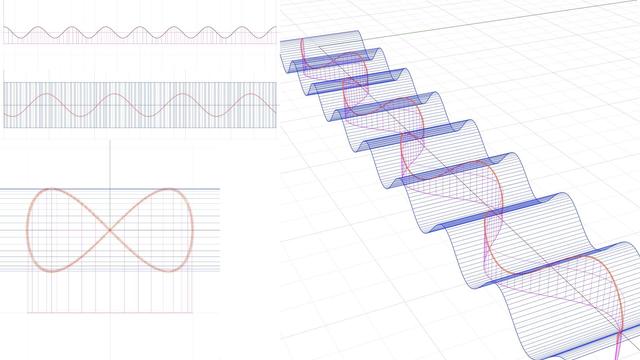
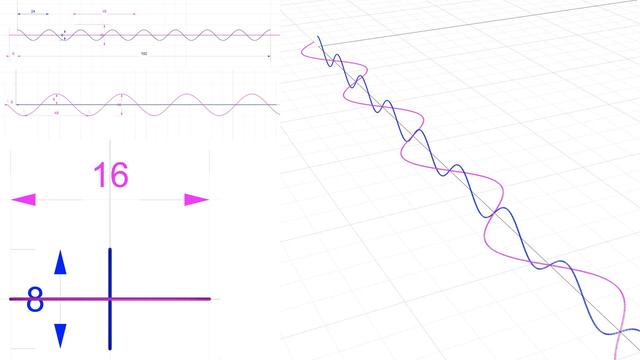
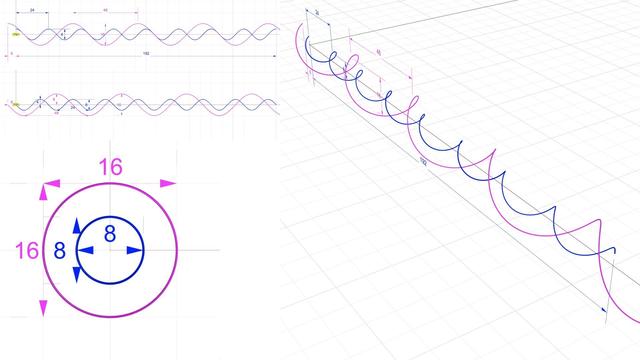
#Braids #3StrandBraids After creating the two #helix curves as described in https://pixelfed.social/p/Splines/797732962403957263, switch to the front view and #project the smaller blue helix on the vertical "wall" of the XZ plane. Hide the original helix. Then switch to the top view and project the larger magenta helix on the "ground" or XY plane and hide the original helix. Now compare the figure in this post with that in the previous post. Both curves have now been #flattened from 3D helix to 2D #sinusoid. When viewed from the front (top-left portion of the diagram), the blue curve is still visible as a #sinusoidal waveform but the magenta appears as a straight line flattened on the ground. When viewed from the top, the magenta curve is still visible as a sinusoid but the blue appears as a straight line clinging to the vertical wall. In the view from side (bottom-left portion of diagram), neither waveform is apparent, and both curves appear as perpendicular straight lines. Only in the perspective view you can see both waveforms, but even here it is clear that they are both flat 2D curves oriented perpendicular to each other in 3D space. Our goal is to convert these two flat sinusoids back into a single composite 3D curve that shows the smaller waveform in the front view and larger one in the top view. In acoustics, a sinusoid represents a pure tone with a single frequency. The tone varies with frequency and its perceptibility varies with amplitude. Musicians and people familiar with acoustic physics will immediately recognize that the blue curve has twice the frequency (or pitch) of the magenta curve, while the magenta curve has twice the amplitude (loudness) of the blue curve. We can divide the period or wavelength into phases. For the blue one, we divide the wavelength into 4 phases of 6 units each and shift the magenta curve left by that amount. Later, we will divide the magenta one into 3 phases — one for each strand, and shift each rightward by that.



 andypiper's bookmarks