 Unofficial PetaPixel Bot
Photographers Need to Stop Worshiping Dynamic Range https://petapixel.com/2026/05/01/photographers-need-to-stop-worshiping-dynamic-range/ #fullwellcapacity #dynamicrange #Educational #tonemapping #Technology #nikond800e #nikond800 #nikond810 #shotnoise #fujifilm #Opinion #sonya7r #sonya7v #14bit #16bit #nikon #noise #fuji #Sony #ADC #raw #dr

 In the Dark
Weekly Update from the Open Journal of Astrophysics – 18/10/2025
It’s time once again for the usual Saturday update of the week’s new papers at the Open Journal of Astrophysics. Since the last update we have published four more papers, which brings the number in Volume 8 (2025) up to 156, and the total so far published by OJAp up to 391.
I’d like to encourage people to follow our feed on the Fediverse via Mastodon (where I announce papers as they are published, including the all-important DOI) so this week I’ll include links to each announcement there.
The first paper to report is “Shot noise in clustering power spectra” by Nicolas Tessore (University College London, UK) and Alex Hall (University of Edinburgh, UK). This was published in the folder Cosmology and NonGalactic Astrophysics on Tuesday October 14th 2025. This presents a discussion of the effects of ‘shot noise’, an additive contribution due to degenerate pairs of points, in angular galaxy clustering power spectra. Here is a screen grab of the overlay:
You can find the officially accepted version of the paper here. The Mastodon announcement is here:
Open Journal of Astrophysics
New Publication at the Open Journal of Astrophysics: "Shot noise in clustering power spectra" by Nicolas Tessore (University College London, UK) and Alex Hall (University of Edinburgh, UK)
https://doi.org/10.33232/001c.145919
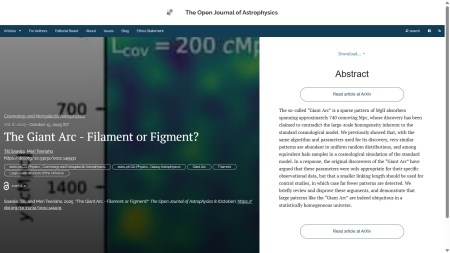
October 14, 2025, 7:07 am 2 boosts 0 favoritesNext one up is “The Giant Arc – Filament or Figment?” by Till Sawala and Meri Teeriaho (University of Helsinki, Finland). This paper discusses the abundance of large arc-like structures formed in the standard cosmological model, with reference to the “Giant Arc” identified in MgII absorption systems. It was published on Wednesday October 15th in the folder Cosmology and NonGalactic Astrophysics. The overlay is here:
The officially accepted version of this paper can be found on the arXiv here and the Mastodon announcement is here:
Open Journal of Astrophysics
New Publication at the Open Journal of Astrophysics: "The Giant Arc – Filament or Figment?" by Till Sawala and Meri Teeriaho (University of Helsinki, Finland)
https://doi.org/10.33232/001c.145931
October 15, 2025, 6:33 am 2 boosts 3 favorites
The third paper this week, published on Monday 6th October, is “Detecting wide binaries using machine learning algorithms” by Amoy Ashesh, Harsimran Kaur and Sandeep Aashish (Indian Institute of Technology, Patna, India). This was published on Friday 17th October (yesterday) in the folder Astrophysics of Galaxies. It presents a method for detecting wide binary systems in Gaia data using machine learning algorithms.
The overlay is here:
You can find the officially accepted version of this paper on arXiv here. The announcement on Mastodon is here:
Open Journal of Astrophysics
New Publication at the Open Journal of Astrophysics: "Detecting wide binaries using machine learning algorithms" by Amoy Ashesh, Harsimran Kaur and Sandeep Aashish (Indian Institute of Technology, Patna, India)
https://doi.org/10.33232/001c.146027
October 17, 2025, 6:55 am 0 boosts 0 favoritesThe last one this week is “Learned harmonic mean estimation of the Bayesian evidence with normalizing flows” by Alicja Polanska & Matthew A. Price (University College London, UK), Davide Piras (Université de Genève, CH), Alessio Spurio Mancini (Royal Holloway, London, UK) and Jason D. McEwen (University College London). This one was also published on Friday 17th October, but in the folder Instrumentation and Methods for Astrophysics; it presents a new method for estimating Bayesian evidence for use in model comparison, illustrated with a cosmological example.
The corresponding overlay is here:
You can find the officially accepted version on arXiv here. The Mastodon announcement is here:
Open Journal of Astrophysics
New Publication at the Open Journal of Astrophysics: "Learned harmonic mean estimation of the Bayesian evidence with normalizing flows" by Alicja Polanska & Matthew A. Price (University College London, UK), Davide Piras (Université de Genève, CH), Alessio Spurio Mancini (Royal Holloway, London, UK) and Jason D. McEwen (University College London)
https://doi.org/10.33232/001c.146026
October 17, 2025, 7:06 am 0 boosts 0 favoritesThat concludes the papers for this week. With two weeks to go I think we might reach the 400 total by the end of October.
#arXiv240505969v3 #arXiv250511072v2 #arXiv250619942v3 #arXiv250703749v2 #BayesInference #BayesianModelComparison #CosmologyAndNonGalacticAstrophysics #DiamondOpenAccess #DiamondOpenAccessPublishing #GAIA #GaiaDR3 #galaxyClustering #GiantArc #InstrumentationAndMethodsForAstrophysics #largeScaleStructureOfTheUniverse #Mastodon #MgIIAbsorptionSystems #normalizingFlows #OpenJournalOfAstrophysics #ShotNoise #WideBinaries
 AEI has moved

 Jim Donegan 🎵 ✅
 xameer