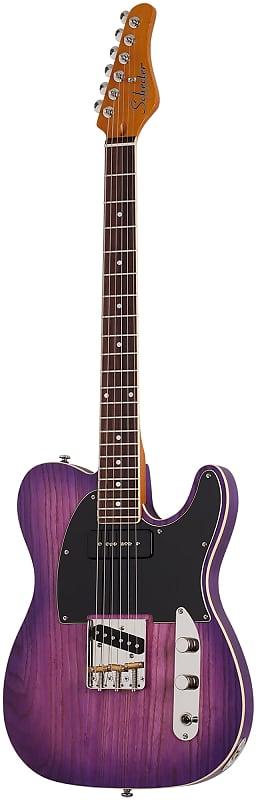
Schecter PT Special - Purple Burst Pearl
We had several candidates to close out #SepTELEmber and after much deliberation we decided to go with… not a Tele at all! (But isn’t it though‽) It’s our hashtag party, and we’ll defy if we want to.
The Telecaster was the first successful production solid body electric guitar. It is a no-frills “everything you need and nothing you don’t” guitar that is easily and often imitated by many other manufactures and individual builders alike.
We have actually never touched a Schecter. Never really payed much attention to them until #PurpleGuitarPhursday. Yet they seem to have embraced purple as a standard color more than other manufacturers, so they do seem to come up lot.
David Schecter started Schecter Guitar Research in California the 1970s. He initially made replacement parts before building complete custom instruments. When production could not keep up with demand, the company was sold first to a group of investors in Texas, then a few years later to Hisatake Shibuya, the founder of ESP Guitars. We sometimes get those two companies mixed up, and although they function independently, it is interesting to learn that they are actually… step-siblings‽
The “PT” part of “PT Special” obviously stands for “Phoney Telecaster.” Not really. It is named for Pete Townsend, who played [phoney] telecaster-style guitars (complete with lawsuit-inducing Fender style headstocks) from Schecter’s early custom shop days. As far as we understand, he never had anything to do with the production models, but considering that he famously smashed guitars on stage, it is not entirely clear that his endorsement would necessarily be considered a positive.
The traditional Tele neck pickup is not especially popular, with many players preferring a humbucker, or a P90, or even removing it entirely as on the original Esquire. This model opts for the P90, for a fatter sound that is still a single coil to hum cancel when combined with the bridge pickup (either in parallel or series via a push-pull knob.) Speaking of knobs, it has a reversed control plate with the knobs in front and the switch behind, which allows easier access to the volume knob for swells such as one can do on a Strat. The pickup switch is a toggle rather than the typical blade. We do like the curvier, aerodynamic shape of the control plate itself.
It has an ashtray bridge with the three adjustable brass saddles. Honestly, not the most practical design, but dripping with “old school cool” vibes. We’ve always loved the aesthetic of the tele bridge.
Finish it off with body and neck binding and a transparent purple burst. We’re not entirely sure what the “pearl” refers to, but perhaps it has a bit of shimmer to it?
All in all, just your basic no-frills guitar… with frills‽
#Schecter
 timoth‽
 Eryck Gu⸸⸸eЯaL
 eFrida
 Miss Koula


 Mr. Dante
 soundbeingmusic