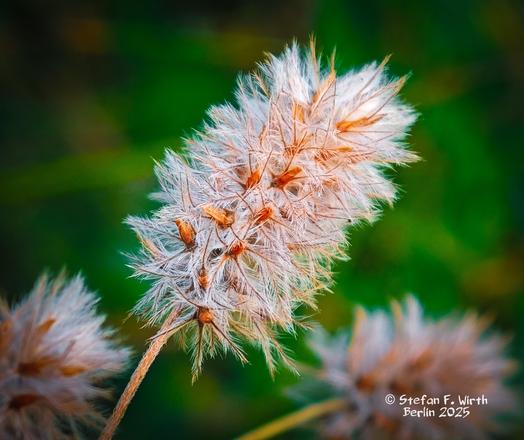
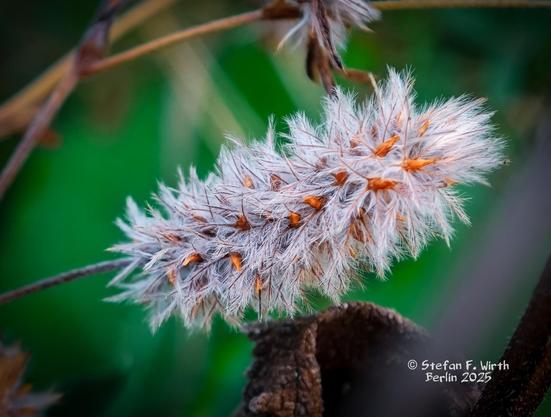
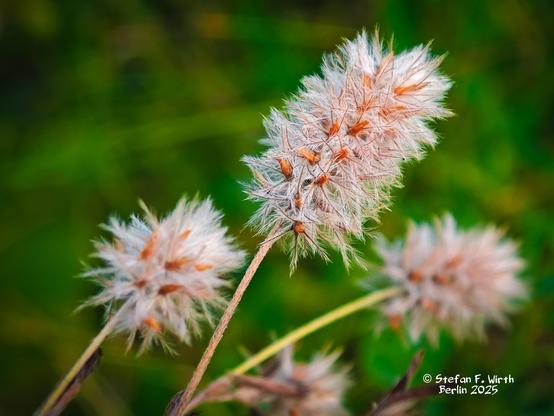
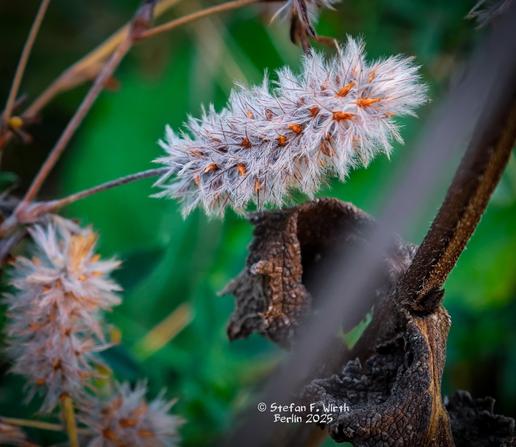
Hare's-foot #clover, #Trifolium #arvense (#Fabaceae), is native to Europe/Western Asia and inhabits dry, sandy, nitrate-poor #habitats. #Seeds are enclosed in feathery calyxes that protect against desiccation, serve as #flightorgans, but also adhere to animals. It hosts #symbiotic nitrogen-fixing bacteria (paraphyletic "#Rhizobia"), which S. Schulz et al. (2013) analyzed in more detail via functional marker gene nifH.
©#StefanFWirth #Berlin 2025

Ref
https://doi.org/10.5194/bg-10-1183-2013

#Photos
©S.F.Wirth

How do plants pick their friends?

A new Insight Article delves into research investigating the symbiotic relationship between legumes, such as soybean, and #rhizobia bacteria and the central role of protein RIN4.
https://elifesciences.org/articles/108116?utm_source=mastodon&utm_medium=social&utm_campaign=organic_insights
#Symbiosis

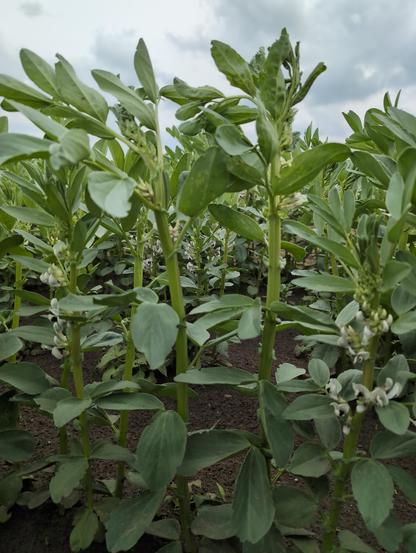
I do a large field experiment with #faba bean genotype mixtures this year with a diverse set of European spring types. Most plants are developing fine. Root colonization with #Rhizobia has started and the N fixation is active. Some genotypes are very susceptible to aphids, with whole plots nearly devastaded. I see a lot of #geneticdiversity for traits such as leaf angle, plant height, and leaf shape.

#Bacteria that live in soil and help roots #fix #nitrogen can
⭐️boost certain plants' capacity to reproduce,
according to an article published in the American Journal of Botany describing a study of this mechanism
in #Chamaecrista #latistipula,
a legume belonging to the Fabaceae family, which includes beans and peas

#rhizobia are bacteria that fix nitrogen in plant roots

In nitrogen-poor sandy soil with nitrogen-fixing bacteria, plants were almost twice as tall and three times larger than those grown in nitrogen-rich soil with organic matter and rhizobia.

On the other hand, the plants grown without rhizobia in both sandy soil and soil rich in organic matter were shorter and smaller than those grown with rhizobia

https://phys.org/news/2024-09-presence-bacteria-soil-pollinators.html

Presence of bacteria in soil makes flowers more attractive to pollinators, study shows

Bacteria that live in soil and help roots fix nitrogen can boost certain plants' capacity to reproduce, according to an article published in the American Journal of Botany describing a study of this mechanism in Chamaecrista latistipula, a legume belonging to the Fabaceae family, which includes beans and peas.

Phys.org

2024 has been a spectacular year for #phytoplankton symbiosis: @vincentflora at #ISME19.

Nitrogen-fixing #organelle in a marine alga https://www.science.org/doi/10.1126/science.adk1075

#Rhizobia–diatom #symbiosis fixes missing nitrogen in the ocean https://www.nature.com/articles/s41586-024-07495-w

#microbes #bacteria #diatoms #algae #protists

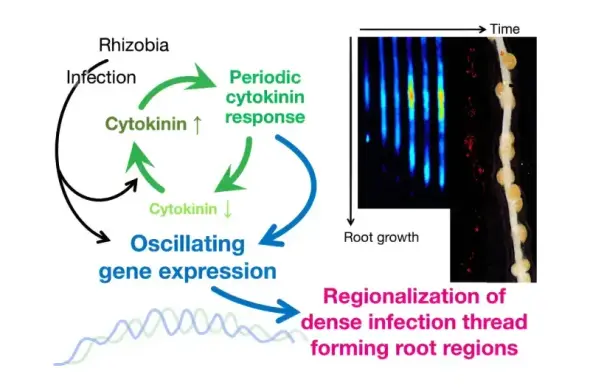
Rhythmic #GeneExpression in #plants is crucial for #symbiosis with nutrient-providing bacteria
https://phys.org/news/2024-07-rhythmic-gene-crucial-symbiosis-nutrient.html

Periodic #cytokinin responses in Lotus japonicus #rhizobium infection and nodule development https://www.science.org/doi/10.1126/science.adk5589

"#Legumes thrive in low-nitrogen environments by partnering with #rhizobia, #soil #bacteria that convert atmospheric #nitrogen into #ammonium, a usable form for the plants. These beneficial bacteria are housed in root nodules formed on legume roots."

Rhythmic gene expression in plants is crucial for symbiosis with nutrient-providing bacteria, study finds

Legumes thrive in low-nitrogen environments by partnering with rhizobia, soil bacteria that convert atmospheric nitrogen into ammonium, a usable form for the plants. These beneficial bacteria are housed in root nodules formed on legume roots.

Phys.org

Wow!
For years, researchers couldn't identify the source of so much nitrogen (N) in the oceans. It was thought that cyanobacteria were the only organisms capable of fixing nitrogen in marine ecosystems, but their numbers could explain only half of the observed N.
Some years ago, mysterious gene fragments coding for a nitrogenase (the enzyme that fixes nitrogen) were found in seawater samples. These traces were not from cyanobacteria. But then, from who?

A recent study found that the N-fixing bacteria are related to Rhizobia and seem to be symbiotic with diatomees (unicellular algae). Yes, *the rhizobia*. *In a symbiosis*. *with unicellular algae* (= plants)
😃
Rhizobia are the bacteria that fix the Nitrogen in the root nodules of leguminous plants, effectively making the rich terrestrial ecosystems possible.
And their cousins in the sea seem to do the same. The plants provide the bacteria carbohydrates (easy-peasy for photosynthetic organisms, as carbon is not their problem) and shelter, and the bacteria fix nitrogen. Just like this. And everyone benefits, including the surrounding ecosystem.
This is really cool and made my day!

https://www.nature.com/articles/s41586-024-07495-w

#Microbiology #Ecology #Nitrogen #Rhizobia #NitrogenCycle #Oceans #MarineBiology #SciComm
#ScienceIsWonderful #AmazingScience

Rhizobia–diatom symbiosis fixes missing nitrogen in the ocean - Nature

Nitrogen (N2) fixation in oligotrophic surface waters is the main source of new nitrogen (N) to the ocean1 and plays a key role in fueling the biological carbon pump2. Oceanic N2 fixation is almost exclusively attributed to cyanobacteria, even though genes encoding nitrogenase, the enzyme fixing N2 into ammonia, are widespread among marine bacteria and archaea3-5. Little is known about these non-cyanobacterial N2-fixers and direct proof that they can fix N in the ocean is missing. Here we report the discovery of a non-cyanobacterial N2-fixing symbiont, Candidatus Tectiglobus diatomicola, which provides its diatom host with fixed-N in return for photosynthetic carbon. The N2-fixing symbiont belongs to the order Rhizobiales and its association with a unicellular diatom expands the known hosts for this order beyond the well-known N2-fixing rhizobia-legume symbioses on land6. Our results show that the rhizobia-diatom symbiosis can contribute as much fixed-N as cyanobacterial N2-fixers in the tropical North Atlantic, and that they may be responsible for N2 fixation in the vast regions of the ocean where cyanobacteria are too rare to account for the measured rates.

Nature
New rhizobia-diatom symbiosis solves long-standing marine mystery

Nitrogen is an essential component of all living organisms. It is also the key element controlling the growth of crops on land, as well as the microscopic oceanic plants that produce half the oxygen on our planet. Atmospheric nitrogen gas is by far the largest pool of nitrogen, but plants cannot transform it into a usable form.

Phys.org
Genes identified that allow bacteria to thrive despite toxic heavy metal in soil

Some soil bacteria can acquire sets of genes that enable them to pump the heavy metal nickel out of their systems, a study has found. This enables the bacteria to not only thrive in otherwise toxic soils but help plants grow there as well.

Phys.org
Researchers uncover a key link in legume plant-bacteria symbiosis

Legume plants have the unique ability to interact with nitrogen-fixing bacteria in the soil, known as rhizobia. Legumes and rhizobia engage in symbiotic relations upon nitrogen starvation, allowing the plant to thrive without the need for externally supplied nitrogen.

Phys.org