 WPS News
What Are We Rebuilding?
By Cliff Potts, CSO, and Editor-in-Chief of WPS News
Baybay City, Leyte, Philippines — June 5, 2026
In high school, I studied electronics during the transition from vacuum tubes to solid-state devices. I learned enough to understand the basics, but not enough to become an engineer. Later, I earned a degree in Telecommunications Management, which taught me far more about communications systems than electronic design. Like a lot of knowledge acquired decades ago, much of what I learned about electronics has faded with time.
Recently, I found myself looking at old vacuum tubes and wondering how much of that world has been forgotten. Electronics did not begin with microchips, smartphones, or the Internet. It began with wires, coils, capacitors, vacuum tubes, radio transmitters, and people trying to solve practical problems with the tools they had available.
This series is an opportunity to rediscover that knowledge together. We will start with the basics and work our way forward, exploring the technologies that built the modern world. Along the way, we will learn how radios worked, how signals traveled, how information moved across continents, and how much of that knowledge can still be understood, repaired, and rebuilt today.
I am calling this series Electronic Archaeology because that is exactly what we are doing. Archaeologists dig through layers of dirt to understand lost civilizations. We will dig through layers of technology to understand the foundations of the electronic age.
Most people carry devices that would have seemed like science fiction a generation ago. Phones contain billions of transistors. Computers perform calculations that once required entire rooms of equipment. Yet very few of us understand the steps that led from the first experiments with electricity to the modern world.
That is not a criticism. Modern technology has become extraordinarily complex. Most of us use these tools without needing to understand every detail of how they work. The problem is that knowledge can disappear when nobody bothers to preserve it.
The goal of this series is not nostalgia. It is understanding.
One way to think about the project is through a simple thought experiment. Imagine that a modern engineer found himself cut off from modern manufacturing and supply chains. How much technology could be rebuilt? Could we generate electricity? Could we build a radio receiver? Could we transmit information? Could we create sensors to measure the world around us?
Science fiction fans might recognize this as a variation of the tricorder problem. In Star Trek, a tricorder combines communications, sensing, navigation, measurement, and information processing into a single handheld device. We are not going to build a tricorder. What we are going to do is examine the long chain of discoveries and inventions that eventually made such a device imaginable.
To get there, we must begin at the beginning.
Over the coming weeks we will examine electricity, resistors, capacitors, magnetism, induction, vacuum tubes, radio receivers, transmitters, antennas, and the systems that allowed information to move across oceans and continents long before the Internet existed.
Our destination is not a specific machine. Our destination is understanding.
Before we can build anything, however, we need to answer the most basic question in electronics.
What is electricity?
That is where we will begin next week.
If this work helps you understand what’s happening, help me keep it going: https://www.patreon.com/cw/WPSNews
For more from Cliff Potts, see https://cliffpotts.org
References
Campbell, J. (2009). The hero with a thousand faces (3rd ed.). New World Library.
National Air and Space Museum. (n.d.). Communications technology timeline. Smithsonian Institution.
IEEE History Center. (n.d.). Milestones in electrical engineering and computing. Institute of Electrical and Electronics Engineers.
#ElectronicArchaeology #electronicsHistory #engineeringEducation #radioCommunications #technologyHistory #vacuumTubes #WPSNews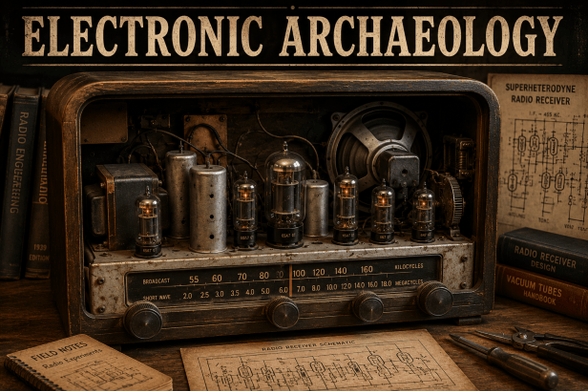
 Tirrimas
  🚫👑
🚫👑
 Kyiv Independent Daily Headlines
 The Victorian News
 Hacker News
 Steve Dustcircle 🌹
 🐧DaveNull🐧 ☣️pResident Evil☣
 Railpage