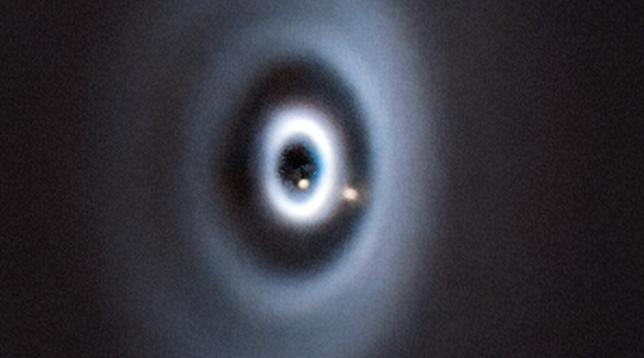
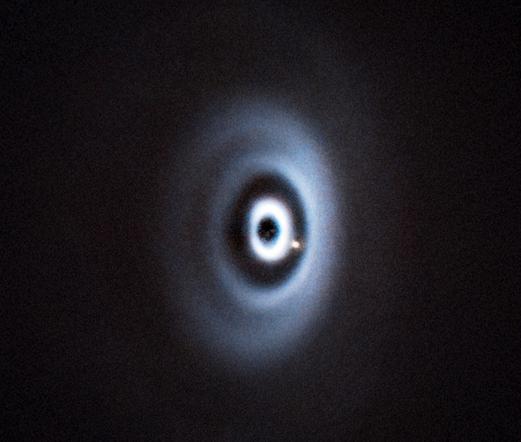
Direct spectroscopic confirmation of the young embedded
#ProtoPlanet WISPIT 2c:
https://arxiv.org/abs/2603.22085 -> A Solar System in the making? Two planets spotted forming in disc around young star:
https://www.eso.org/public/news/eso2604/
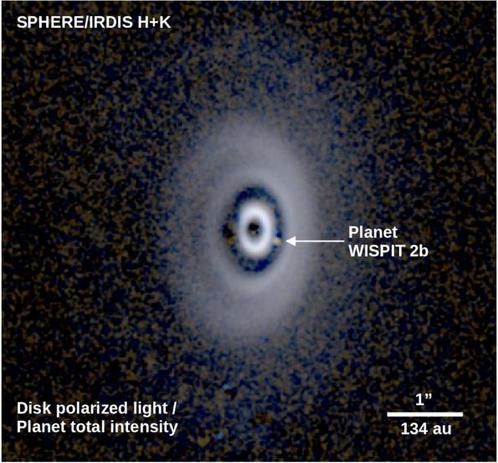
Direct spectroscopic confirmation of the young embedded proto-planet WISPIT 2c
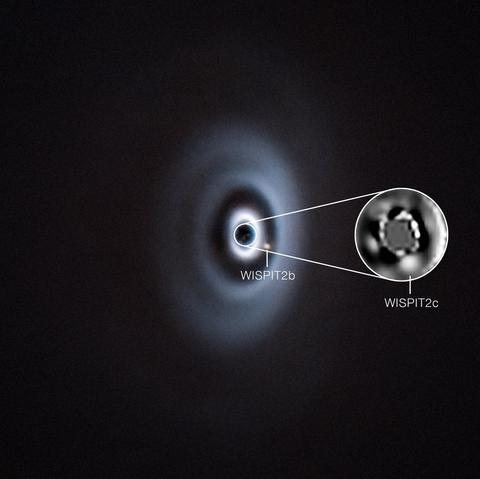
WISPIT 2 is a nearby young star with a multi-ringed disk which was recently confirmed to host a ~4.9 MJup gas giant planet embedded in a large (60 au) gap at a radial separation of 57 au from the host star. We confirm and characterise a second, close-in planet in the WISPIT 2 system using a combination of new VLT/SPHERE H-band dual-polarisation imaging and VLTI/GRAVITY K-band interferometric observations of the WISPIT 2 system. The GRAVITY detection is consistent with a point-like source while its extracted K-band spectrum shows CO band-head absorption at 2.3 microns and a continuum shape consistent with a young giant planet. From the GRAVITY data we extract a medium resolution K-band spectrum of the companion and fit atmospheric model grids using the species tool with nested sampling to constrain its effective temperature, radius, and luminosity. We infer Teff of 1500-2600 K, a radius of 0.91-2.2 RJup, and a luminosity of (-3.47)-(-3.63). Comparison with evolutionary tracks implies a mass range of 8-12 MJup, approximately twice as massive as the previously confirmed WISPIT 2b. The astrometry rules out a background source and marginally detects orbital motion of WISPIT 2c, which needs further follow-up observations for confirmation. WISPIT 2 now becomes an analogue to PDS 70, offering a second laboratory for studying the formation and early evolution of a multi-planet system within its natal disk.
arXiv.org
Erdkollision: Theia kam aus Richtung Sonne
Planetarer Cold Case: Vor 4,5 Milliarden Jahren kollidierte der Protoplanet Theia mit der jungen Erde – diese Katastrophe schuf den Mond. Doch woher kam
scinexx | Das Wissensmagazin🪐 First direct #imaging of a forming #exoplanet carving multiple rings in its accretion disk! Van Capelleveen et al. (2025) reveal a ~5 MJup #protoplanet 57 AU (~8.5 billion km, farther than Pluto) from its star (#WISPIT2, ~133 pc) with #VLT/SPHERE, showing #Keplerian motion and Hα #accretion. A rare, striking view of planet–disk interaction in real time 💫
🌍 https://doi.org/10.3847/2041-8213/adf721
#PlanetFormation #Astrophysics #ALMA #WISPIT2b
Ein Protoplanet schafft sich Platz. Erster Nachweis eines Jungplaneten in der Staubscheiben-Lücke eines sonnenähnlichen Sterns.
#Protoplanet #Exoplanet #Astronomie #VLT #WISPIT2 #Planetenbildunghttps://www.scinexx.de/news/kosmos/ein-protoplanet-schafft-sich-platz/
Ein Protoplanet schafft sich Platz
Platz da: Astronomen haben zum ersten Mal einen jungen Exoplaneten entdeckt und fotografiert, der sich eine eigene Lücke in der mächtigen Staubscheibe
scinexx | Das Wissensmagazin
A very hungry planet
www.eso.org🌌🔭 A cosmic spectacle! ESO’s Very Large Telescope spotted a protoplanet carving stunning spiral patterns in the disc of star HD 135344B, offering a rare glimpse into planet formation. A first in real-time observation!
@goodnews
#GoodNews #Protoplanet #SpaceDiscovery #VeryLargeTelescope #StarFormation
https://thedebrief.org/esos-very-large-telescope-spots-newfound-protoplanet-sculpting-patterns-in-a-distant-stars-disc/

ESO's Very Large Telescope Spots Newfound Protoplanet Sculpting Patterns in a Distant Star's Disc
Science, Tech and Defense for the Rebelliously Curious.
The DebriefWarum ist der Planet Merkur so anders? Kollision mit einem fast gleichgroßen Protoplaneten erklärt Eigenheiten des innersten Planeten.
#Merkur #Planet #Sonnensystem #Protoplanethttps://www.scinexx.de/news/kosmos/warum-ist-der-planet-merkur-so-anders/
Warum ist der Planet Merkur so anders?
Rätsel gelöst? Seit langem rätseln Planetenforscher über die Eigenheiten des Planeten Merkur – jetzt könnten sie eine Erklärung gefunden haben. Demnach
scinexx | Das Wissensmagazin#GoetheUniversität:
"
.. OSIRIS-REx .. gelang es .., etwas Material .. einzusammeln .. Analyse .. durch .. mehr als 50 ..Teams .. zeigte .. Reihe organischer Substanzen, d. d. Grundlagen f. Biomoleküle bilden. .. deuten d. Mineralien d. Probe darauf hin, dass d. Protoplanet, dessen Teil Bennu einst war, flüssiges, salziges Wasser besaß. ..
"
https://www.puk.uni-frankfurt.de/165866672/Staub_vom_Asteroiden_Bennu_zeigt__Bausteine_des_Lebens_und_m%C3%B6gliche_Lebensr%C3%A4ume_waren_in_unserem_Sonnensystem_verbreitet
30.1.2025
#Asteroid #Bennu #Biomoleküle #Leben #Organik #OSIRISREx #Planetologie #Protoplanet #Raumfahrt #Raumsonde #Wasser

Jungplaneten: Eher Smartie als Kugel
Keine Kugel: Junge Gasriesen sehen in ihrer Anfangszeit anders aus als gedacht. Denn diese Protoplaneten sind noch keine runden Kugeln, sondern ähneln
scinexx | Das Wissensmagazin