Des météorites “angrites” viennent d’un monde détruit avant la Terre : une proto-planète pulvérisée, vestige d’un chaos cosmique oublié www.jeuxvideo.com/news/2077082... #Space #Science #Innovation #Astrophysics #Angrites #Protoplanet #SolarSystem #PlanetFormation

Ces scientifiques ont fait une...
Ces scientifiques ont fait une incroyable découverte : ces roches extraterrestres sont les restes d'un monde pulvérisé il y a 4,5 milliards d'années

Imaginez un monde colossal, détruit avant même que notre propre planète n'ait eu le temps de se former. C'est le scénario digne d'un film de science-fiction que viennent de confirmer des chercheurs en analysant de mystérieuses météorites, révélant ainsi les vestiges d&...

Jeuxvideo.com
Ces scientifiques ont fait une incroyable découverte : ces roches extraterrestres sont les restes d'un monde pulvérisé il y a 4,5 milliards d'années

Imaginez un monde colossal, détruit avant même que notre propre planète n'ait eu le temps de se former. C'est le scénario digne d'un film de science-fiction que viennent de confirmer des chercheurs en analysant de mystérieuses météorites, révélant ainsi les vestiges d&...

Jeuxvideo.com

#MPG:
"
Seltener Nachweis zweier Protoplaneten
"
".. zwei Protoplaneten im jungen Sternsystem WISPIT 2 nachgewiesen – Planeten, die sich im Prozess ihrer Entstehung befinden. Die Entdeckung zweier Planeten-Embryos um einen Stern gelang unter mehr als 6000 Exoplaneten bisher erst in einem weiteren System: PDS-70."

https://www.mpg.de/26291657/0323-ext0-news20260324-151510-x

27.3.2026

#Astronomie #ESO #Exoplanet #Interferometrie #PDS70 #Planetenentstehung #Protoplanet #VLT #VLTI #WISPIT2 #WISPIT2c

Seltener Nachweis zweier Protoplaneten

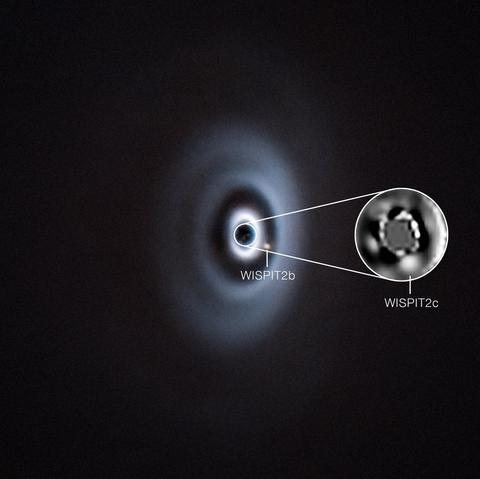
Zwei Protoplaneten im jungen Sternsystem WISPIT 2 wurden nachgewiesen, was einen seltenen Einblick in die Planetenentstehung bietet. Mit dem GRAVITY-Instrument am VLT Interferometer gelang der Nachweis des neuen Protoplaneten WISPIT 2c, der Kohlenmonoxid in seiner Atmosphäre aufweist. Dies unterstützt die Erkenntnis, dass Planetensysteme parallel entstehen.

The asteroid #Pallas, the second to be discovered, was clearly identified on #ThisDayInHistory in 1802. German astronomer #HeinrichWMOlbers pinpointed the highly eccentric, high-inclination #asteroid that is likely a #protoplanet left over from the formation of our solar system.
Zwilling des frühen Sonnensystems entdeckt. Staubscheibe um Jungstern WISPIT 2 hat mindestens zwei heranwachsende Planeten. #Astronomie #Planetensystem #WISPIT2 #Protoplanet #protoplanetareScheibe #Planetenbildung
https://www.scinexx.de/news/kosmos/astronomen-finden-zwilling-des-fruehen-sonnensystems/
Zwilling des frühen Sonnensystems entdeckt

Planetare Kinderstube: Astronomen haben das bisher ähnlichste Analog zur Frühphase unseres Sonnensystems entdeckt – einen sonnenähnlichen Jungstern mit

scinexx | Das Wissensmagazin
Direct spectroscopic confirmation of the young embedded #ProtoPlanet WISPIT 2c: https://arxiv.org/abs/2603.22085 -> A Solar System in the making? Two planets spotted forming in disc around young star: https://www.eso.org/public/news/eso2604/
Direct spectroscopic confirmation of the young embedded proto-planet WISPIT 2c

WISPIT 2 is a nearby young star with a multi-ringed disk which was recently confirmed to host a ~4.9 MJup gas giant planet embedded in a large (60 au) gap at a radial separation of 57 au from the host star. We confirm and characterise a second, close-in planet in the WISPIT 2 system using a combination of new VLT/SPHERE H-band dual-polarisation imaging and VLTI/GRAVITY K-band interferometric observations of the WISPIT 2 system. The GRAVITY detection is consistent with a point-like source while its extracted K-band spectrum shows CO band-head absorption at 2.3 microns and a continuum shape consistent with a young giant planet. From the GRAVITY data we extract a medium resolution K-band spectrum of the companion and fit atmospheric model grids using the species tool with nested sampling to constrain its effective temperature, radius, and luminosity. We infer Teff of 1500-2600 K, a radius of 0.91-2.2 RJup, and a luminosity of (-3.47)-(-3.63). Comparison with evolutionary tracks implies a mass range of 8-12 MJup, approximately twice as massive as the previously confirmed WISPIT 2b. The astrometry rules out a background source and marginally detects orbital motion of WISPIT 2c, which needs further follow-up observations for confirmation. WISPIT 2 now becomes an analogue to PDS 70, offering a second laboratory for studying the formation and early evolution of a multi-planet system within its natal disk.

arXiv.org
Erdkollision: Theia kam aus Richtung Sonne. Die junge Erde und der Protoplanet Theia könnten enge Nachbarn gewesen sein. #Theia #Mond #Erde #Erdgeschichte #Sonnensystem #Kollision #Protoplanet
https://www.scinexx.de/news/kosmos/erdkollision-theia-kam-aus-richtung-sonne/
Erdkollision: Theia kam aus Richtung Sonne

Planetarer Cold Case: Vor 4,5 Milliarden Jahren kollidierte der Protoplanet Theia mit der jungen Erde – diese Katastrophe schuf den Mond. Doch woher kam

scinexx | Das Wissensmagazin

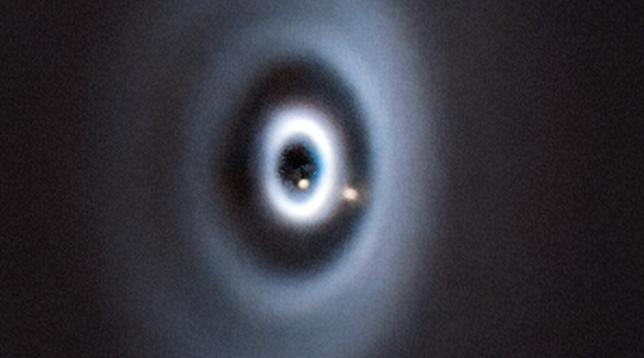
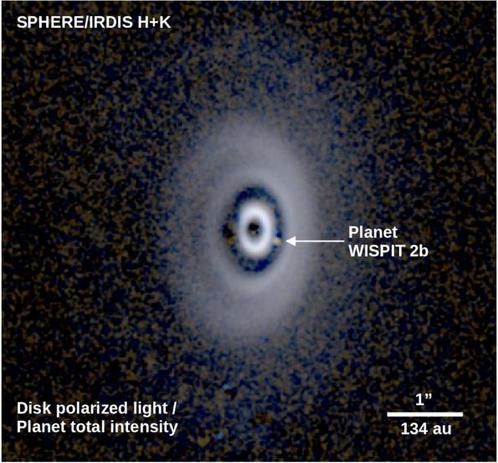
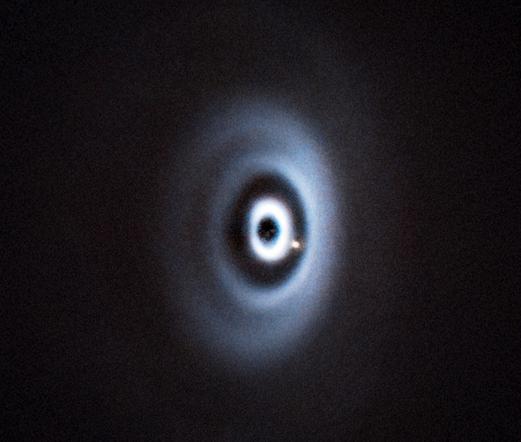
🪐 First direct #imaging of a forming #exoplanet carving multiple rings in its accretion disk! Van Capelleveen et al. (2025) reveal a ~5 MJup #protoplanet 57 AU (~8.5 billion km, farther than Pluto) from its star (#WISPIT2, ~133 pc) with #VLT/SPHERE, showing #Keplerian motion and Hα #accretion. A rare, striking view of planet–disk interaction in real time 💫

🌍 https://doi.org/10.3847/2041-8213/adf721

#PlanetFormation #Astrophysics #ALMA #WISPIT2b

Ein Protoplanet schafft sich Platz. Erster Nachweis eines Jungplaneten in der Staubscheiben-Lücke eines sonnenähnlichen Sterns. #Protoplanet #Exoplanet #Astronomie #VLT #WISPIT2 #Planetenbildung
https://www.scinexx.de/news/kosmos/ein-protoplanet-schafft-sich-platz/
Ein Protoplanet schafft sich Platz

Platz da: Astronomen haben zum ersten Mal einen jungen Exoplaneten entdeckt und fotografiert, der sich eine eigene Lücke in der mächtigen Staubscheibe

scinexx | Das Wissensmagazin
WIde Separation Planets In Time (WISPIT) - Discovery of a Gap Hα #Protoplanet WISPIT 2b with MagAO-X / A Gap-clearing Planet in a Multi-ringed Disk around the Young Solar-type Star WISPIT 2: https://iopscience.iop.org/article/10.3847/2041-8213/adf7a5 / https://iopscience.iop.org/article/10.3847/2041-8213/adf721 -> A growing baby planet photographed for first time in a ring of darkness / Discovery of the first ring-shaping embedded planet around a young solar analog / A very hungry planet: https://news.arizona.edu/news/growing-baby-planet-photographed-first-time-ring-darkness / https://www.astronomie.nl/nieuws/en/discovery-of-the-first-ring-shaping-embedded-planet-around-a-young-solar-analog-4637 / https://www.eso.org/public/images/potw2534a/