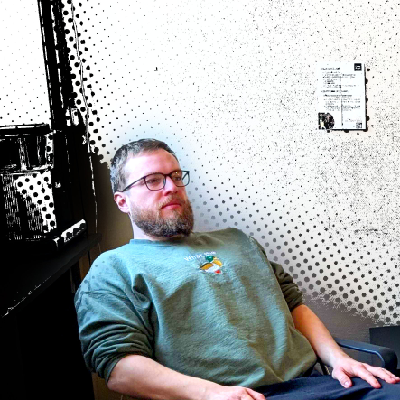
Yorick Phoenix comments on the programming languages he used or was exposed to over his long career in computing. Lots of interesting anecdotes and historical tidbits.

This series of over 30 posts has no table of contents but the posts are arranged in a doubly linked list.

https://blog.scribblings.com/progaming-languages-1-cesil

#ProgLang #retrocomputing

Languages: #1: CESIL โ€ข Yorick Phoenix

I struggle at languages. I was taught French in school. Hated it. When I lived in Germany for a while I learnt enough to get around.German I enjoyed. I always thought Esperanto was a cool idea but never tried it. My wife is from Wales and Welsh is... | Yorick Phoenix | Technology Entrepreneur, Tenacious Engineer

Yorick Phoenix on Svbtle

https://www.kindness.city/blog/2026-03-22-care.html

A bit of a ranty blog today.

I really want to write software that's actually good.

Increasingly, I believe the trick to doing this isn't #types, or #proglang , or formal methods, or #agile, or #XP, or #TDD, or any other fancy technique, process, or technology. It's Care.

And the reason most software still sucks? It's not stupidity, and it's not because everyone else has been duped by the "wrong" development ideology (waterfall, formal methods, agile, etc). It's the Market.

Here's what #openbsd , #slackware, and #emacs are teaching me about taking the time to work on what matters.

Care: The missing ingredient

Wi'out it, neither agile nor formal-methods, nor fancy tools, nor LLMs will save you.

Rupert Lane reconstructed the code of Joseph Weizenbaum's Online Programming Language (OPL).

Based on a printout of source code found among Weizenbaum's papers archived by MIT Libraries, I have reconstructed the language so it can live again for the first time in nearly sixty years on a IBM 7094 emulator running CTSS.

https://timereshared.com/reconstructing-joseph-weizenbaums-opl

#eliza #ProgLang #retrocomputing

Reconstructing OPL: Joseph Weizenbaum's Online Programming Language ยท Time Reshared

Still looking for type theory or prog lang-nerding developers, or hints on where they hang out, if anyone on here can help point me in the right direction ๐Ÿ˜ https://mas.to/@nielsa/116096359944346857
#proglang #typetheory
Niels Abildgaard (@[email protected])

Hey y'all - how do I get in touch with language/type system nerds who want to build something cool? Concretely, type inference for CUE lang in the context of helm charts in Kubernetes. I can find a budget, if I find the right person to build this, and we can move fast on it. Goal: Programatically determine CUE schema for helm values file based on how the values are used in template files, starting from the schemas for well-known Kubernetes resources. Who do I need to fund to build this?

mas.to

This draft paper dated 1979, apparently never published, gave an historical overview of early programming languages for AI.

The document helps make sense of names like POPLER and QLISP. What's interesting is high level languages such as PLANNER and CONNIVER saw initial interest but little actual use.

https://stacks.stanford.edu/file/druid:vg077ps3762/vg077ps3762.pdf

#retrocomputing #ai #lisp #interlisp #ProgLang

X-mas comes early this year: the ICFP 2025 talks are now on YouTube.

You can catch my talk on "Domain-specific tensor languages" below. We explore implementing tensor calculus in #Haskell, supporting both Einstein notation and Penrose diagrams to model things like General Relativity and black holes. ๐Ÿ•ณ๏ธ๐Ÿš€

My talk: https://www.youtube.com/watch?v=04cxfddDwuI

Full Playlists:
๐Ÿ”— ICFP papers: https://www.youtube.com/watch?v=COD4tnVtHoQ&list=PLyrlk8Xaylp4WyLpPH40RBw-kZSdkpkVs
๐Ÿ”— JFP First papers: https://www.youtube.com/watch?v=oZLSDFfpHp0&list=PLyrlk8Xaylp68qJ-kEeXEPne0ePPwNGFi

https://mastodon.acm.org/@sigplanav/115667300324636252

cc @sigplanav (https://sigplan.org)

#icfpsplash25 #ProgLang #TensorCalculus #Physics #FunctionalProgramming

How long have you been using Lisp? Any dialect, including Emacs Lisp.

#interlisp #lisp #ProgLang

less than 1 year
6.9%
1-3 years
9.2%
more than 3 years
54%
I don't use Lisp
29.9%
Poll ended at .

Multi-language IDEs that interact with interpreters via protocols are now common, from classic Emacs with its inferior process protocols to VS Code with LSP and similar modern environments.

This paper described an early exploration of these ideas: a language-independend, Interlisp-based environment that interfaced with language processors over the ARPANET. In 1974.

https://dl.acm.org/doi/10.1145/1500175.1500251

#interlisp #retrocomputing #ProgLang #IDE

How would you do this? Using the Guppy programming language you can write programs with arbitrary control flow, function calls, classical logic and data types, dynamically allocated quantum and classical data, etc etc.

Since quantum computer time is very expensive, we also have a strong type (linear) system to catch many common errors at compile time.

It's open source. There is also a simulator called Selene you can use to run it. Check it out.

https://guppylang.org

#quantum #quantumcomputing #programming #proglang #guppy

Guppy

Quantum-first programming language, embedded in Python.

Rachit Nigam on why design new programming languages and what is a language.

[...] we create programming languages to experience new ideas; ideas that would have remained inaccessible had we stayed with the old languages.

https://people.csail.mit.edu/rachit/post/why-study-programming-languages

#ProgLang #programming

Why Study Programming Languages | Rachit Nigam