What Bluesky Got Right: No Quote-Dunking

By Cliff Potts, CSO, and Editor-in-Chief of WPS News

Baybay City, Leyte, Philippines — April 8, 2026

For years, quote-tweeting was framed as a neutral feature. In practice, it became one of the most efficient harassment tools ever built into a social platform. A single post could be ripped from context, broadcast to a hostile audience, and turned into a target without the original author having any control over the outcome.

That dynamic was not accidental. It was profitable.

When Bluesky removed quote-dunking as a core mechanic, it eliminated a primary vector for pile-ons. The effect was immediate: fewer dogpiles, fewer viral humiliations, and fewer people learning the hard way that visibility can be dangerous.

Quote-Dunking Was Never About Conversation

Quote-dunking rarely functioned as dialogue. Its real purpose was amplification without consent. A post was no longer addressed to the person who wrote it; it was addressed to an audience primed to laugh, mock, or attack.

This created a structural imbalance. One user spoke. Another summoned a crowd.

On algorithm-driven platforms, that crowd was often rewarded. Engagement spiked. Conflict spread. The original author absorbed the consequences.

Removing quote-dunking did not silence criticism. It changed where criticism happened.

Context Is a Form of Protection

When responses occur in-thread or in separate posts without forced amplification, context survives. Readers can see what was actually said. Disagreements unfold at a human scale instead of being reframed for maximum outrage.

Bluesky’s design forced responses to stand on their own. If someone wanted to criticize a post, they had to do so without dragging the original author into a hostile spotlight. That requirement alone reduced abuse.

It also improved discourse.

People were more careful.
Arguments were more precise.
Performative cruelty lost efficiency.

Pile-Ons Require Infrastructure

Harassment at scale does not happen spontaneously. It requires tools that allow many people to converge quickly on a single target. Quote-dunking provided that infrastructure.

By removing it, Bluesky disrupted the mechanics of mob behavior. Pile-ons became harder to organize and easier to ignore. Abuse lost momentum before it could metastasize.

This mattered most for marginalized users, who have historically been the primary targets of public dunking. When the spotlight could not be weaponized as easily, participation felt safer.

Disagreement Did Not Disappear

Critics argued that removing quote-dunking would weaken debate. That did not happen. Disagreement remained common. What changed was tone and scale.

Arguments stayed closer to the people involved. They did not automatically escalate into spectacle. Users could disagree without turning someone else into content.

That distinction is the difference between conversation and theater.

Why Other Platforms Kept the Feature

Quote-dunking drives engagement. It produces screenshots, viral moments, and outrage cycles that algorithms love. Platforms that depend on attention extraction have little incentive to remove it.

Bluesky made a different choice. It accepted lower spectacle in exchange for lower harm.

That decision revealed something important: many of the internet’s worst behaviors are not cultural inevitabilities. They are the result of specific design choices.

Removing quote-dunking did not make Bluesky perfect.
It made abuse less scalable.

For more social commentary, please see Occupy 2.5 at https://Occupy25.com

This essay will be archived as part of the ongoing WPS News Monthly Brief Series available through Amazon.

References (APA)

Marwick, A., & boyd, d. (2011). To see and be seen: Celebrity practice on Twitter. Convergence, 17(2), 139–158.
Citron, D. K. (2014). Hate Crimes in Cyberspace. Harvard University Press.
Gillespie, T. (2018). Custodians of the Internet. Yale University Press.

Massanari, A. (2017). #Gamergate and the fappening: How Reddit’s algorithm, governance, and culture support toxic technocultures. New Media & Society, 19(3), 329–346.

#BlueSky #Gamergate #internetCulture #onlineHarassment #platformDesign #queerSafetyOnline #quoteTweeting #socialMediaGovernance

📡 If social platforms retreat from youth engagement, something else will fill the vacuum: gaming economies, private Discords, encrypted platforms, influencer-led ecosystems. Regulation does not reduce demand for stimulation or belonging; it redistributes it. Also, teens already route around controls with VPNs, burner accounts, secondary devices, and social pressure. Any design reform that ignores teen ingenuity and status economies will underperform.

https://www.platformer.news/social-media-addiction-trial-eu-tiktok-investigation/ #PlatformDesign

Good Idea: No more infinite scrolling

https://www.politico.eu/article/tiktok-meta-facebook-instagram-brussels-kill-infinite-scrolling/

The EU has introduced new rules that aim to make large social media platforms safer and more transparent. Regulators are now questioning features like infinite scroll and highly personalized feeds, arguing they can fuel unhealthy use, especially among young people. Companies may have to prove their design choices are not harmful or face major fines. The broader goal is to shift platforms away from maximizing screen time at any cost and toward more responsible digital spaces.

#TechPolicy
#DigitalRights
#OnlineSafety
#PlatformDesign
#PublicInterest

The EU moves to kill infinite scrolling

Brussels is going head-to-head with social media platforms to change addictive design.

POLITICO

I can’t talk about Reddit on Reddit. I can’t talk about Facebook on Facebook. Both platforms block criticism, hide feedback channels, and trap users in permanent identities you can’t reset or reuse. I’m posting here because I need a place where digital identity and user autonomy can actually be discussed.

#DigitalIdentity #Privacy #DataRights #Fediverse #AccountDeletion #UserAutonomy #PlatformDesign

Other platforms already allow username changes or resets. Reddit is the outlier. Permanent identity systems don’t reflect how people grow or change. We need modern platform design that respects user autonomy and lets people start fresh when they need to.

#TechEthics #PlatformDesign

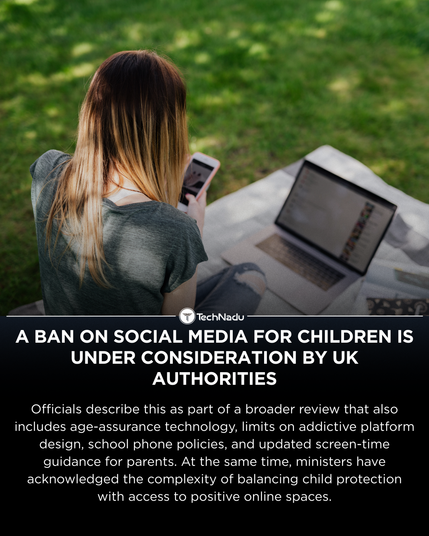
The UK’s review of children’s social media use highlights a growing intersection between online safety, platform design, identity assurance, and regulation.

Beyond age limits, officials are looking at age-verification systems, addictive engagement mechanics, and enforcement challenges — all areas with technical, ethical, and operational implications.

From a security and policy standpoint, implementation and unintended consequences may matter as much as intent.

Source: https://therecord.media/uk-says-it-will-consider-social-media-ban-kids

Thoughts welcome. Follow @technadu for neutral coverage of tech regulation and digital risk.

#TechPolicy #OnlineSafety #AgeVerification #PlatformDesign #DigitalRisk #Infosec

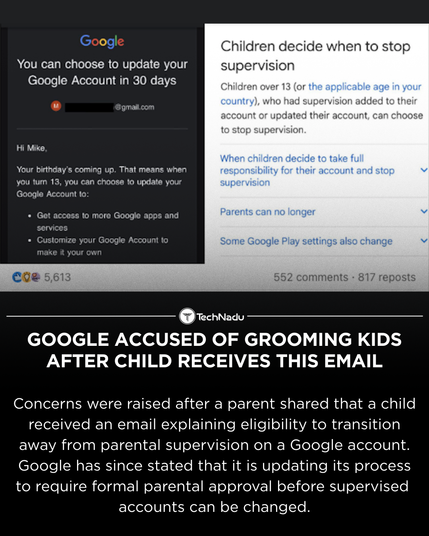
Recent debate highlights how consumer platforms manage age-based transitions for supervised accounts.

Following public concern, Google stated it will require formal parental approval before teens can exit supervised account settings. While no security breach is involved, the issue intersects with privacy design, consent models, and child data governance.

From a governance perspective, this raises questions about:

• consent frameworks for minors
• notification design
• regulatory alignment across regions

How should platforms architect parental control systems to balance autonomy and protection?

Share your analysis and follow @technadu for policy-aware tech reporting.

Source: https://cybernews.com/tech/google-parental-controls-email/

#PrivacyEngineering #ChildDataProtection #TechPolicy #DigitalConsent #PlatformDesign #OnlineSafety

Người dùng nền tảng cộng đồng thường gặp khó khăn nhất là gì? Nhiều người phàn nàn về giao diện phức tạp, chức năng thừa thãi. Một số đã chuyển sang công cụ đơn giản, tối ưu hóa trải nghiệm. Bạn ưu tiên chức năng hay sự dễ dùng? #SaaS #QuanLyCongDong #UX #PlatformDesign #KinhNghiemSuyDung

https://www.reddit.com/r/SaaS/comments/1pnj04p/community_platform_users_whats_the_most/

@ErikJonker @geopolitics This is such an important observation about how platform design shapes public discourse!
It’s both fascinating and concerning to see how the same factual information can spark constructive conversation on one platform and devolve into disinformation on another. The contrast between Bluesky and X really underscores how algorithms and moderation policies influence the quality of dialogue.

For me, the fediverse—especially Mastodon—has been a breath of fresh air in this regard. It feels like a space where facts and evidence-based discussions can thrive, rooted in a shared reality rather than outrage or misinformation. But I’m curious: Is this just my personal experience, or do others share the impression that Mastodon fosters a more fact-based discussion environment? Have you explored other platforms beyond Bluesky that prioritize constructive dialogue?

It’s disheartening to see how platforms that prioritize engagement over accuracy can drown out meaningful conversations. While I’m fortunate enough to avoid Twitter/X and Meta, I recognize that transitioning to open-source, decentralized social networks isn’t feasible for everyone. This makes me wonder: How can we encourage more platforms to adopt models that foster informed debate rather than outrage? Supporting not-for-profit or decentralized alternatives might be part of the solution, but it’s a challenge that requires broader awareness and action.

Thanks for sharing this—it’s a powerful reminder of how critical platform design is to the health of our digital public spaces!

#DigitalLiteracy #PlatformDesign #EvidenceBasedDiscourse #Fediverse #Mastodon #TechEthics #ConstructiveDialogue #AlgorithmicBias #FactOverFiction
#twitter #Bluesky

Interfaces, incentives, emergence, and second-order thinking constitute the biggest differences between platform and application design.

#PlatformDesign #ProductDesign #UXDesign

https://matthewstrom.com/writing/platform-design

What it means to design a platform

How interfaces, incentives, emergence, and second-order thinking make platforms a unique design opportunity